
Circle Energy Focuses on Acreage Expansion and Capital Formation Amid Exploration-Stage Challenges
Circle Energy maintains a controlling interest in Permian Basin acreage but faces typical exploration-stage hurdles including capital needs and lack of production.
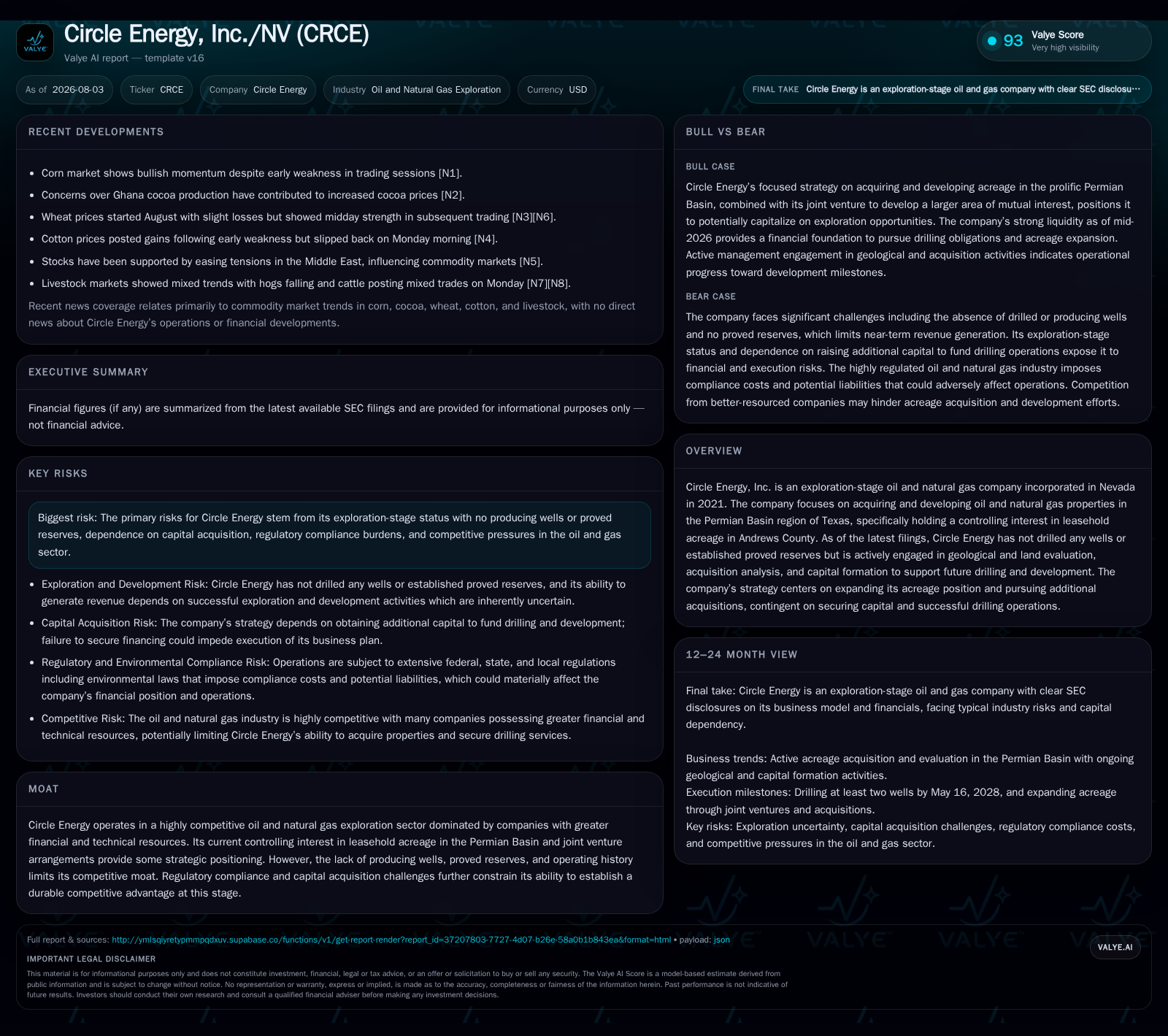
Circle Energy, Inc. remains an exploration-stage oil and gas company holding an 80-acre lease with a 75% working interest in Andrews County, Texas. The company has no producing wells or proved reserves yet and is actively pursuing additional acreage acquisition and capital formation to support future drilling. Competitive pressures from better-capitalized peers and regulatory complexities limit its moat. Its near-term milestones hinge on drilling obligations expiring in 2028, joint venture development efforts, and securing funding to transition from exploration to production.
Recent Operating Update
Circle Energy's latest quarterly filing dated August 3, 2026 confirms continued activity as an exploration-stage entity with no revenue generation or production to date [S2][F1]. It holds a controlling working interest of 75% in an 80-acre oil and gas lease in Andrews County within the prolific Permian Basin of Texas. Under existing farmout arrangements, the company must drill at least two wells (one per each 40-acre tract) before May 16, 2028 to maintain its lease rights—failure to do so will result in automatic reversion of undrilled tracts [S2][S15].
Alongside this core acreage, Circle has entered into a joint venture covering an approximately 880-acre area surrounding its current leasehold. This JV structure aligns with upstream industry norms where smaller operators pool acreage and share capital/operational risk — critical given Circle’s limited resources compared to larger independents or majors active in the region [S2][S15].
Operationally, the company has not drilled any wells nor reported proved reserves or hydrocarbon production, a reflection of its startup phase focusing on acquisition analysis, geological evaluation, land management, and capital raising for future development [S2][F1]. Expenses remain primarily tied to legal, accounting, transfer agent fees associated with maintaining public company compliance and evaluating acquisition opportunities. General and administrative expenses increased modestly in recent quarters due to these activities but remain low overall given the absence of drilling-related outlays [S19][S17].
Management reiterates that fresh capital deployment is critical for advancing exploratory drilling plans. Discussions with potential industry partners about funding participation via working-interest sharing indicate positive sentiment yet no definitive funding arrangements have been finalized [S6][S21]. Equity capital markets could serve as an alternative source once operational milestones justify further financing rounds.
Business Model Breakdown
Circle Energy’s business archetype fits within the upstream oil and gas sector focusing on early-stage exploration activities: acquiring mineral rights (leasehold acreage), conducting geological assessments to identify viable drilling targets, negotiating joint ventures or farmout agreements to mitigate financial risk, then proceeding toward exploratory and development drilling. Revenue will ultimately derive from sales of hydrocarbons produced once wells become operational.
Key monetization levers encompass securing advantageous working interests that maximize net revenue interests post-cost deductions; managing lease retention through timely drilling per contractual obligations; minimizing finding-and-development costs; and navigating regulatory approvals efficiently particularly relating to hydraulic fracturing techniques commonly employed in Permian development [S1][F1]
Currently possessing only one core lease with no production or assets subject to depletion/amortization expenses constrains immediate income generation but allows focused application of funds towards capitalization efforts supporting acreage expansion and drill rig engagement.
Industry Structure and Competitive Position
Operated within a highly contested segment of shale plays like the Permian Basin—where thousands of active leases compete under constant commodity price volatility—the company's scale remains small relative to midstream-integrated independents or majors such as Devon Energy or Pioneer Natural Resources. These peers command substantial financial firepower enabling rapid leasing expansions amid bidding wars and swift access to drilling rigs amid tight service markets.
Circle’s competitive moat is limited by:
- No existing producing wells or proved reserves reducing appeal versus established peers.
- Dependency on external capital for costly exploration stages.
- Regulatory complexities around environmental compliance increasing time/cost burdens.
- A market environment where capitalization size influences negotiation leverage for favorable joint ventures or rig contracts.
However, its focused strategy around consolidating contiguous acreage near existing holdings via JV enhances prospect value relative to scattered prospects lacking scale synergies. Also, success moving from unproven property classification through confirmed reserve booking upon exploratory well results would materially improve competitive stance [S15].
Growth Drivers
Immediate growth catalyzed by funds raised enabling incremental drilling activity aligned with lease obligations. Successful exploratory wells proving commercial volumes unlock phased development pipelines boosting asset valuations. Additional acreage acquisitions within joint ventures expand resource base proportionally enhancing future revenue potential whenever production initiates.
Commodity price improvements augment project economics lowering breakeven thresholds encouraging investment zeal typical across oil & gas during cyclical upswings.
Moreover, regulatory environment stability allowing continued use of hydraulic fracturing preserves access to proven extraction technology indispensable for Permian shale plays. Partnership structures that distribute upfront capital commitments also help manage risk exposure sustaining operational momentum.
Risks and Watchpoints
The most significant risks derive from Circle Energy's very early lifecycle:
- Failure to raise sufficient capital before May 2028 threatens forfeiture of leasehold rights if drilling deadlines are missed.
- Unsuccessful exploratory results leaving acreage devoid of commercial reserves would impair asset value irrevocably.
- Inflationary pressures on labor/equipment inflate operating costs challenging budget adherence.
- Increasing regulation around hydraulic fracturing intensifies permitting timelines or introduces added compliance expenditures [S10][S15].
- Market liquidity constraints for small cap energy stocks potentially restricting access to equity markets when needed.
- Competition pressure both from financial resource-rich operators securing prime acreage first and elevated service pricing due to rig scarcity impacting economics.
Monitoring early signs of JV progress (acreage expansion deals) alongside management’s ability to execute financing rounds will be vital indicators signaling advancement beyond pure exploration stage.[S21]
What To Watch Next
Investors should track:
- Execution status against mandatory drilling obligations leading up to May 2028 deadline;
- Progress in expanding joint venture acreage holdings beyond initial leased acres;
- Completion of reserve certification studies following any successful well drilling;
- Announcements regarding partnering agreements providing funding on future wells;
- Updates on regulatory approvals particularly affecting hydraulic fracturing practices;
- Cash burn trends relative to liquidity levels indicating runway duration before new fundraising needed;
- Entry into new leases/acquisitions consistent with stated growth strategy [S15][S21]
Financial Profile Discussion
As of June 30, 2026, Circle Energy maintained cash and equivalents totaling approximately $79K against current liabilities near $5.9K yielding a strong current ratio above 14x—a sign of ample near-term liquidity sufficient for ongoing administrative functions but far below estimated well drilling costs likely exceeding several hundred thousand dollars per well given regional average capex intensities [F1].[S15]
The absence of any operating revenues thus far translates into recurring net losses driven by G&A expenses primarily related to legal/accounting fees climbing modestly year-over-year due principally to acquisition efforts as evidenced by losses averaging around $12K annually recently reported through end-2025 [F1][S11]. With no depreciable assets or production-related charges such as depletion/amortization recorded yet due to lack of producing wells, cash flows depend fully on equity raises or partner contributions for ramp-up investments.
In sum, while liquidity has supported fundamental corporate activities since incorporation in late 2021, substantial additional capital formation remains mandatory prior to transitioning into producing phases capable of generating positive cash flow [S11][F1]
This analysis synthesizes publicly available regulatory filings up to August 3, 2026 without offering investment advice or forecasts. The outlook reflects conditions inherent in early-exploration upstream oil & gas enterprises operating amid sector-specific volatility and development uncertainty.
Disclaimer: This is research-only, informational analysis and not investment advice. It may include AI-generated interpretation and general industry context. Always verify important details using primary sources.

Comments