
Huntsman Faces Break-Even Q2 as Merger Uncertainty Looms Over Specialty Chemicals Market
Huntsman Corporation’s latest quarter reveals operational stabilization amid merger-related risks and competitive specialty chemicals dynamics.
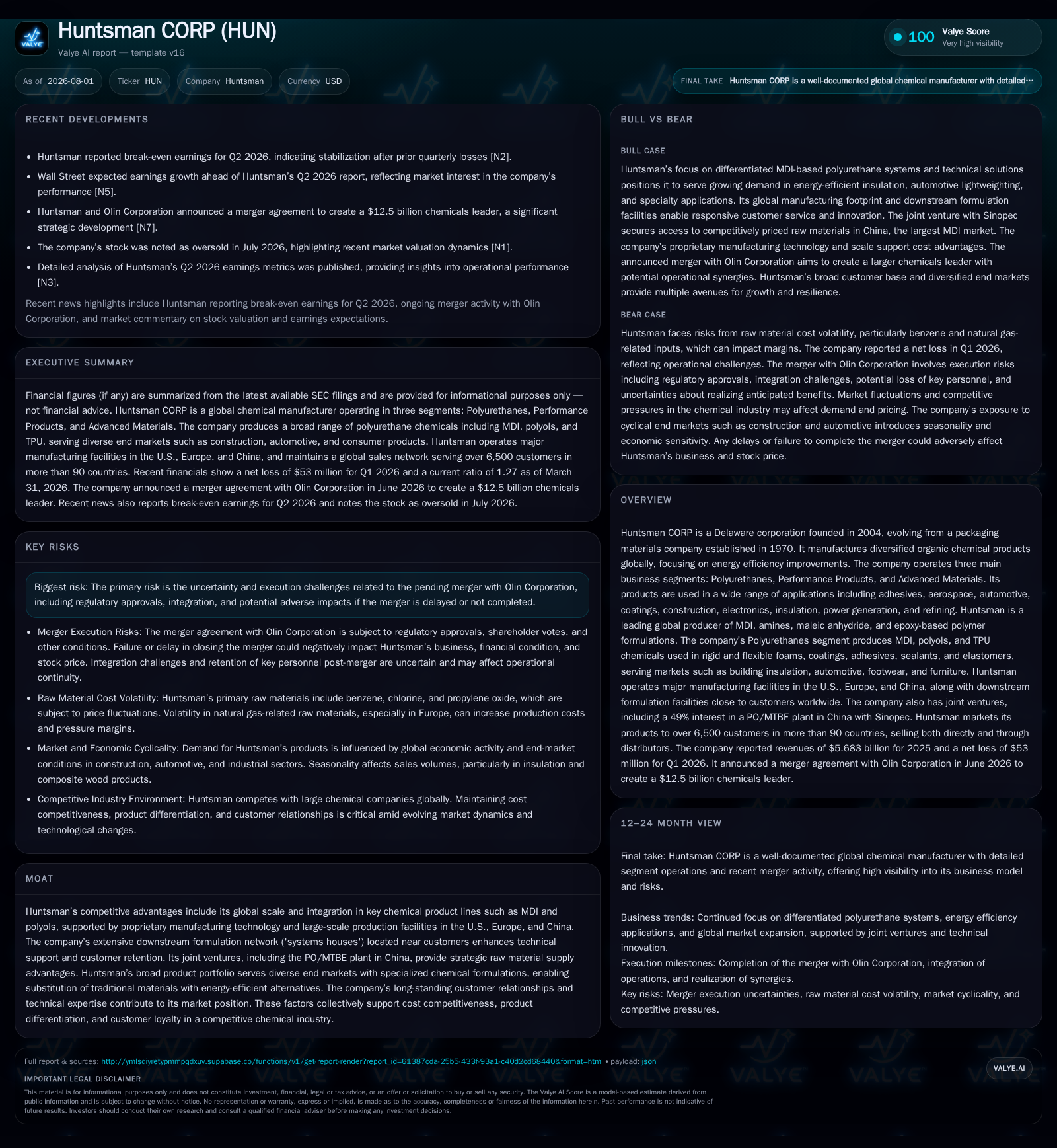
In Q2 2026, Huntsman delivered break-even earnings reflecting a challenging market environment for specialty chemicals focused on polyurethane intermediates and performance products. The company continues to leverage its integrated global manufacturing footprint and downstream formulation capabilities but faces execution risks related to its pending merger with Olin Corporation. Huntsman's business model centers on producing differentiated MDI, polyols, and epoxy formulations serving diverse industrial markets, supported by technical service and strategic joint ventures that enhance raw material security. Monitoring merger progress, capacity utilization, and pricing trends will be instrumental in assessing Huntsman’s near-term outlook.
Recent Operating Update
Compounding operational challenges is the pending all-stock merger with Olin Corporation announced mid-2026 [S7][S18]. The transaction is subject to multiple regulatory approvals and shareholder votes with no definitive closing timeline. This uncertainty has introduced execution risk potentially distracting management focus from core operations and pressuring investor sentiment. Notably, the fixed exchange ratio pegged to Olin common stock exposes Huntsman shareholders to market price fluctuations until closing [S2].
Business Model Analysis
Huntsman’s revenue comes from producing and marketing diversified organic chemical products across three segments: Polyurethanes, Performance Products, and Advanced Materials [S1]. Its Polyurethanes segment commands leadership in MDI production — a niche intermediate vital for rigid/flexible foams used extensively in building insulation, automotive lightweighting, footwear, furniture, and cold chain packaging applications [S9]. The integrated production of aniline (a primary raw material) internally or via strategic long-term contracts mitigates input cost volatility—a critical factor given the thin margin nature of chemical intermediates [S1][S9].
The company monetizes through direct industrial sales complemented by a network of downstream "systems houses" — formulation partners geographically co-located near customer manufacturing sites [S9]. These systems houses develop customized polyurethane formulations combining MDI and polyols tailored to specific application needs. This downstream integration fosters strong customer retention due to superior technical support services that create switching costs and enable identifying new product opportunities [S9].
Performance Products comprise specialty chemicals such as amines and maleic anhydride used across coatings, adhesives/sealants (CAS), agriculture chemicals, water treatment agents, among others. Advanced Materials deliver epoxy-based polymers employed in aerospace composites, electronics encapsulation, and durable consumer products. Each segment contributes differentiated offerings spanning several high-growth industrial verticals.
Industry Structure & Competitive Position
Situated within specialty chemicals manufacturing focused on complex formulation-based intermediates rather than commoditized bulk chemicals, Huntsman occupies a midstream value-chain position supplying essential inputs to industrial OEMs across automotive, construction, aerospace, electronics etc.
Its principal competitors include Covestro (notably in polyurethanes), BASF Specialty Chemicals' segments (epoxy resins & amines), as well as key Asian producers like Wanhua Chemical Group competing regionally in polyols/MDI. What distinguishes Huntsman is its global scale with large-scale world-class manufacturing plants in Geismar (Louisiana), Rotterdam (Netherlands), and Caojing (China) that leverage proprietary MDI technology fostering cost competitiveness [S9]. Long-standing joint ventures also secure access to critical raw materials such as aniline—an upstream integration advantage lacking among some peers reliant solely on spot markets or third-party suppliers [S1][S9].
The company's multi-segment portfolio helps offset cyclicality endemic to discrete end markets. Its technical service strength via systems houses affords differentiation through tailored formulations rather than commoditized chemical sales alone. This mix enhances pricing power sustainability against competitors more reliant on volume-driven commodity sales.
Growth Drivers
Long-term drivers for Huntsman stem from accelerating adoption of energy-efficient materials mandated by evolving environmental regulations favoring superior insulation foams in residential/commercial buildings and lightweight composite solutions for electric vehicles or aerospace—both relying heavily on advanced polyurethane chemistry. Rising urbanization accelerating construction activity especially in emerging markets underpins increased demand for insulation-grade foam chemicals.
Innovation in formulations tailored for high-performance coatings or adhesives continues to expand applications into new end-use domains like electronics miniaturization or improved corrosion resistance. Huntsman's ongoing investment in R&D (R&D intensity not quantified here) supports pipeline expansion targeting these growth adjacencies.
Strategic geographic presence counters geopolitical risk concentration; facilities spanning US/Europe/Asia enable closer proximity to customers reducing logistics costs while complying with regional rules such as EU REACH or China Green Label standards enhancing product acceptance.
Risks & Constraints
A salient near-term risk is the merger with Olin Corporation fraught with regulatory scrutiny covering antitrust aspects due to overlapping chemical portfolios. Failure or delay could introduce volatility into Huntsman's share price alongside potential disruption of customer relationships if perceived distraction occurs at management level [S2][S18].
Raw material price volatility remains a perennial challenge; while Huntsman's partial vertical integration reduces this exposure versus pure-play intermediates producers reliant on external spot purchase markets for feedstock like benzene or aniline [S1], sustained inflationary pressures could still erode margins if not offset by price increases.
Cyclicality inherent to end-markets such as automotive production or construction can produce sharp demand troughs affecting volume-dependent metrics like capacity utilization rates—a critical KPI given high fixed-cost nature of large-scale manufacturing plants. Regulatory compliance costs relating to environmental liabilities or emissions pose additional operational risks; past settlements related to Texas emissions illustrate this ongoing area of vigilance.
Cybersecurity governance has been emphasized by board oversight given increasing threats impacting operational integrity—this reflects wider industry attention on IT resilience crucial for continuous manufacturing systems.
What to Watch Next
Investors should monitor:
- Progress toward completion of the Olin merger including shareholder voting outcomes and regulatory approvals.
- Quarterly updates on volume trends particularly MDI/polyols sales volumes reflecting capacity utilization variability.
- Price realizations per ton amid input cost swings impacting gross margins.
- Updates from downstream systems houses regarding customer adoption rate of new formulations signaling innovation efficacy.
- Costs attributed to integration readiness or potential restructuring related to the merger which may impact future profitability.
- Regulatory developments regarding environmental compliance or potential liabilities especially from legacy operations.
Financial Profile Discussion
As of March 31, 2026, Huntsman's balance sheet shows $369 million in cash and cash equivalents against $2.06 billion in total debt, yielding a net debt figure around $1.69 billion with a current ratio near 1.27, indicating manageable short-term liquidity coverage [F1]. Capital structure is supported by an $800 million revolving credit facility maturing in 2031 with adjustable interest based on leverage ratios offering flexible liquidity access [S14].
In summary, while financial returns have been pressured recently due primarily to macroeconomic sluggishness combined with transaction uncertainties, Huntsman’s integrated operational model coupled with global scale provides a foundation for recovery contingent on successful deal closure and favorable market conditions.
This analysis synthesizes publicly available filings dated up to July 31, 2026. It does not constitute investment advice but aims to provide an informed perspective grounded in company disclosures and industry fundamentals.
Disclaimer: This is research-only, informational analysis and not investment advice. It may include AI-generated interpretation and general industry context. Always verify important details using primary sources.

Comments