
M/I Homes Navigates 2026 Housing Market Challenges with Geographic Diversification and Financial Discipline
M/I Homes reports Q2 2026 results highlighting margin pressures amid cyclical housing headwinds but emphasizes liquidity, diversified footprint, and integrated financial services as strategic strengths.
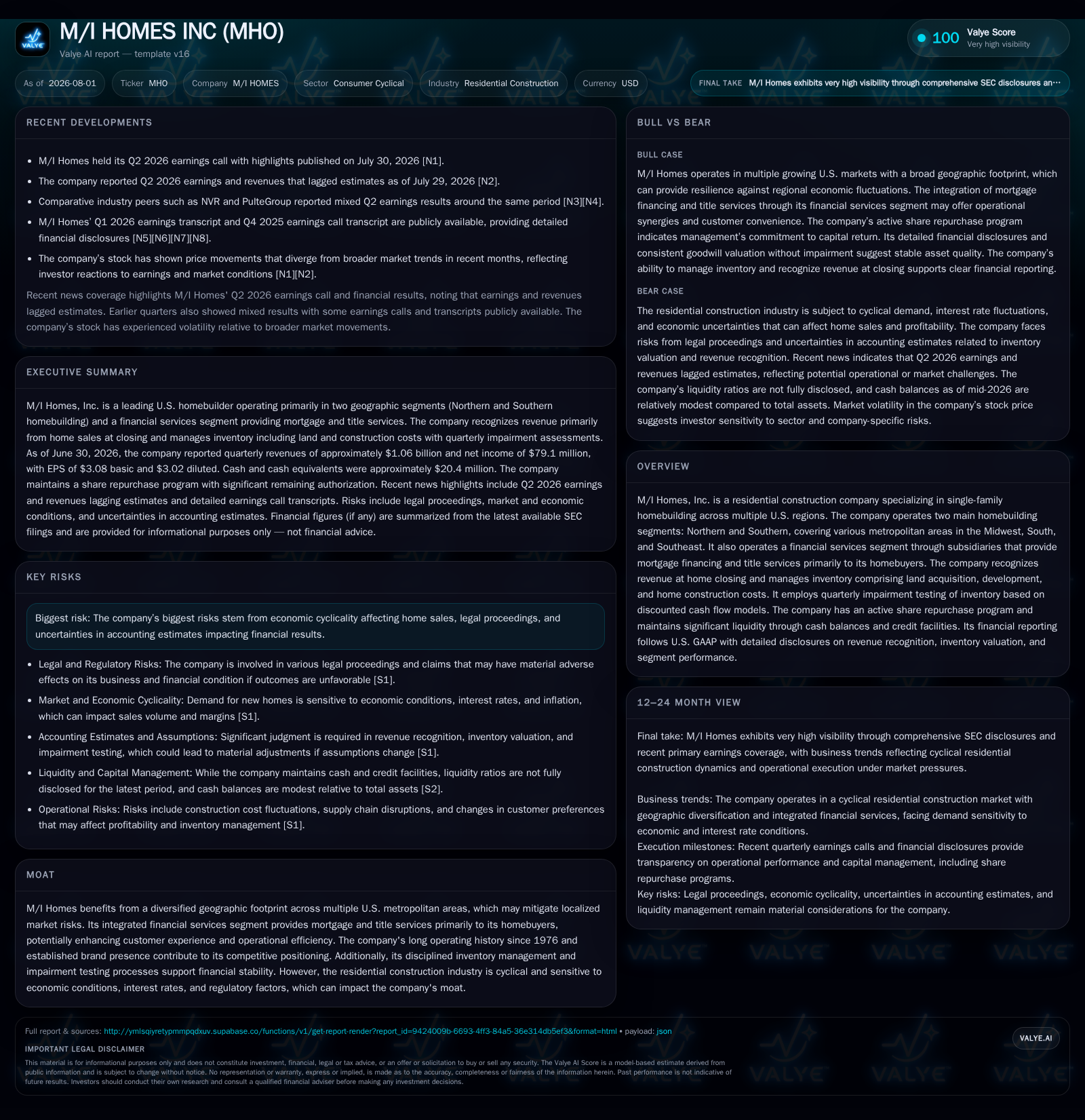
M/I Homes’ Q2 2026 performance illustrates ongoing impacts from elevated mortgage rates and affordability constraints within the U.S. residential construction sector. The company's diversified regional business model and integrated mortgage and title services provide resilience in a volatile market environment. While revenue and home delivery volumes moderated, disciplined inventory management and warranty reserve adjustments support financial stability. Capital structure remains robust with ample liquidity, supported by a $900 million revolving credit facility and substantial available borrowing capacity under its mortgage repurchase agreements. Legal risks and economic cyclicality remain key watchpoints as M/I Homes balances growth prospects against market headwinds.
Recent Operating Update
M/I Homes’ second quarter ended June 30, 2026, reflected the typical cyclical challenges facing the residential construction industry amid elevated mortgage interest rates and affordability headwinds. The company’s revenues and home deliveries lagged some market expectations, revealing continued softness in buyer demand consistent with broader sector trends reported by peers such as NVR [N2][N3]. Despite these near-term pressures, M/I Homes underscored stable gross margins supported by effective cost control measures across its key regional markets and noted no material changes in risk factors compared to its prior annual disclosures [S2][S19].
Importantly, the company’s geographically diversified Northern and Southern segments operate across various Midwest, Southern, and Southeastern metro areas, which historically helps mitigate the impact of localized downturns. This footprint diversification remains a fundamental pillar supporting M/I Homes’ operating resilience [S1]. Concurrently, the integrated mortgage financing and title services subsidiaries facilitate smoother transaction processes for buyers, potentially offsetting some market friction due to tighter credit conditions [S1][N1].
Business Model and Revenue Mechanics
M/I Homes generates revenue primarily through the sale of newly built single-family homes—a capital-intensive model requiring layered management of land acquisition, development costs, construction expenses, and warranty obligations [S1]. The company recognizes revenue only at home closing events when contractual obligations are fully satisfied. Consequently, backlog of homes under contract and new home orders serve as critical forward-looking indicators tied closely to future revenue streams
The integration of financial services offers distinct advantages: subsidiaries provide mortgage lending products alongside title insurance predominantly to the company's own buyers. This alignment not only improves buyer experience but also helps streamline the closing process—an important competitive differentiator in cycles of fluctuating interest rates when financing is more scrutinized [S1]. Revenue contribution from these financial services segments is reported separately but intertwined operationally.
Warranty reserves represent a material aspect of cost forecasting given their sensitivity to construction quality variances across geographies. M/I Homes deploys actuarial analyses incorporating historical claims data along with market-specific adjustments—for instance, recent increased expenditures linked to attic ventilation issues in Florida communities compelled reserve recalibration during 2025 [S1]. Moreover, regular quarterly assessments ensure timely impairment recognition on inventory based on discounted cash flow models reflecting anticipated selling prices net of estimated costs—an essential practice in residential construction given market price volatility [S1].
Industry Structure and Competitive Position
Operating within the single-family residential construction industry places M/I Homes amid intense price sensitivity driven by macroeconomic factors such as interest rate levels, inflationary pressures on materials/labor costs, regulatory hurdles including zoning laws, and consumer income dynamics. Unlike larger national players like PulteGroup (PHM), which benefit from even broader scale and national brand cachet, M/I Homes functions primarily as a multi-region builder focused on segmented U.S. markets with an emphasis on quality control and customer service via integrated financial offerings.
Its main peers include other regional builders like Beazer Homes (BZH) and firms such as NVR that also emphasize single-family homes but differ in geographic concentration or strategic scope. M/I Homes' breadth across Midwest to Southeast gives it exposure diversity but requires continual management focus on distinct local market trends—for instance differing supply chain disruptions or labor availability vary substantially across its footprint.
Margins are under persistent pressure industry-wide due to input cost inflation; however, M/I Homes counters this through disciplined cost management protocols paired with active inventory turnover policies aimed at avoiding prolonged land or home inventory holding that can erode returns if local pricing softens unexpectedly.
Growth Drivers
Several structural drivers underpin potential growth trajectories for M/I Homes:
- Modestly declining mortgage interest rates from recent peaks would incrementally restore buyer affordability over time.
- Demographic tailwinds from population expansion in suburban areas where M/I operates support sustained housing demand.
- Integration of mortgage financing and title services enhances closing efficiencies that may increase buyer conversion rates.
- Continued innovation in build processes aiming at reducing cycle times could improve throughput without proportional cost escalation.
- The company’s expanding presence in certain markets allows scalable absorption of overhead costs while leveraging existing supplier/subcontractor relationships.
While governmental stimulus or housing subsidies could also augment demand spikes unpredictably, these remain secondary influences relative to core economic fundamentals impacting buyer willingness to purchase newly constructed homes.
Risks, Watchpoints, and Growth Constraints
The most significant risk remains the inherent cyclicality of residential construction tied tightly to macroeconomic realities—especially mortgage rates that influence buyers’ purchasing power profoundly. Elevated interest rates directly mute demand for newly built homes due to higher monthly payment burdens.
Additionally:
- Warranty claims pose uncertainty given their reliance on past product quality metrics; unanticipated rises can erode profit margins further.
- Inventory impairment charges linked to unexpected declines in market prices remain a watchpoint requiring conservative valuation techniques.
- Legal proceedings discussed in prior filings highlight ongoing contingent liabilities whose outcomes remain uncertain yet potentially damaging financially or reputationally [S1][S18].
- Supply chain disruptions or labor shortages could delay home completions altering delivery schedules critical for revenue recognition timing.
- Cancellation rates affect backlog reliability; rising cancellations would suggest weakening underlying demand strength.
Monitoring these factors alongside KPIs such as number of homes delivered, backlog size evolution, cancellation rates, warranty expense trends per region, average sales price shifts by segment will illuminate operational momentum or emerging vulnerabilities.
What to Watch Next
Key upcoming milestones include subsequent quarterly earnings releases that will reveal if Q2 softness was transient or indicative of a protracted slowdown. Tracking how new contract volumes behave—especially in light of any macroeconomic shifts regarding interest rates—is vital.
Further indications will come from:
- Changes in backlog levels versus cancellations; stable or growing backlog supports near-term volume assumptions.
- Adjustments in warranty reserves—material increases may signal quality issues or cost inflation impacting profitability.
- Management commentary around land acquisition spending will inform amount of future inventory buildup versus current absorption pace.
Comparisons against peer performance such as improvements or deteriorations relative to companies like PulteGroup or Beazer could offer insight into relative competitiveness within evolving market conditions.
Financial Profile Discussion
Financial services operations maintain separate borrowing lines totaling $300 million via mortgage repurchase facilities renewed annually secured against mortgage originations [S8][S25]. Compliance with associated debt covenants has been consistently affirmed reflecting prudent risk oversight.
Share repurchase programs authorized cumulatively up to $250 million illustrate an intent to deploy excess capital towards shareholder value initiatives when market conditions allow [S21], balancing internal reinvestment needs against external capital return priorities.
In summary, M/I Homes maintains disciplined capital management offering sufficient liquidity buffers essential for navigating cyclical troughs inherent in residential construction markets while financially supporting steady operational cadence necessary for long-term franchise value preservation.
Disclaimer: This is research-only, informational analysis and not investment advice. It may include AI-generated interpretation and general industry context. Always verify important details using primary sources.

Comments