
TriMas Focuses on Core Packaging and Specialty Businesses after Aerospace Divestiture
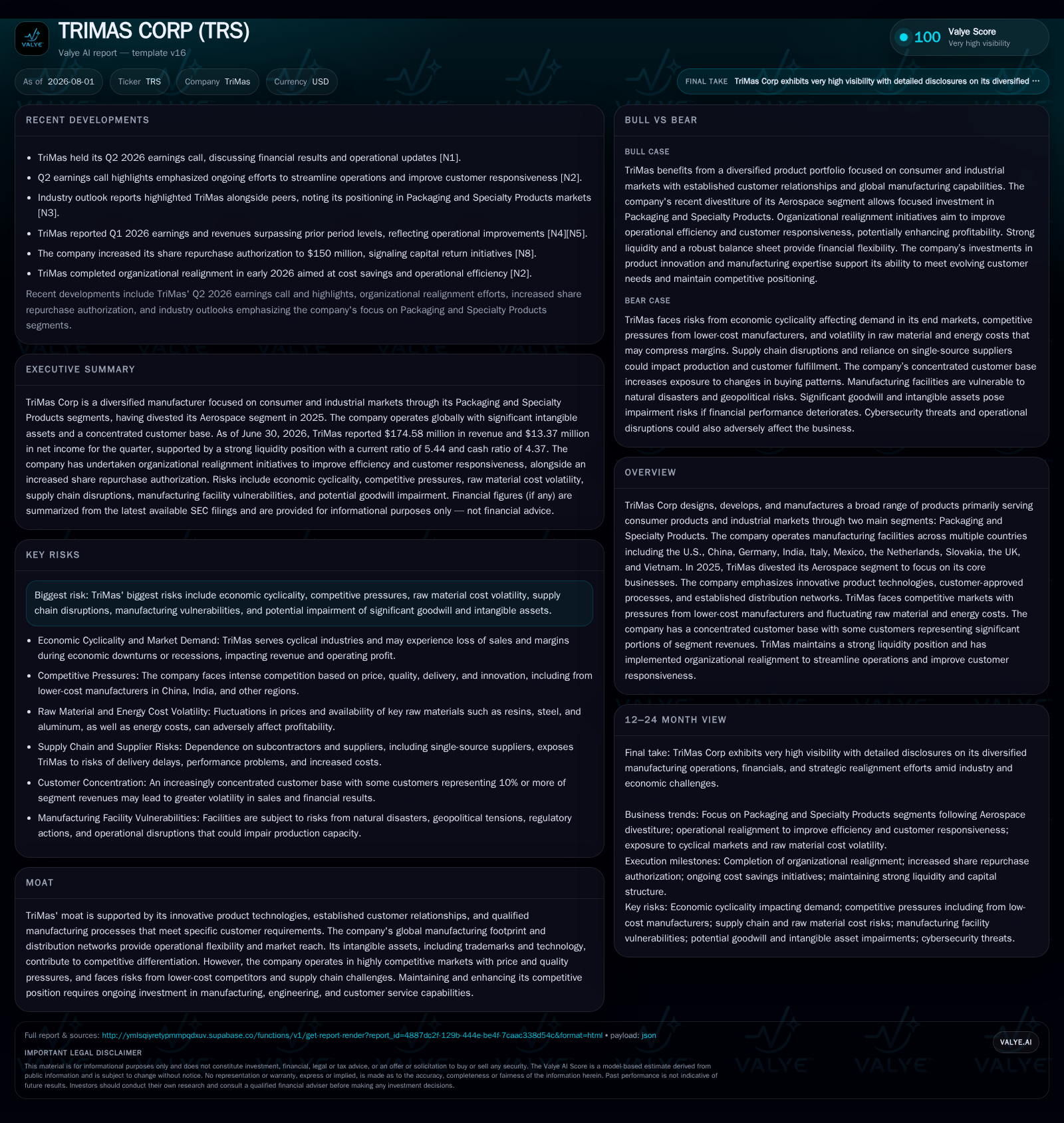
TriMas reported Q2 2026 results reflecting operational realignment and strong liquidity amid competitive industry pressures.
In Q2 2026, TriMas Corporation solidified its strategic pivot by completing the $1.45 billion sale of its Aerospace segment, thereby sharpening its focus on Packaging and Specialty Products. The company operates a diverse global manufacturing footprint to serve consumer and industrial markets, leveraging proprietary technologies and customer-approved processes to maintain differentiation despite aggressive pricing competition and raw material cost volatility. TriMas demonstrates robust financial health with strong liquidity and manageable debt post-divestiture but faces typical sector risks including cyclical demand and concentrated customer exposure.
Recent Operating Update: Aerospace Divestiture Consolidates Focus
TriMas Corporation’s latest quarterly filing dated July 31, 2026 ([S2]) highlights the pivotal completion of its Aerospace segment divestiture on March 16, 2026. The transaction brought gross proceeds of approximately $1.46 billion with net proceeds near $1.24 billion after tax payments and costs. This one-time event strategically refocuses TriMas on its core Packaging and Specialty Products businesses. The move is designed to sharpen operational efficiencies while concentrating management attention on segments where the company holds differentiated technology advantages and established customer relationships.
This divestiture materially alters TriMas’ business profile by exiting aerospace—a capital-intensive sector—thereby potentially reducing cyclicality exposure albeit also eliminating a diversification component. Confirmatory markers will be future segment profit contributions skewed towards Packaging and Specialty Product lines alongside ongoing reinvestment of divestiture proceeds into these areas. Liquidity enhancements from this transaction provide operational flexibility as evidenced by the company's significant cash balance of $1.24 billion as of June 30, 2026 ([F1]).
Business Model: Dual-Segment Innovation with Global Manufacturing Reach
TriMas operates primarily through two reportable segments: Packaging and Specialty Products ([S1]). These serve a broad consumer products and industrial market base via innovative product designs often governed by proprietary technology portfolios—including patents—and customer-specific manufacturing qualifications that confer switching-cost advantages.
Revenue is generated through direct sales or via established distribution networks to mostly industrial customers requiring high-quality engineered components or packaged products that meet strict application requirements. Key revenue drivers include production volume growth fueled by increased order backlog and sustained customer retention rates supported by constantly evolving product innovation pipelines.
The company’s manufacturing footprint extends across multiple global facilities in the U.S., China, Germany, India, Italy, Mexico, the Netherlands, Slovakia, the UK, and Vietnam ([S1]). This geographic diversity enhances supply chain resilience against localized disruptions yet requires sophisticated operational oversight to manage cost efficiencies amid fluctuating raw material prices and energy costs typical in industrial hardware sectors.
Operating margins reflect a balance between innovation-driven premium pricing and intensity of competitive pricing pressure from lower-cost manufacturers both domestically and offshore.[S1] Enhanced product quality metrics like low defect rates coupled with reduced manufacturing lead times are crucial for maintaining customer satisfaction in competitive bidding environments.
Industry Structure and Competitive Positioning
The industrial hardware and specialty manufacturing industry confronts persistent challenges such as raw material input cost volatility, cyclical end-market demand (consumer goods to automotive sectors), intense competition especially from lower-cost offshore producers, and complex regulatory dynamics impacting operations globally.
TriMas distinguishes itself through investment in proprietary product technologies protected by patents with useful lives ranging up to 30 years ([S1]). Its strong intangible asset base includes well-established trademarks supporting brand recognition. Customer relationships are concentrated but built over long durations with likely embedded switching costs validated by historical retention data ([S1]). This provides some insulation against commoditization pressures prevalent in packaging solutions.
However, peer companies like AptarGroup or Ball Corporation represent benchmarks for manufacturing efficiency gains worth monitoring relative to TriMas' own performance improvements. Additionally, Illinois Tool Works typifies peer specialization in proprietary technology development intensities relevant to TriMas’ specialty products segment.
Growth Drivers
Post-Aerospace divestiture growth largely hinges on several interlinked factors:
- Rising demand for innovative packaging solutions: Driven by trends in consumer goods requiring sustainable materials or novel dispensing technologies.
- Expansion into emerging geographies: TriMas leverages its global manufacturing footprint for market penetration backed by local supply chain integration.
- Customer-driven customization: Increasing preference for tailored components underpinned by engineering expertise strengthens loyalty.
- Operational excellence programs: Initiatives such as brand unification and facility optimization aim at driving margins despite input cost volatility ([N4],[S1]).
- Capital redeployment: With substantial cash influx from the Aerospace sale ([S2]), strategic acquisitions targeting complementary product niches or geographic markets support organic growth avenues.
KPIs spotlighting new product introduction rates alongside order backlog growth will be critical early indicators of sustained organic expansion.
Risks and Watchpoints
Key risk areas facing TriMas are emblematic of industrial hardware firms but merit close observation given company-specific exposures:
- Economic cyclicality: Sensitivity to downturns impacting demand across consumer products and broader industrial markets could pressure sales volumes.
- Raw material price swings: Given input dependency for metals/plastics used in packaging components; margin compression risk remains if pricing power erodes ([S1]).
- Supply chain disruption vulnerability: Geopolitical tensions or logistic bottlenecks within its extensive international footprint could affect delivery reliability.
- Customer concentration: With some customers contributing significant revenue portions per segment ([S28]), dependency risk signals potential revenue volatility if contracts shift.
- Intangible asset impairment: Goodwill or technology valuation impairments require monitoring particularly if competitive dynamics deteriorate or innovation lags ([S1]).
Operational KPI monitoring such as capacity utilization rates and product defect frequencies will be practical metrics for early problem detection.
What to Watch Next
Future updates should clarify TriMas' deployment of Aerospace divestiture proceeds—specifically investments in R&D productivity enhancements or strategic add-ons within Packaging/Specialty segments. Tracking quarterly segment profit margins post-realignment will indicate benefits realization from sharpened focus.
Management commentary on navigating raw material inflationary cycles will reveal pricing power durability amidst competitive pricing pressure. Also notable will be any announcements regarding adjustments to capital return policies including stock repurchase programs since board authorization to increase buybacks was expanded late 2025 ([S23]).
Operational delivery metrics such as improved lead times or increased new product introduction cadence are leading indicators warranting investor attention alongside evolving international sales percentages reflecting global demand shifts.
Financial Profile Discussion
As of June 30, 2026, TriMas exhibits a robust financial position characterized by cash & equivalents totaling approximately $1.24 billion against total debt near $397 million yielding a net cash position close to $846 million ([F1]). This strong liquidity posture substantially reduces refinancing risk over near-term horizons while underpinning planned capital deployments following divisional restructuring.
The company’s credit agreement was amended in March 2025 extending maturity dates through March 2030 with no current borrowings outstanding under the revolving facility as of mid-2026 but available capacity exceeding $243 million ([S2]).
Future shifts in leverage will likely reflect acquisition activity consistent with stated strategic growth priorities rather than operational weakness.
This analysis synthesizes publicly filed SEC documents including the latest quarterly Form 10-Q dated July 31, 2026 [S2], recent event filing Form 8-K [S3], prior annual report [S1], supplemented by recent earnings call transcripts [N1][N2] alongside companyfacts numerical snapshots [F1]. It draws upon industry-standard operating KPIs and business model frameworks relevant to the industrial hardware sector without projecting forward-looking valuations or investment research views.
Disclaimer: This is research-only, informational analysis and not investment advice. It may include AI-generated interpretation and general industry context. Always verify important details using primary sources.

Comments