
Ralliant Records $1.44 Billion Goodwill Impairment Impacting Test and Measurement Segment
The goodwill charge stems from lowered expectations for EA Elektro-Automatik, while Ralliant maintains liquidity and operational continuity amid industry growth and economic risks.
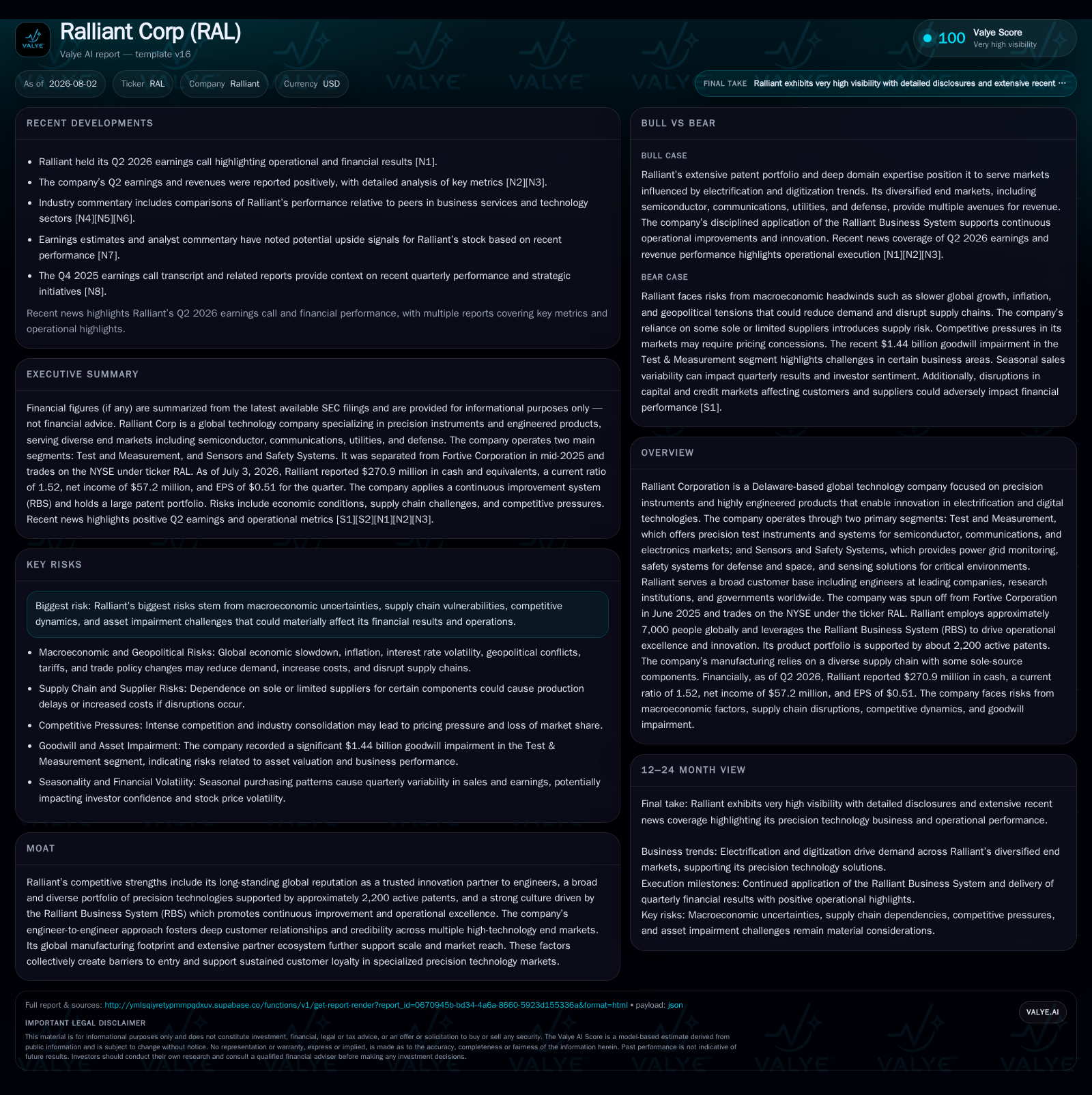
Ralliant Corporation, spun off from Fortive in mid-2025, reported a significant $1.44 billion non-cash goodwill impairment related to its Test and Measurement segment in Q2 2026, driven mainly by revised expectations for the EA Elektro-Automatik business. Despite this, the company maintains a strong operational foundation through its Ralliant Business System and a diverse portfolio of precision instruments and engineered products serving electrification and digital technology markets. The industry backdrop features steady demand growth linked to semiconductor expansion, IoT proliferation, and infrastructure modernization, but risks include macroeconomic volatility and supply chain disruptions. Ralliant’s financial profile shows reasonable liquidity with a current ratio of 1.52 but elevated net debt near $880 million as of July 2026.
Recent Operating Update
Ralliant Corporation’s latest quarterly filing for Q2 ending July 3, 2026, revealed a substantial $1.44 billion non-cash goodwill impairment charge reflecting revised expectations for the EA Elektro-Automatik (EA) business within its Test and Measurement segment [S1]. This adjustment marks a material accounting recognition of softer prospects or integration challenges with EA, which was acquired before the spin-off from Fortive in mid-2025 [S1]. While non-cash impairments do not affect immediate liquidity or cash flow directly, they signal strategic headwinds that may dampen near-term earnings potential within that segment.
The company’s Q2 results otherwise demonstrated operational resilience with stable execution across its core product lines serving semiconductor test equipment, communications systems testing, sensors for power grids, defense safety monitoring, and space applications [S2], aligning with its positioning as an advanced provider of precision instruments.
Business Model Overview
Ralliant generates revenue principally through the design, manufacture, and servicing of highly engineered precision instruments vital for innovation in electrification and digital technologies. It operates via two strategic segments:
- Test and Measurement: Delivering advanced test instruments and systems essential for semiconductor chip manufacturing process control, electronics validation, and communications network optimization.
- Sensors and Safety Systems: Supplying sensors for electric power grid monitoring alongside safety apparatuses for defense aerospace platforms and critical environmental sensing solutions.
The company monetizes through direct product sales often facilitated by long-term contracts with industrial OEMs, government entities, research institutions, and telecommunications providers [S1]. Recurring revenue streams also arise from aftermarket services such as instrument calibration, maintenance contracts, software upgrades, and system integration support — a key margin stabilizer given the capital-intensive nature of initial equipment deployment.
Customer adoption is driven by high technology specificity requiring close engineering collaboration that Ralliant emphasizes via its "engineer-to-engineer" approach. This ensures deep customer engagement early in product development cycles enabling design wins that can translate into longer sales visibility and backlog stability [S1]. Pricing power is supported by differentiated patented technology — around 2,200 active patents fortify Ralliant’s competitive moat — yet remains sensitive to competitive intensity especially among semiconductor test equipment peers [S1].
Industry Structure and Competitive Position
Ralliant sits within the precision instruments and industrial hardware sector characterized by long product development lead times coupled with intense engineering differentiation. The market landscape features peer groups such as Keysight Technologies (semiconductor test), TE Connectivity (sensor solutions), Amphenol Corporation (engineered interconnects), Fortive Corporation (former parent with diversified instrumentation), and National Instruments (automated test systems).
Within this landscape, Ralliant leverages a global manufacturing footprint complemented by an extensive ecosystem of partners supporting scale economies and geographic reach [S1]. The company’s commitment to operational excellence is institutionalized through its proprietary Ralliant Business System (RBS). RBS blends disciplined operating cadence with continuous improvement tools fostering speed to market alongside cost efficiency gains — critical given the sector’s exposure to supply chain dynamics and raw material inflation pressures [S1].
The industry benefits from rising electrification trends driving demand for power measurement precision while digital transformations fuel growth in communications testing needs. Infrastructure modernization across energy grids and defense sectors spurs demand for reliable sensor platforms capable of addressing critical environment monitoring.
Growth Drivers
Ralliant stands positioned to benefit structurally from several secular tailwinds:
- Electrification Expansion: Accelerated adoption of electric vehicles and renewable energy increases requirements for advanced sensors in power distribution networks.
- Semiconductor Market Growth: Rising complexity in chip manufacturing processes necessitates increasingly sophisticated test instruments supporting next-gen node development.
- IoT Proliferation: Expansion of connected devices nationally expands sensing demand not only commercially but also in defense/security applications.
- Government & Institutional R&D: Sustained public investment drives innovation needs responded to by Ralliant’s engineer-to-engineer sales model.
- Infrastructure Modernization: Upgrading aging grids requires digitalized monitoring supported by precise sensor systems.
Monitoring metrics like design wins in new platforms or product categories can provide early indicators of future book-to-bill improvements; order backlog trends will reflect sustained longer sales cycle conversion; while aftermarket service revenue growth often signals improving customer retention amidst cyclical end markets.
Risks and Watchpoints
Despite growth opportunities, notable risks persist:
- Macroeconomic Volatility: Global economic uncertainty could curtail capital expenditures by end customers leading to weakened demand or longer sales cycles [S4].
- Supply Chain Fragility: Current geopolitical tensions risk extending component lead times or inflating costs jeopardizing timely delivery commitments.
- Competitive Intensity: Pricing pressure particularly in electronic test equipment could erode gross margins;
- Asset Impairments: The recent EA-related goodwill charge indicates potential integration or market misjudgments that may recur if acquisitions underperform [S1].
- Regulatory Complexity: Compliance with evolving export control laws or environmental regulations imposes operational constraints especially across international subsidiaries [S6][S7].
- Currency Fluctuations: Foreign exchange volatility may affect translated earnings given global footprint [S4].
- Customer Concentration: While diversified broadly across 90k+ customers globally, pockets of concentration may expose Ralliant to order volatility if key accounts reduce purchases unexpectedly.
Monitoring forthcoming quarterly profitability by segment will be important for assessing whether the impairment signals deeper Test & Measurement structural challenges versus temporary headwinds. Continued patent filings intensity can indicate ongoing innovation capability preservation vital for future product differentiation.
What to Watch Next
The upcoming quarters should be evaluated on multiple fronts:
- Confirmation if Q2 goodwill impairment is an isolated event or indicative of wider asset revaluation requirements;
- Trends in order backlog growth within both segments signaling customer demand momentum;
- Progress on reducing product development cycle times via RBS-driven continuous improvement initiatives accelerating time-to-market;
- Evolution of aftermarket services revenue as an indicator of installed base scaling;
- Management commentary on supply chain dynamics including component availability and logistics costs;
- Any capital allocation changes reflecting strengthened balance sheet management given net leverage roughly at $879 million as of July 2026 [F1];
- Patent portfolio expansion tracking intellectual property moat maintenance;
- Degree to which geopolitical or regulatory developments influence international operations.
Financial Profile Discussion
Ralliant exhibits a balanced but leveraged financial position reflective of its capital-intensive acquisition history, with total debt near $1.15 billion and cash and equivalents around $271 million as of July 3, 2026 [F1]. Current assets of approximately $972 million and current liabilities near $638 million yield a current ratio of about 1.52, indicating adequate short-term liquidity coverage amid ongoing working capital needs tied to manufacturing inventories and receivables [F1].
Overall cash flow generation capacity from operations combined with access to committed revolving credit facilities will remain critical liquidity pillars enabling continued investment in R&D intensity crucial for platform competitiveness throughout cyclical fluctuations.
This analysis provides an integrated view anchored in Ralliant's recent public disclosures without investment research views or speculative claims beyond documented evidence or established industry context.
Disclaimer: This is research-only, informational analysis and not investment advice. It may include AI-generated interpretation and general industry context. Always verify important details using primary sources.

Comments