
Kosmos Energy’s Shifting Production Dynamics and Strategic Capital Moves
Kosmos Energy’s Q2 2026 filings reveal operational execution challenges in production alongside strategic licensing extensions and capital structure refinements amid commodity volatility.
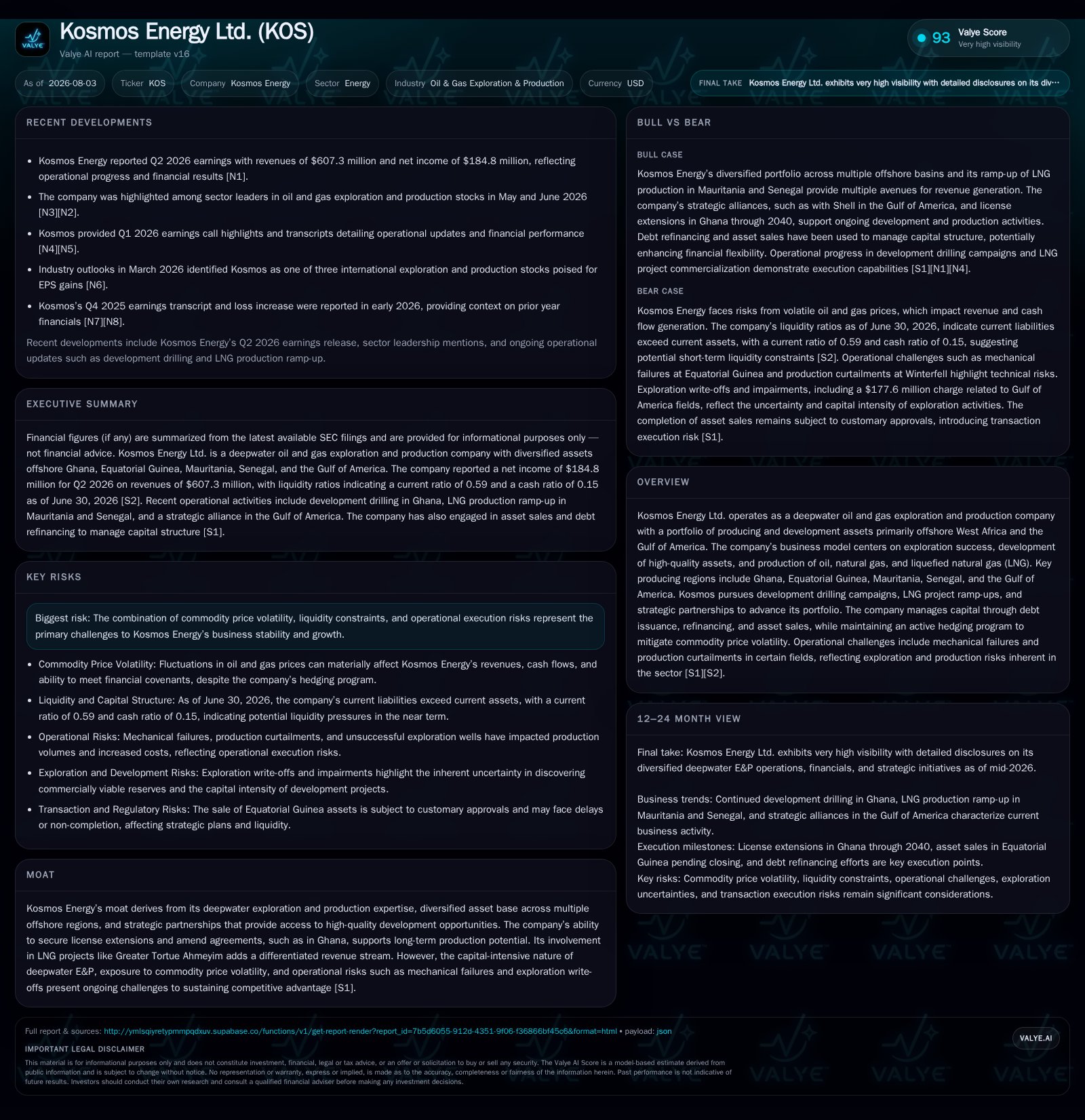
Kosmos Energy reported operational pressures in its offshore production volumes during Q2 2026, reflecting ongoing mechanical issues and curtailments. However, license extensions secured through 2040 in key Ghana fields underpin medium-term reserve visibility, supporting development drilling campaigns. The company maintains an active hedging program to mitigate commodity price fluctuations while navigating a capital-intensive balance sheet with recent refinancing. Asset sales and partnership maneuvers aim to optimize the portfolio amid disciplined capex investment. These developments collectively highlight Kosmos’s balancing act between maintaining production momentum and securing financial flexibility critical for sustaining deepwater growth.
Q2 Operational Evolution: Production Volumes and Uptime Pressures Highlight Execution Realities
Kosmos Energy’s latest quarterly disclosure for Q2 ended June 30, 2026, highlights production challenges intrinsic to offshore deepwater operations. The company experienced curtailments and mechanical failures that led to reduced operational uptime across several key producing fields. This translated into lower barrels of oil equivalent per day (boepd) than planned, directly constraining near-term revenue generation given the dependency on continuous production flows in upstream oil and gas. Such execution disruptions are common in complex offshore environments but underscore the impact of equipment reliability on cash flow stability for mid-tier operators like Kosmos [S2], [N1]. Reduced uptime also pressures unit operating costs as fixed expenses are spread over fewer productive barrels.
Deepwater Drilling Campaigns and License Extensions: Anchoring Medium-Term Reserves Growth
Despite short-term operating headwinds, Kosmos secured pivotal license extensions through 2040 for its Jubilee and TEN blocks offshore Ghana—the core producing concessions for the company. Formal government approval came by year-end 2025 following a Memorandum of Understanding earlier that year. These extensions not only solidify production tenure but also include provisions to amend the development plan to add up to twenty additional wells, reinforcing targeted reserve replacement ratios. The drilling campaign on Jubilee field advanced with successful producer wells brought online recently; plans for further producer and water-injector wells signal ongoing capital investment towards sustaining plateau production levels [S1]. This regulatory and operational foundation is vital for underpinning medium-term cash flows amidst an otherwise uncertain exploration outlook.
Commodity Price Exposure and Hedging Program: Navigating Market Volatility Responsibly
Kosmos employs a comprehensive hedging program to mitigate the effects of commodity price volatility that otherwise imposes pronounced earnings swings on upstream producers. In the current environment of market uncertainty involving crude oil and natural gas prices, such financial risk management tools contribute to smoothing realized prices versus spot market turbulence. The Nordic bond issuance proceeds were partly deployed toward retiring higher-coupon debt, supporting financial stability through reduced interest expense exposure—an indirect benefit shared by many peers who hedge both physical production volumes and financial instruments. Hedging coverage remains a critical KPI reflecting Kosmos’s approach to maintaining predictable cash generation capabilities required to fund capital expenditure commitments [S1], [S2].
Asset Portfolio Optimization: Strategic Sales and Partnership Positioning Alongside Capex Management
In tandem with managing operational expenditures, Kosmos executed strategic portfolio moves such as selling equity stakes in Equatorial Guinea assets to Panoro Energy earlier in 2026. Such asset sales reflect management's focus on optimizing capital allocation by divesting non-core or mature assets while preserving liquidity amid ongoing development needs across West African basins and Gulf of America offshore properties. These transactions provide incremental cash inflows that support disciplined capex deployment without exacerbating leverage levels unnecessarily—a salient priority given the company’s intensive investment profile linked to deepwater exploration, drilling programs, and LNG project participation [N7], [S2]. As of June 30, 2026, total debt stood near $2.72 billion with net debt approximating $2.62 billion after accounting for $102 million cash on hand, resulting in a relatively constrained current ratio under 0.6—signaling short-term liquidity pressure points typical among mid-tier offshore explorers [F1]. Recent refinancings including a $350 million Nordic bond issuance maturing in 2031 and a $250 million Gulf of America term loan facility maturing by 2029 restructure near-term maturities favorably while reducing average interest costs compared to legacy senior notes repurchased or redeemed earlier in the year [S1]. Maintaining adaptable capital structure amid fluctuating commodity cycles is essential for funding extended drilling campaigns and LNG ramp-up without compromising solvency.
Growth Vectors: Exploration Upside, LNG Ramp-Up, And Regulatory Support In West Africa Fields
Growth prospects hinge on unfolding exploration success in proven basins offshore Mauritania, Senegal, Ghana, alongside LNG project ramp-up notably at the Greater Tortue Ahmeyim facility—a significant liquefied natural gas operation co-developed with regional partners. This infrastructure advancement diversifies revenue beyond traditional crude oil streams toward growing global natural gas demand sectors [S1]. Concurrently, license extension agreements furnish crucial regulatory certainty encouraging further reserve additions through planned development drilling campaigns anchored on seismic data acquisition enhancements achieved over recent years. Together these initiatives underpin Kosmos’s strategy emphasizing stable long-run production profiles supported by diversified hydrocarbon product mix comprising oil, gas liquids, and LNG.
Risks on the Horizon: Operational Curtailements, Commodity Swings, And Regulatory Shifts to Watch
Despite solid progress areas, key risks persist that could restrain growth or destabilize financial health if not mitigated effectively. Operational risks remain pronounced with mechanical failures leading to unplanned downtime capable of disrupting revenue generating capacity especially during economically sensitive periods when commodity prices waver unpredictably [S2]. Furthermore, upcoming scheduled increases in government interests from July 2036 onward reduce partners’ percentages pro rata within extended licenses potentially affecting future net entitlement volumes absent compensatory fiscal terms adjustments—an important consideration facing all international E&P companies negotiating host country agreements today. Leveraged balance sheets also expose Kosmos to refinancing risk should credit markets tighten unexpectedly during cyclical downturns given their dependence on external funding sources tied inherently to project timelines typical of deepwater assets.
What Investors Should Monitor Next: Production Guidance, Development Drilling Outcomes, Liquidity Trends
Upcoming milestones worth tracking include quarterly updates on production volumes that will reveal how effectively previous curtailments are being managed alongside maintenance schedules aiming to restore uptime metrics closer to historical averages [S2]. Results from continuing development drilling campaigns—especially those tied to license extension-linked well increases—will serve as tangible evidence of reserve replacement progress essential for longer horizon sustainability. Additionally, monitoring liquidity status against impending debt maturities and capital expenditure requirements offers insight into financial flexibility that bears directly upon execution risk management going forward [S3]. Collectively these inputs will provide clearer directional signals regarding Kosmos’s operational resilience balanced against evolving market conditions inherent in deepwater upstream equity investments.
Financial Profile Discussion
As of June 30, 2026, Kosmos held approximately $102 million in cash versus total debt obligations around $2.72 billion resulting in a net debt position near $2.62 billion with a current ratio below one at roughly 0.59—indicative of limited near-term working capital cushion typical among companies heavily invested in capital projects with long payback horizons [F1]. Recent refinancings including the Nordic bonds due 2031 extend debt maturity profiles while lowering coupon burdens compared to previous senior notes partially retired early during H1 2026 [S1]. However, these improvements do not fully alleviate leverage concerns arising from inherent volatility in commodity price-driven revenues combined with periodic operational downtime impacting free cash flow generation capacity essential for self-funding growth activities without dilutive equity issuances or incremental borrowing.
In this context, Kosmos must balance capex commitments aimed at sustaining production volume trajectories—such as multi-well development campaigns—with prudent liquidity management driven by hedging strategies designed to stabilize realized pricing environments amidst cyclicality pervasive in energy markets. This integrated financial-operational approach mirrors practices common among peer mid-tier deepwater exploration and production firms seeking resilience while pursuing growth opportunities across diversified geographic portfolios.
This analysis reflects information available as of August 3, 2026 based on Kosmos Energy's SEC filings including its Q2 Form 10-Q and associated event disclosures as well as secondary reporting sources. It does not constitute investment advice but rather an independent industry-focused evaluation of operating dynamics and strategic positioning anchored primarily in verified regulatory disclosures.
Disclaimer: This is research-only, informational analysis and not investment advice. It may include AI-generated interpretation and general industry context. Always verify important details using primary sources.

Comments