
Wheels Up Accelerates Fleet Modernization and Cost Savings Amid Capital Intensity Challenges
The company’s completion of fleet modernization and expanded cost-saving initiatives mark pivotal steps in scaling premium private aviation services.
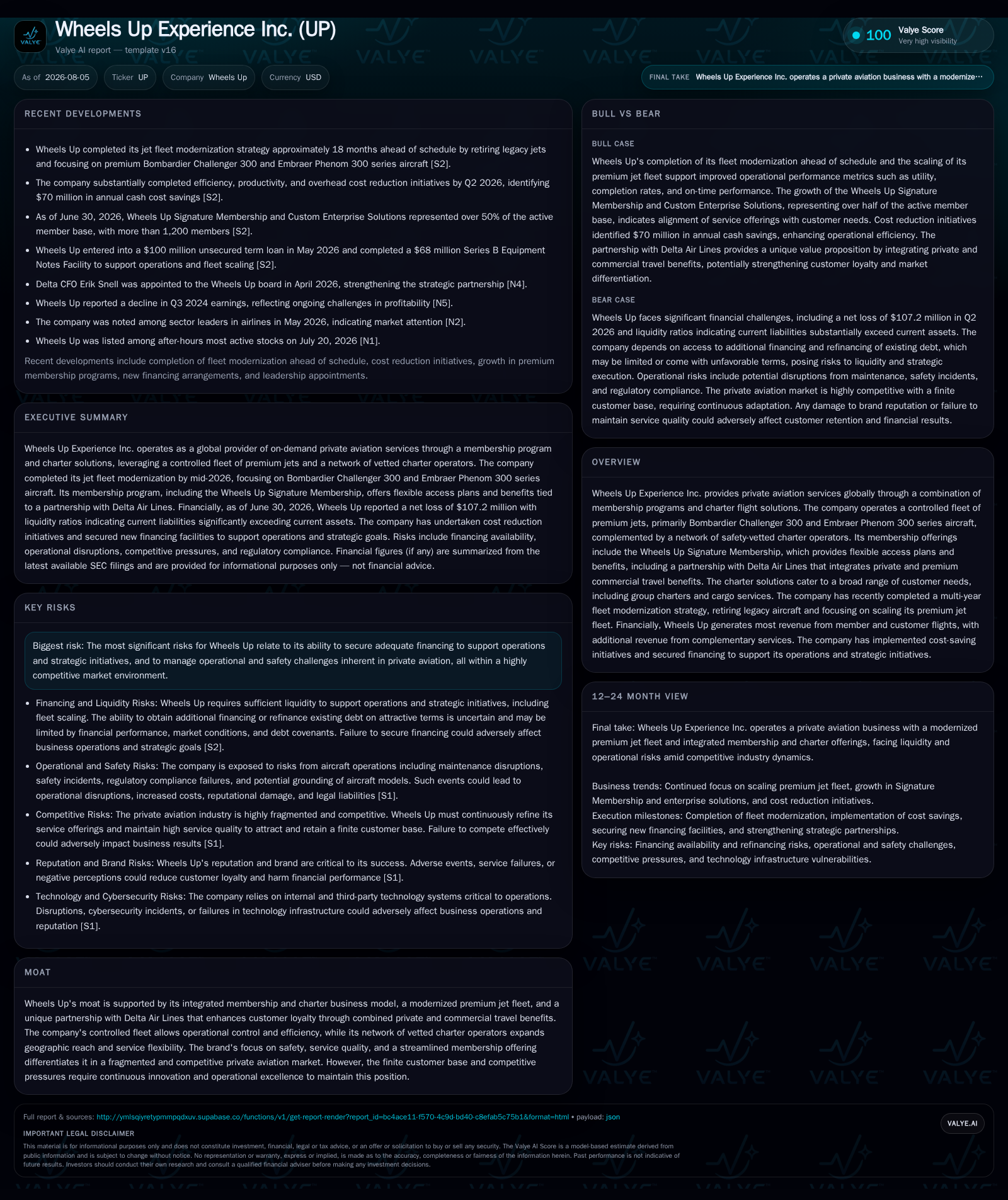
Wheels Up Experience Inc. recently completed its fleet modernization strategy ahead of schedule, retiring legacy jets and focusing exclusively on Bombardier Challenger 300 and Embraer Phenom 300 aircraft, aiming to grow this premium fleet to about 50 jets by year-end 2026. Complementing these operational shifts, Wheels Up has implemented efficiency initiatives targeting $70 million in annual cash savings to improve margins amid persistent net losses and heavy leverage. Its integrated membership program, notably the Wheels Up Signature Membership with flexible access plans and a unique Delta Air Lines partnership, underpins revenue through prepaid flight credits and on-demand charter flights. However, the company faces ongoing financing risks tied to capital intensity and debt obligations in a competitive private aviation market requiring sustained operational execution.
Recent Operating Update
A cornerstone development in this period was the accelerated completion of the jet fleet modernization approximately 18 months ahead of schedule as of May 2026. This milestone was achieved by fully retiring legacy aircraft fleets—specifically Cessna Citation X and Hawker 400XP models—from revenue service. Consequently, the company now operates exclusively a controlled fleet of premium Bombardier Challenger 300 series and Embraer Phenom 300 series jets [S2][S6]. Following this transition focus shifts toward scaling this premium fleet to approximately 50 aircraft by end of year from the current level of around 40 units [S2].
Operational improvements manifested in higher utility rates, improved completion rates (percentage of scheduled flights completed), and enhanced on-time performance metrics through July 2026 [S2]. The company reported accumulating "119 Brand Days" — days with perfect completion rate and zero cancellations — indicative of operational reliability gains which are essential for customer satisfaction and brand loyalty
Business Model Specifics
Wheels Up’s core revenue driver is its blended membership program paired with on-demand charter flight services. The Wings Up Signature Membership serves as a linchpin product designed for flexibility, simplicity, and premium service access. Members pay a modest monthly fee plus purchase prepaid flight credits termed "Membership Funds," which can be allocated toward flights or ancillary services such as catering and ground transport [S1][S2]. The membership unlocks access to two distinct pricing models:
- Dynamic Access Plan: Offers discounted hourly rates with pricing dynamically adjusted based on demand.
- Fixed Access Plan: Provides predictable hourly rates enabling budget certainty for frequent flyers.
This model aligns incentives with members’ travel usage patterns while maintaining upfront cash flow through Membership Fund purchases [S1][S2]. Additionally, Wheels Up offers Custom Enterprise Solutions tailored for larger corporate clients seeking bespoke travel programs
Complementing membership flights are diverse charter solutions that accommodate trips without pre-purchased funds. This segment caters to broader customer needs including international group charters (15+ passengers), sports teams logistics, corporate event travel, tour operations, as well as cargo services facilitated via Air Partner Cargo [S1][S2]. Charter bookings benefit from an extensive global network of safety-vetted partner operators expanding geographic reach beyond the controlled fleet.
A critical differentiator is Wheels Up’s partnership with Delta Air Lines which enables cross-utilization benefits: Wheels Up members can earn Delta SkyMiles Diamond Medallion status based on qualifying spend within the private aviation program; membership funds may also be applied towards discounted Delta commercial flights under agreed terms [S1][S2]. This creates an integrated travel ecosystem spanning private jets and commercial premium cabins—strengthening member retention through enhanced loyalty rewards tied directly to flight activity across both entities
Industry Structure and Competitive Positioning
Private aviation services operate within a capital-intensive industry ecosystem requiring ongoing investment in aircraft acquisition/maintenance coupled with stringent safety compliance. Demand is typically driven by high-net-worth individuals (HNWIs), corporations seeking flexible executive travel solutions, sports entities, governments using special purpose charters, and cargo customers requiring specialized logistics.
Wheels Up positions itself among peers such as NetJets—known for fractional jet ownership—Flexjet with premium charter focus, VistaJet's global orientation, JetSuite’s hybrid membership-charter model, airline-affiliated Delta Private Jets leveraging an airline customer base, and XOJET emphasizing on-demand charter flexibility. Unlike fractional ownership models demanding large upfront commitments for partial equity shares in aircraft assets (e.g., NetJets), Wheels Up emphasizes more flexible membership structures supplemented by a controlled fleet mix allowing operational control without the capital burden of full ownership.
Fleet modernization advances elevate Wheels Up’s competitive stance by standardizing on reliable medium-cabin jets known for operational efficiency (Challenger and Phenom series). This supports improved asset utilization critical in achieving acceptable economics given the significant fixed costs associated with maintenance overheads and crew staffing.
The exclusivity of the Delta partnership also enriches Wheels Up’s value proposition as few private aviation providers embed direct airline loyalty integration at this scale. Nevertheless, competition remains intense with many regional operators offering bespoke services often at localized price points or differentiated customer experiences.
Growth Drivers
Several structural drivers underpin Wheels Up’s anticipated growth trajectory:
- Increasing preference among wealthy individuals and corporates for flexible on-demand private air travel options over expensive fractional ownership or traditional charters.
- Expansion of membership offerings centered around prepaid flight credits supports upfront cash inflow while deepening customer stickiness.
- Completion of fleet modernization allows scalability concentrating resources on premium jets ensuring reliability alongside potential margin improvements from lower maintenance costs compared to legacy aircraft.
- Enhanced synergy via the Delta Air Lines alliance facilitates cross-selling opportunities into established commercial frequent flyer bases leveraged through co-branded benefits.
- Recovery and growth in corporate travel demand following macroeconomic cycles enhancing discretionary business flying budgets.
- Potential geographic expansion into new international markets enabled by charter operator partnerships broadens addressable demand segments.
- Continued technology investments optimizing booking platforms improve operational efficiency reducing service delivery costs while raising customer experience standards.
- Health concerns post-pandemic persist driving some travelers toward private over commercial air transport owing to convenience and perceived safety.
Risks and Watchpoints
Despite progress there remain notable risks confronting Wheels Up:
- High capital requirements inherent in fleet acquisition necessitate consistent access to financing markets; existing substantial debt ($919 million) against limited cash ($86 million) heightens refinancing risk especially if credit markets tighten or interest costs rise substantially [F1][S7].
- Negative net income trends highlight ongoing challenges converting scale into profitability despite cost initiatives; sustaining financial viability depends on ramping utilization rates alongside disciplined expense control [S2][S12].
- Execution risks related to integrating new aircraft types smoothly without disrupting member experience or incurring unexpected expenses.
- Retention challenges loom given niche clientele who may switch among providers based on service reliability or changing travel patterns.
- Volatility in fuel prices presents cost uncertainty impacting charter pricing dynamics directly tied to operational expenses.
- Legal disputes such as ongoing litigation related to fleet programs could impose financial or reputational damages if unfavorable outcomes ensue [S1].
- Highly fragmented competitive landscape complicates pricing power; differentiation by service quality alone may not suffice as low-cost operators expand regional coverage.
- Dependence on macroeconomic conditions affecting discretionary spending specifically impacts luxury/private aviation uptake during downturns or geopolitical instability.
- Regulatory requirements around flight safety continue evolving potentially increasing compliance burdens requiring continuous investment.
What To Watch Next
Key indicators to monitor encompass:
- Fleet size progression toward targeted ~50 Challenger/Phenom jets—a proxy for capacity scaling ambitions [S2].
- Trends in active membership counts alongside shifts favoring Signature Membership products reflecting successful migration from legacy offerings [S1].
- Realized run-rate cost savings evidenced in Adjusted EBITDA trends during Q3/Q4 reporting periods clarifying whether $70 million target sustains financial improvement trajectory [S2][S12].
- Booking volume growth particularly within charter segments signaling market acceptance amid competitive pressures.
- Liquidity position measured via current ratio improvements or debt refinancing activity ensuring covenant compliance against sizable liabilities [F1][S7].
- Operational KPIs including completion rates above industry norms (~99%+) reaffirming execution excellence contributing directly to customer satisfaction metrics.
- Impact assessment of Delta integration initiatives extending beyond loyalty benefits into joint marketing or bundled product offerings creating barrier effects versus peers.
- Development or announcement of further strategic transactions (acquisitions/divestitures) shaping growth profile amidst ongoing industry consolidation possibilities.
Financial Profile Discussion
As of June 30, 2026, Wheels Up holds approximately $86 million in cash against roughly $919 million total debt resulting in net debt near $833 million—a substantial leverage context reflective of continued capital intensity typical for private aviation firms scaling premium fleets [F1][S7]. The company’s current ratio stands at about 0.28 indicating tight near-term liquidity relative to current liabilities totaling over $785 million—highlighting reliance on committed credit facilities maintained partly via agreements amended recently including extensions negotiated with lenders such as Delta Air Lines acting both as a strategic partner shareholder (~36% equity stake) and creditor enabling revolving facility availability through September 2028 [S2][S7].
This analysis integrates public SEC filings through August 5th, 2026 without conjecture beyond cited data points. The material nature of Wheels Up's ongoing transformation coupled with sector dynamics underscores monitoring developments across fleet expansion progress, member engagement trends, liquidity management efforts, as well as broader economic factors impacting demand for private air travel services.
Disclaimer: This is research-only, informational analysis and not investment advice. It may include AI-generated interpretation and general industry context. Always verify important details using primary sources.

Comments