
Gyre Therapeutics Advances Liver Fibrosis Pipeline with Phase 3 Progress Amid Solid Cash Position
Gyre Therapeutics reports encouraging Phase 3 clinical trial progress for Hydronidone while maintaining a healthy cash balance supporting its dual-market model.
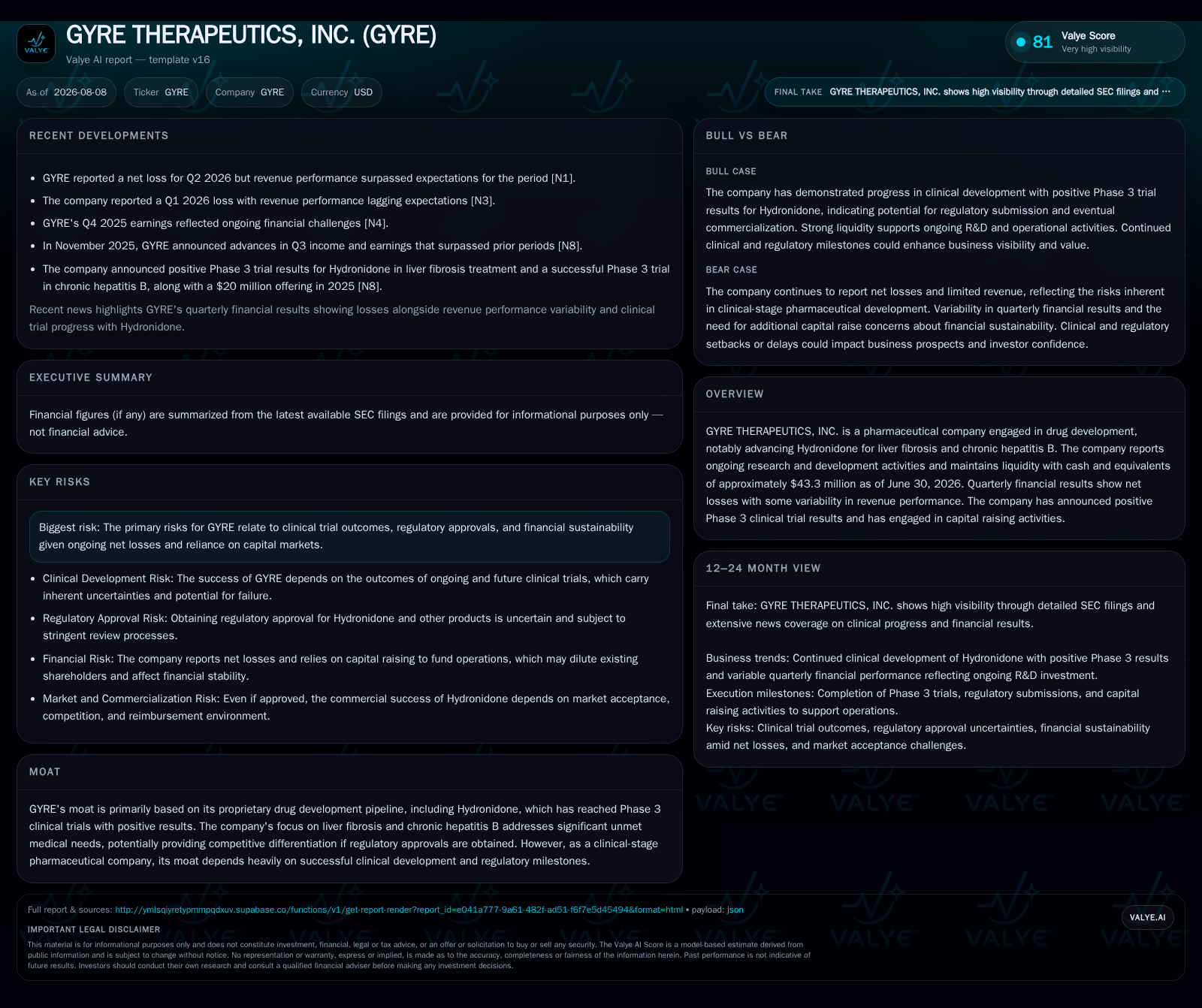
In its Q2 2026 filing, Gyre Therapeutics highlighted substantial advancement in the Phase 3 clinical trial of Hydronidone, its lead candidate targeting liver fibrosis. Concurrently, the company sustains financial stability with $43.3 million in cash and equivalents, providing a runway beyond 12 months amid ongoing net losses. Gyre's commercial operations in the PRC, including products like ETUARY®, underpin funding for its U.S.-based R&D expansion. The interplay of clinical progress and liquidity marks a critical juncture as Gyre navigates late-stage development risks and regulatory pathways. Investors should monitor patient enrollment rates and regulatory submissions as near-term execution milestones.
Q2 Results Highlight Progress Toward Liver Fibrosis Milestones and Operational Continuity
Gyre Therapeutics’ most recent quarterly filing dated August 7, 2026, reveals meaningful operational momentum anchored by advances in its lead drug candidate Hydronidone’s Phase 3 clinical trial targeting liver fibrosis [S2]. This late-stage clinical progress is critical, signaling reduced development risk as the dataset matures toward demonstrating safety and efficacy on clinically relevant endpoints. Clinical trials at this stage typically intensify patient enrollment efforts to meet statistical rigor requirements for regulatory review. The company's management commentary underscores that patient recruitment pace remains robust relative to plans, enhancing confidence in meeting Phase 3 milestones on schedule.
Financially, Gyre reported maintaining cash and equivalents totaling approximately $43.3 million as of June 30, 2026 [F1], supported by minimal debt exposure which favors financial flexibility. Operating results show net losses consistent with investment-phase biotech firms balancing commercial revenue inflows against costly late-stage trial execution and administrative overheads [N1], [S2]. The reported revenue growth reflects underlying traction from established commercial products in China.
(Re)defining Fibrosis Treatment: Gyre’s Integrated Approach to Commercialization & Pipeline Expansion
Gyre’s business model synergistically integrates a China-based commercial subsidiary generating recurring revenues from marketed antifibrotic therapies like ETUARY® (pirfenidone) with its U.S.-focused development pipeline where most R&D investments occur [S1]. ETUARY® participates in centralized drug procurement tenders to Chinese public hospitals—a distribution channel exerting price compression but capable of volume scale—providing a relatively predictable revenue base amidst competitive dynamics.
This hybrid approach allows Gyre to underwrite capital-intensive clinical trials for novel small-molecule candidates such as Hydronidone advancing through the rigorous Phase 3 stage. The latter targets liver fibrosis—a condition characterized by progressive extracellular matrix deposition disrupting organ function—with broad unmet medical need globally. Strategically, this cross-jurisdictional footprint aims to leverage successful commercialization expertise within pulmonary fibrosis as a platform to de-risk broader organ fibrosis indications including hepatic manifestations [S1].
Technically notable is Hydronidone’s design as a multi-pathway modulator at various stages of fibrotic progression rather than focusing on singular profibrotic pathways; this potentially addresses pathophysiological complexity that first-generation drugs failed to overcome in certain patient subsets.
Phase 3 Clinical Trial Execution: Enrollment Pace and Endpoint Quality as Crucial Value Drivers
Critical KPIs driving near-term value creation include patient enrollment rate into Hydronidone’s Phase 3 trial and validation of chosen efficacy endpoints that align with regulatory expectations [S1], [S2]. Rapid enrollment mitigates timeline risks while high-quality endpoints—such as liver stiffness measured by imaging or serum biomarkers—enhance likelihood of favorable benefit-risk profiles demonstrated for regulatory submissions.
Safety profiling remains paramount given fibro-inflammatory disease population vulnerabilities; interim analyses signaling tolerability fuel investor confidence while informing adaptive trial conduct adjustments if needed. Positive interim data can also act as clinical endorsements supporting negotiating power with potential partners or licensing counterparties.
Gyre’s emphasis on meticulous protocol design and long-standing relationships with principal investigators across multiple geographies reflect an experienced infrastructure facilitating consistent data collection standards essential for submission dossiers.
Competitive Positioning Within Fibrotic Disease Biotech: Peer Benchmarking vs. Trial & Regulatory Risks
Within the fibrosis therapeutic space, strategic comparables include companies like FibroGen and Intercept Pharmaceuticals which have advanced distinct mechanisms through late-stage trials targeting organ fibrosis including liver cirrhosis or nonalcoholic steatohepatitis (NASH). Relative to these peers, Gyre’s diversified approach marrying China-scale commercialization with U.S.-based late-stage development is noteworthy.
However, all players face shared industry challenges: balancing sustained capital needs against clinical risk outcomes; navigating protracted regulatory review processes both at the FDA and National Medical Products Administration (NMPA) in China; managing intellectual property portfolios securing exclusivity; and addressing pricing dynamics especially within state-driven procurement regimes impacting revenue models.
Consistent advancement through rigorous Phase 3 designs bolsters Gyre's competitive profile by reducing binary risk events towards potential approvals while its established presence in PRC markets provides commercial leverage not all peer biotechs possess.
Unlocking Growth: Regulatory Pathways, Market Opportunities, and Strategic Capital Deployment
Regulatory authorization represents the critical unlocking event for Gyre pipeline assets. Positive Phase 3 outcomes should enable New Drug Application (NDA) filings initially within China’s NMPA framework—with a sequential or simultaneous FDA pursuit plausibly following—leveraging harmonized safety and efficacy data sets [S1], [S2]. Successful approvals expand addressable markets significantly beyond chronic conditions currently served by ETUARY®.
Geographically diverse market entry strategies reflect different reimbursement environments where centralized hospital tendering contrasts with insurance payor negotiations typical of Western markets. These differences require calibrated pricing strategies balancing penetration against margin goals.
Capital raising activity remains integral given persistent net losses driven by upfront R&D costs—the latest filings highlight preparation for subsequent financing rounds timed around key clinical milestones to minimize dilution while ensuring project continuity. Integration efforts post-Merger with Cullgen broaden pipeline depth but likewise require resource allocation efficiency.
Key Risks to Monitor: Clinical Outcomes, Regulatory Timing, and Financial Sustainability Challenges
Principal downside risks stem from potential delays or failures within ongoing trials including slower patient recruitment than anticipated or adverse safety signals impacting utility assessments post-approval submissions [S1], [S2]. Regulatory bodies’ protracted review timelines could postpone market access compressing forecasted revenue streams.
Pricing pressures originating from PRC public hospital tender competitions impose margin risks on established products as well.
Intellectual property enforcement remains vital since insufficient patent breadth or expiration ahead of competitive entry can erode exclusivity-dependent profitability, while market acceptance among physicians and payors determines ultimate commercial uptake post-launch.
"Focus Ahead": Upcoming Catalysts and Critical Execution Watchpoints Through Next Reporting Cycle
Investors should closely track several forward-looking indicators: incremental interim data releases from the Hydronidone Phase 3 study elucidating efficacy/safety trends; NDA submission timing updates particularly across jurisdictions; progress on patient enrollment benchmarks confirming trial feasibility; and any regulatory feedback relevant to dossier completeness or additional requested evidence [S2], [S3].
Commercial developments concerning ETUARY® market share expansions or tender renewals within China will provide insight into revenue stability supporting R&D spending capacity. Monitoring cash burn rates relative to forecast will inform sustainability assessments alongside announcements about new financing instrumentation or partnership agreements enhancing resource pools.
Financial Profile Discussion: Cash Runway Buffering Development with Modest Commercial Revenue Traction
As of June 2026 quarter-end, Gyre held $43.3 million in cash and equivalents supported by zero recorded debt—resulting in a current ratio above four times illustrating healthy short-term balance sheet liquidity available to fund operating outflows comfortably over at least a year under present assumptions [F1], [S2].
Operating losses persist due to intensive investment in late-stage clinical trials; however, revenues derived primarily from commercialized fibrotic disease products contribute modest but growing offsets easing overall funding demands somewhat. The absence of debt enhances flexibility relative to many peers still reliant on credit facilities or frequent equity raises during similarly resource-draining developmental phases.
Overall financial posture supports continued execution momentum while highlighting necessity for well-timed capital raises aligned with upcoming value inflection points based on clinical/regulatory milestones.
This analysis is prepared solely for informational purposes reflecting publicly available filings through August 7, 2026; it does not constitute investment advice or research views regarding securities of Gyre Therapeutics Inc.
Disclaimer: This is research-only, informational analysis and not investment advice. It may include AI-generated interpretation and general industry context. Always verify important details using primary sources.

Comments