
Park National’s Scale Expansion Triggers Heightened Regulation and Integration Risks
The 2026 acquisition of First Citizens pushed Park National over $10 billion in assets, increasing regulatory complexity and operational challenges.
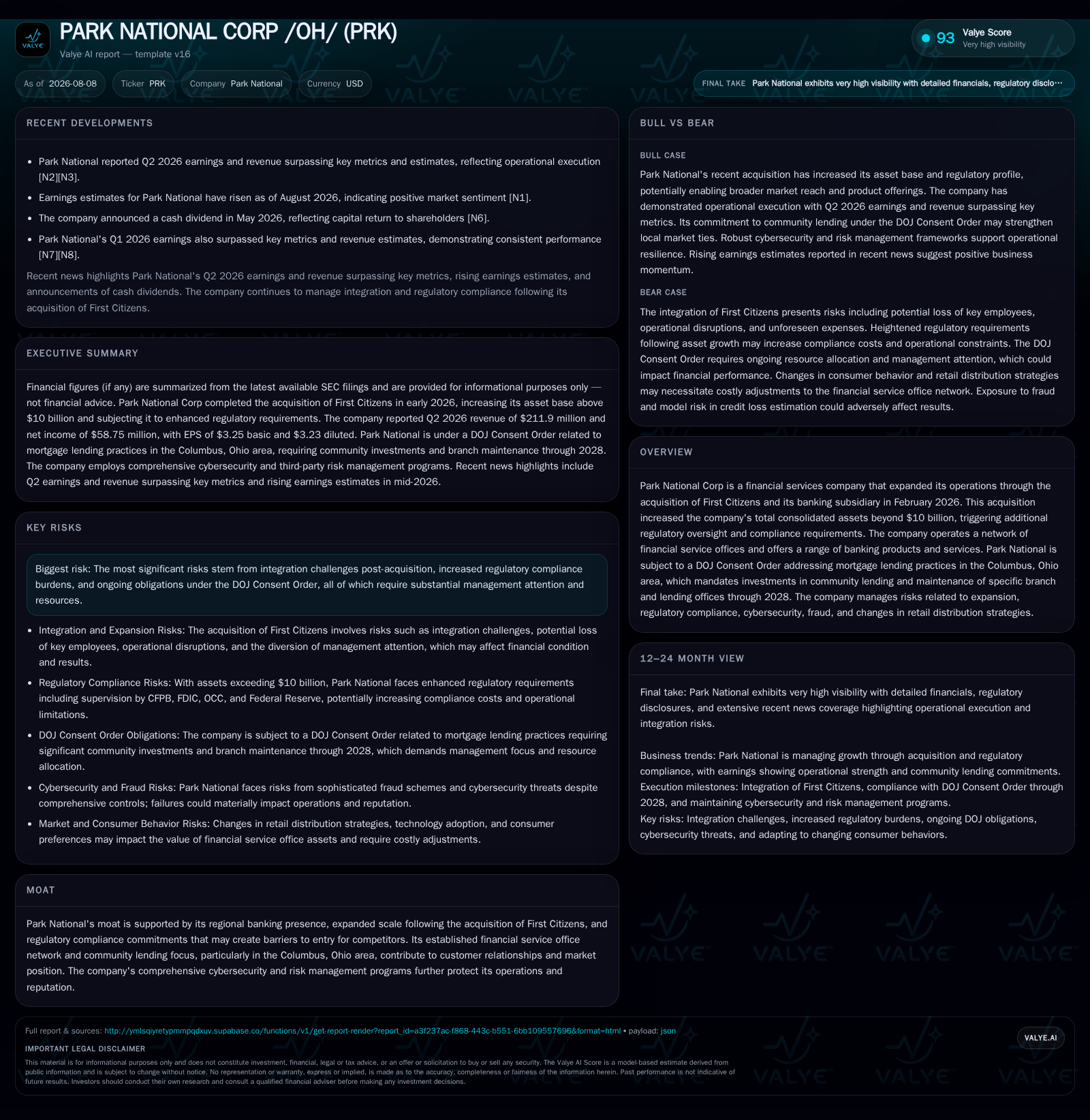
Park National Corporation’s acquisition of First Citizens on February 1, 2026, elevated its consolidated assets beyond the $10 billion threshold, subjecting the company and its banking subsidiary to enhanced regulatory oversight including CFPB supervision and additional compliance costs [S1][S9]. This strategic scale increase offers growth opportunities but demands significant integration efforts and resource allocation to comply with a DOJ Consent Order related to mortgage lending practices in Columbus, Ohio [S11][S12]. Key risks center on acquisition integration execution, regulatory compliance burden, credit risk amid economic volatility, and evolving retail distribution strategies. The company maintains a well-capitalized position with ample liquidity as of mid-2026 [F1].
Recent Operating Update
Park National Corporation’s most pivotal recent development centers on its February 1, 2026 acquisition of First Citizens Bancshares and its subsidiary First Citizens National Bank. This transaction propelled Park's total consolidated assets past the critical $10 billion mark, thereby subjecting the firm to heightened regulatory requirements arising from the Dodd-Frank Act framework [S1][S9]. The effects are multifaceted: increased supervision by the Consumer Financial Protection Bureau (CFPB), altered FDIC insurance assessment methodologies possibly leading to higher premiums, restrictions on interchange fee income from debit card transactions, and elevated Volcker Rule compliance standards impose substantial new operational complexity [S9]. These regulatory changes necessitate additional personnel hiring, internal control enhancements, and increased compliance expenditures that could pressurize operating margins.
Simultaneously, Park remains bound by a U.S. Department of Justice (DOJ) Consent Order approved in March 2023 concerning alleged discriminatory mortgage lending practices in Columbus, Ohio. To date, Park complies fully with this order but must sustain a minimum community investment commitment totaling at least $7.75 million over five years focused on majority-black and Hispanic census tracts within Columbus. Required activities include maintaining specific branch infrastructure: one full-service branch, a mortgage loan production office, and four specialized mortgage lenders dedicated to community lending efforts through the order's term ending in 2028 [S11][S12]. This regulatory engagement imposes rigid operational requirements influencing branch network strategy and product focus.
Business Model Analysis
Park National operates primarily as a regional bank holding company generating revenue predominantly through net interest income — lending at rates exceeding the cost paid on deposits and borrowings — augmented by various fee-based banking products including mortgage originations, deposit accounts maintenance fees, wealth management services, and treasury solutions. The recent acquisition extends its loan portfolio breadth and deposit base scale while deepening geographic penetration particularly within Ohio markets.
The net interest margin (NIM) is inherently sensitive to fluctuations in interest rates driven by Federal Reserve policies. Changes impact both loan yields and deposit pricing dynamics; rising rates typically force upward adjustments in deposit costs to retain funding stability while challenging fixed-rate loan portfolios. The company employs forecasting models to manage interest rate risk though inherent model limitations could lead to unexpected losses upon sharp market moves [S1][S19]. Fee income performance hinges on mortgage activity levels which remain volatile due to prevailing economic conditions.
The DOJ Consent Order underscores an intersection between regulatory compliance and business strategy — requiring sustained investment into underserved communities that may not immediately yield commensurate financial returns but reinforces community ties acting as competitive moat elements against larger or less locally engaged peers. This tradeoff reflects the challenges regional banks face balancing growth ambitions against mandated social responsibility initiatives.
Industry Structure and Competitive Position
Park National situates within the highly regulated regional banking sector characterized by intense competition among comparable entities such as Fifth Third Bancorp, Regions Financial Corporation, KeyCorp, Independent Bank Group, and First Busey Corporation. While none possess direct disclosed peer underwriting metrics herein for precise benchmarking, general patterns indicate these institutions compete on service quality in defined geographic footprints combining branch presence with digital banking capabilities.
The $10 billion asset threshold bump imposes scale-related regulatory burdens that may disproportionately challenge smaller competitors lacking comparable capital or compliance infrastructures. Hence Park’s acquired scale provides both strategic leverage for growth deployments but simultaneously adds fixed-cost burdens detrimental if top-line expansion stalls.
Additionally, regional banks confront structural industry shifts such as evolving consumer preferences away from traditional branches towards digital platforms — mandating continual recalibration of branch networks without eroding depositor engagement or credit origination capabilities. Compliance costs linked to community reinvestment commitments further delineate operational contours versus fintech entrants who evade similar constraints but lack extensive depositor funding bases.
Growth Drivers
Key growth vectors for Park include leveraging organic loan growth fueled by regional economic expansion alongside cross-selling opportunities realized through an enlarged branch footprint post-acquisition. The integration of First Citizens expands geographic reach and customer segments supported by complementary product offerings.
Community lending initiatives prescribed by the DOJ Consent Order augment lending volumes selectively within targeted minority communities fostering goodwill and fulfilling regulatory mandates — potentially translating to longer-term customer loyalty benefits though at moderated near-term margins.
Favorable interest rate environments that sustain positive net interest margins underpin core earnings capacity provided that deposit pricing competition remains manageable without excessive spread compression. Technology adoption aimed at enhancing client experience while optimizing back-office efficiency further supports scalable growth without corresponding operating expense inflation.
Risks and Watchpoints
Integration risk stands foremost post-acquisition: divergent corporate cultures between Park and First Citizens risk fracturing employee cohesion impacting client service continuity or talent retention [S1]. Realizing merger synergy-related cost savings may take longer than expected or run below projections introducing profitability headwinds.
Regulatory compliance complexity entails sustained expenditure; failure to meet DOJ Consent Order terms could invoke fines or reputational damage. Heightened CFPB scrutiny linked to surpassing $10 billion assets anticipates rigorous oversight creating ongoing resource demands.
Credit risk intensifies amid economic uncertainties including inflation-driven cost pressures on borrowers affecting repayment capacity [S1][S8][S17]. Elevated allowance for loan losses will be necessary if forecasted credit deterioration materializes exacerbated by concentration exposures within certain commercial real estate sectors or consumer loans.
Interest rate volatility presents unpredictable impacts on net interest margin; rapidly rising short-term rates could squeeze spread if deposit repricing accelerates beyond loan yield adjustments despite hedging efforts employing analytical models which carry intrinsic assumptions vulnerabilities [S19]
The increasing sophistication of cyber threats paired with fraud attempts exposes Park to growing operational risks requiring continuous investment in security infrastructure to safeguard assets and preserve trust [S1]. Meanwhile changing consumer behaviors create uncertainty around optimal branch density versus digital channel investments with potential write-offs or reconfigurations imposing further capital outlays.
What to Watch Next
Upcoming milestones include monitoring quarterly earnings releases for signs of merger integration progress reflected in expense ratio improvements or stable customer retention metrics versus pre-acquisition baselines [N2][N3]. Tracking performance relative to DOJ-mandated investment schedules will inform about adherence risks impacting operational flexibility.
Key KPIs such as net interest margin movement under current monetary policy regimes will gauge resilience against rising funding costs; similarly non-performing loans ratio trends alongside provision for credit losses will flag evolving asset quality dynamics crucial for prudent capital planning. Leadership commentary during investor presentations might provide transparency regarding technology investments targeting fraud reduction or distribution model optimization as sector digitalization accelerates.
Overall regulatory dialogue particularly any CFPB pronouncements affecting operational constraints or fee income sources requires observation given their potential material effect on bottom-line trajectories under stricter than expected supervisory frameworks.
Financial Profile Discussion
As of June 30, 2026, Park National held cash and cash equivalents totaling approximately $580 million while carrying zero reported debt as of September 30, 2025—indicating a strong liquidity position supportive of ongoing operations including compliance-driven expenditures [F1]. Net income for the twelve months ended December 31, 2025 reached $180.1 million reflecting solid profitability prior to the closing of the First Citizens acquisition [F1].
Notwithstanding this sound financial footing, management must balance continuing investment requirements triggered by acquisition integration challenges and regulatory compliance against margin compression risks emanating from competitive pressures on deposit pricing amid evolving interest rate cycles along with provisions for credit losses adapting dynamically to macroeconomic conditions.
This analysis synthesizes facts drawn exclusively from publicly filed SEC documents including filings up to August 7, 2026 ([S1], [S2], [S3]) combined with current financial snapshot data ([F1]). It contextualizes these within standard frameworks applicable to regional banking institutions without conjecture beyond evidenced disclosures or peer comparisons unsupported by direct data linkage. No investment advice is offered nor implied.
Disclaimer: This is research-only, informational analysis and not investment advice. It may include AI-generated interpretation and general industry context. Always verify important details using primary sources.

Comments