
Universal Health Services Faces Margin Pressure and Regulatory Headwinds While Pursuing Behavioral Health Growth
UHS’s latest quarterly results highlight ongoing reimbursement, litigation, and inflation challenges alongside strategic investments in behavioral health.
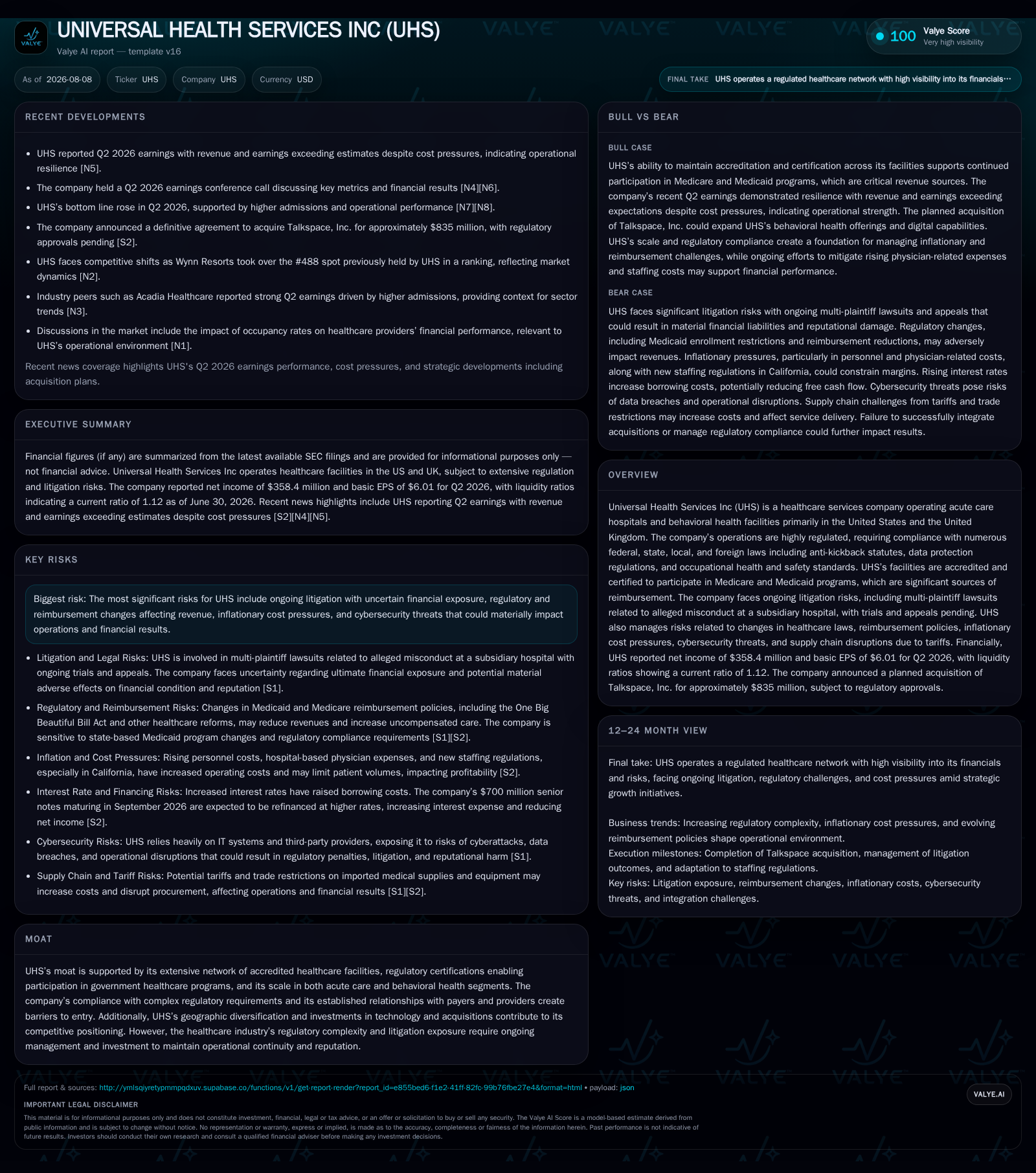
Universal Health Services Inc (UHS) reported Q2 2026 results reflecting revenue resilience despite cost pressures from labor inflation and regulatory reimbursement shifts. Medicaid program changes mandated by recent federal legislation pose a multi-year revenue headwind estimated at up to $500 million annually by 2032. Meanwhile, UHS is expanding its behavioral health footprint through the imminent acquisition of virtual care provider Talkspace. Operational risks include legal exposures tied to subsidiary litigation and healthcare regulatory compliance. The company’s broad network across acute and behavioral health care segments, alongside payer diversification, underpin a durable competitive moat amid a capital-intensive, highly regulated industry environment.
Latest Operating Update: Q2 2026 Earnings Highlights
Universal Health Services Inc (UHS) released its second quarter 2026 financial results on July 27, 2026, beating revenue and earnings estimates despite facing significant cost headwinds [S2][N2][N3]. The company attributed margin compression primarily to increased labor expenses driven by a tight healthcare labor market and inflationary pressures on supplies. Nevertheless, stable patient volumes and revenue per patient day helped sustain top-line growth. UHS’s network includes a substantial portfolio of acute care hospitals and behavioral health facilities across the US and UK, providing diversified exposure to multiple payer sources including Medicare, Medicaid, private insurance, and self-pay patients.
One notable update is the expected impact of the One Big Beautiful Bill Act passed in mid-2025, which imposes work requirements on Medicaid beneficiaries reducing enrollment and limits on provider fees used for federal funding enhancements [S1][S2]. UHS anticipates aggregate annual net revenue reductions of approximately $500 million by fiscal year 2032 due to these limitations on Medicaid reimbursements in numerous key states where it operates sizable Medicaid programs [S1][S2]. This legislative environment introduces uncertainty into government reimbursement streams historically accounting for a meaningful portion of UHS’s revenue.
Additionally, UHS disclosed ongoing legal proceedings associated with alleged misconduct at certain subsidiary hospitals [S1], continuing to weigh on operational risk profiles and potentially affecting future earnings volatility. These exposures integrate into the company’s overarching risk framework that also includes regulatory compliance demands spanning anti-kickback laws, Stark Law restrictions on referral patterns, occupational safety requirements, data privacy regulations such as UK GDPR, and environmental controls [S1].
Business Model Overview
UHS generates revenues principally by providing acute medical care and behavioral health services through directly owned or operated hospitals and treatment centers. Its acute care segment includes emergency services, surgical procedures, inpatient care, outpatient diagnostics, and various specialty services. Behavioral health offerings encompass inpatient psychiatric beds, substance abuse treatment programs, counseling services, and increasingly telehealth-enabled mental health support.
Revenue flow stems from contractual arrangements with multiple payers: government programs like Medicare and Medicaid reimburse according to established fee schedules or prospective payment systems; private insurers negotiate reimbursed rates; self-pay patients contribute out-of-pocket balances; and state- or county-based programs provide additional localized funding [S1]. Payer mix composition materially influences revenue per patient day metrics since government payers typically reimburse below private insurer rates. Therefore, changes in payer mix ratios or reimbursement policies directly affect margins.
Operational efficiency relies heavily on key healthcare KPIs such as patient admissions volume, occupancy rates at facilities, average length of stay adjustments to optimize resource utilization while managing readmission penalties imposed under value-based care frameworks [S2]. Staffing levels constitute another critical lever —with labor costs representing a dominant expense category—turned challenging by national nurse shortages and competitive wage inflation [N3]. Maintaining regulatory accreditations allows continued participation in Medicare/Medicaid programs essential for sustaining high facility utilization rates.
The business model requires significant recurring capital investment directed towards facility maintenance, technological upgrades including EMR systems integration, compliance-driven modifications (e.g., infection control infrastructure), and capacity expansions particularly in high-demand behavioral health markets [S22]. These capital expenditures are financed from operating cash flow supplemented by credit facilities.
Industry Structure & Competitive Positioning
The healthcare services sector is marked by complex regulation governing both operations and payments. UHS competes among large hospital operators—Community Health Systems (CHS), Tenet Healthcare—and specialized behavioral health providers like Acadia Healthcare. Scale matters given the capital intensity of hospital construction/equipment upkeep coupled with economies achievable through centralized administrative functions such as billing or compliance monitoring.
UHS's extensive accreditation portfolio enables participation across diverse public programs maintaining its competitive moat. Furthermore, geographical dispersion across multiple states including Texas, Florida, California affords some insulation against localized reimbursement shifts or legislative actions [S1][S2]. Compared against peers like CHS which has experienced revenue softness aligned with rural hospital exposure or Tenet focusing more heavily on elective surgery markets sensitive to economic cycles, UHS reflects a balanced mixed-revenue model.
The inclusion of behavioral health assets sets UHS apart by positioning it favorably amidst increasing societal focus on mental health—a segment traditionally undersupplied relative to demand [N1]. Acquiring Talkspace is a strategic maneuver to broaden virtual care delivery capabilities catering to modern consumer preferences for teletherapy access [S22]. Yet this segment also introduces complexity from a regulatory standpoint given evolving telehealth reimbursement policies.
Growth Drivers
Several structural factors underpin growth opportunities:
- Demographic Trends: Aging populations increase demand for both acute medical interventions (chronic disease management) and behavioral health services.
- Government Program Expansion: Although Medicaid faces enrollment limits via new legislation leading to medium-term headwinds,[S2] ongoing reforms towards value-based care could incentivize volume shifts towards quality-focused providers like UHS.
- Behavioral Health Demand: Rising awareness around mental health challenges fuels inpatient admissions growth; digital therapy platforms like Talkspace represent scalable extensions into outpatient channels [S22].
- Technological Investment: Adoption of electronic records integration enhances operational efficiencies while improving clinical outcomes.
- Strategic Acquisitions: M&A activity enables geographic expansion or entry into adjacent service lines with incremental margin potential [S22].
Risks & Watchpoints
Key risks include:
- Regulatory & Reimbursement Changes: The One Big Beautiful Bill Act materially constrains Medicaid eligibility/reimbursements prospectively impacting revenues; extended uncertainties around ACA subsidy extensions create volatility in insured patient flows [S1][S2].
- Litigation Exposure: Multi-plaintiff lawsuits related to subsidiary misconduct impose financial liabilities/reputational risks possibly triggering costly settlements or operational disruptions.
- Inflationary Pressures: Sustained increases in labor wages plus medical supply chain inflation could erode operating margin unless offset by improved pricing or efficiency gains [N3].
- Cybersecurity Threats: Patient data breaches could precipitate fines/regulatory sanctions imposing unexpected costs[S1].
- Access to Capital: Refinancing of near-term maturing debt with higher interest rates will increase interest expenses depressing net income[S6].
- Staffing Shortages: Healthcare worker scarcity may limit capacity expansion or compromise quality standards.
Monitoring quarterly trends in patient admissions volumes segmented by payer type would clarify demand stability amidst the shifting insurance landscape. Likewise tracking operating margins adjusted for nonrecurring legal costs signals management effectiveness mitigating inflation impacts.
What To Watch Next
Upcoming milestones influencing UHS’s outlook:
- Completion of the Talkspace acquisition expected in Q3 2026 will provide insight into integration challenges/opportunities [S22].
- Implementation progress on managing impacts from Medicaid enrollment curtailments will manifest in future state-by-state revenue disclosures [S2].
- Quarterly reporting against inflationary cost pressures will reveal if margin contraction persists or stabilizes following internal mitigation efforts.
- Resolution developments on pending litigation cases will affect reserve requirements impacting profitability.
- Capital expenditure execution pace especially related to expansion/renovation projects will influence future capacity availability.
Financial Profile Discussion
As of June 30, 2026, UHS held $139 million in cash and equivalents against current liabilities totaling approximately $3.3 billion for a current ratio near 1.12x demonstrating adequate short-term liquidity [F1]. Total debt approximated $4.8 billion at year-end 2025 carrying an estimated net debt load around $4.63 billion after considering cash balances [F1].
Refinancing risk is present given the September 2026 maturity of $700 million senior notes at historically low fixed interest rates issued in prior years; expected reissuance at elevated market rates will increase interest burden potentially constraining net income going forward [S6]. Capital expenditures continue between $950 million to $1.1 billion annually—a sizable commitment reflective of hospital system maintenance needs but partially supported internally via robust operating cash flow generation exceeding $800 million over six months ending June 30th 2026 [S26].
This analysis integrates publicly filed SEC disclosures up through August 7th, 2026 alongside industry contextual insights relevant for evaluating Universal Health Services' performance dynamics without providing investment research views.
Disclaimer: This is research-only, informational analysis and not investment advice. It may include AI-generated interpretation and general industry context. Always verify important details using primary sources.

Comments