
First Northern Community Bancorp Strengthens Regional Banking Amid Stable Asset Quality
Second-quarter 2026 results reflect steady core banking fundamentals supported by disciplined credit risk management and a strong local franchise.
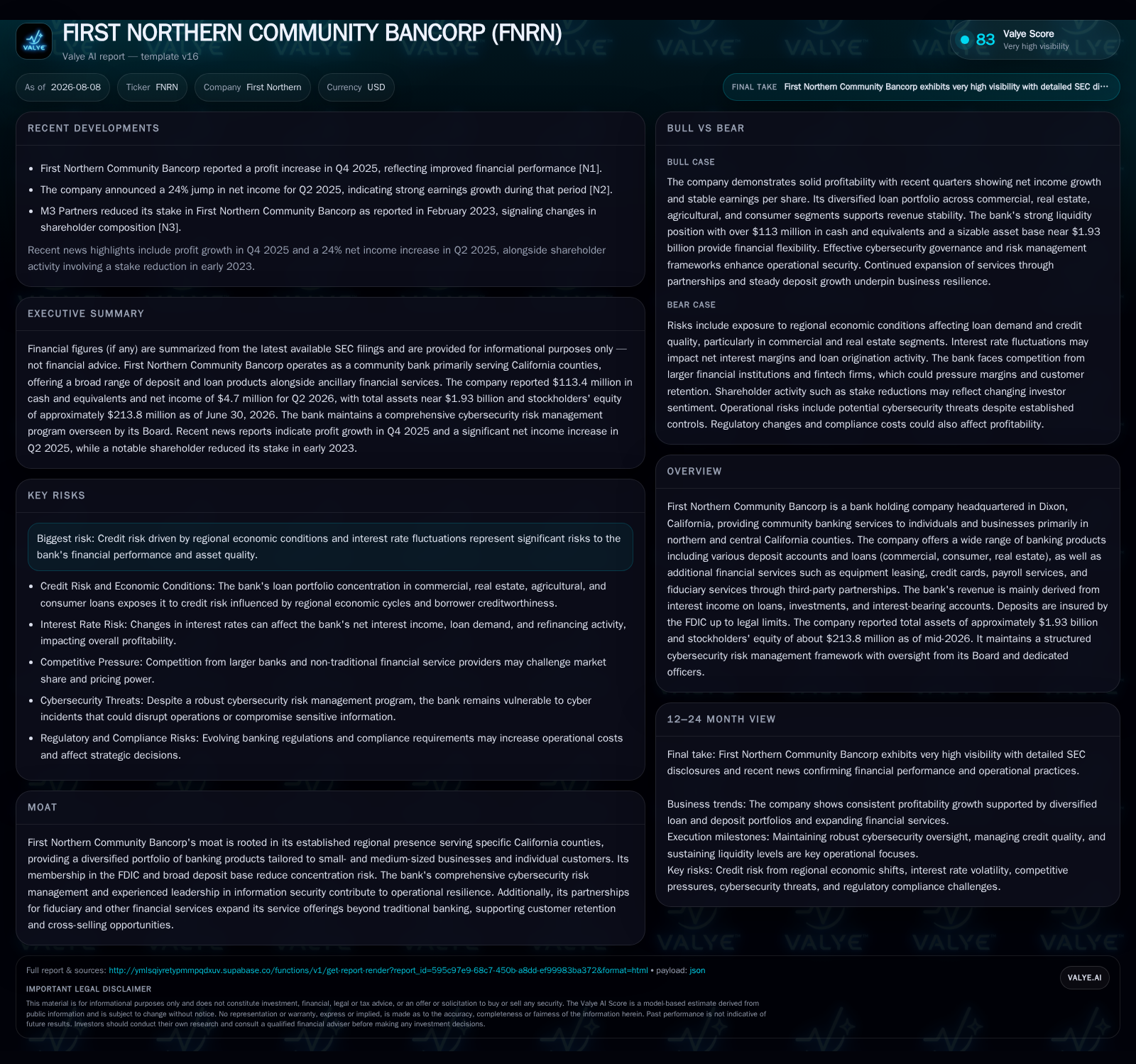
First Northern Community Bancorp's latest quarterly filing shows sustained asset quality and stable net interest income, underscoring the resilience of its community-focused banking model in northern and central California. The bank continues to balance a diversified loan portfolio with robust deposit growth, while maintaining zero debt on its balance sheet and a well-capitalized position. Credit risk remains the key watchpoint given regional economic dependencies. Its cybersecurity governance framework and expanded financial service partnerships further support operational stability and customer retention.
Recent Operating Update
First Northern Community Bancorp released its second-quarter 2026 Form 10-Q on August 7, 2026, providing fresh insight into its operating fundamentals and balance sheet strength. Total assets remained approximately $1.93 billion with stockholders’ equity at about $213.8 million as of June 30, demonstrating stable scale since year-end 2025 [S2], [F1]. The loan portfolio shows sustained diversification across commercial, consumer, real estate (both residential and agricultural), reflecting the bank’s commitment to serving small- and medium-sized businesses alongside individual customers within northern and central California counties [S1]. Importantly, the bank reports no outstanding debt as of December 31, 2025, maintaining a net cash position with cash and equivalents exceeding $113 million mid-year 2026—an indicator of liquidity strength uncommon among some peers [F1]. This strong liquidity likely supports flexibility in lending activities and cushioning against volatility.
On the income side, First Northern’s net interest income benefits from consistent loan demand coupled with careful management of available-for-sale investment securities without allowance for credit losses, underscoring stable asset quality during regional market conditions [S2]. The bank’s deposit base remains broad and insured by the FDIC up to legal limits, reducing concentration risk—a pillar for funding stability that supports the company’s intermediary role between savers and borrowers in its communities [S1], [F1].
Business Model Analysis
First Northern Community Bancorp operates within the archetype of a relationship-driven community bank. Its primary revenue source is net interest income—the difference between interest earned on loans/investments and interest paid on deposits. This is complemented by noninterest income derived from fee-based financial services such as fiduciary services via third-party partnerships, equipment leasing arrangements, credit card offerings, and payroll services tailored to local businesses [S1]. These ancillary revenue streams help diversify earnings but typically represent a smaller portion of total revenue compared to large regional or national banks.
The company monetizes through direct lending products: commercial loans supporting small- to medium-size enterprises vital to the local economies; consumer loans designed for individuals; various real estate loans including residential mortgages and agricultural property loans which align with the agrarian segments prevalent in its operating regions. Loan volumes fluctuate with local economic activity and underwriting prudence. Meanwhile, deposits come primarily from local households and businesses attracted by personalized banking relationships typical to community banks.
Margins depend heavily on managing the net interest margin (NIM), which is sensitive to interest rate changes and mix shifts between higher-yielding loans versus lower-yielding investments or cash balances. First Northern’s zero debt level removes leverage-related interest expenses seen in more leveraged peers but also indicates reliance on core deposits rather than wholesale funding—a conservative posture that can enhance credit ratings but may limit rapid scaling.
The company’s comprehensive cybersecurity risk management program led by an Information Security Officer with deep institutional experience provides operational resilience against growing digital threats—a necessity given increasing regulatory scrutiny on data protection in banking operations [S1]. The Board’s direct oversight ensures alignment between governance standards and strategic priorities in information security.
Industry Structure and Competitive Position
Operating within the community banking sector in California positions First Northern among regional players such as Bank of Marin Bancorp or Umpqua Holdings Corporation that emphasize local market proximity over broad national footprints. The community banking industry's intrinsic value lies in deep customer relationships enabling tailored credit decisions based on localized knowledge.
Unlike competing fintech lenders focusing on high-tech platforms but limited physical presence or larger regional banks leveraging scale advantages in technology investments, First Northern sustains customer intimacy bolstered by product breadth—from traditional loans to value-added financial services. This helps mitigate fintech disruption risks while offering cross-selling opportunities that improve retention.
Maintaining regulatory capital compliance without resorting to simplified community bank leverage frameworks speaks to prudent capital allocation priorities sustaining resilience under stress tests governed by federal agencies post-2008 crisis reforms [S1]
Growth Drivers
Key growth drivers for First Northern include:
- Regional Economic Expansion: Growth in northern and central California small business activity directly fuels demand for commercial loan products.
- Net Interest Margin Improvement: Rising interest rate environments can boost spread revenues if managed without significant deposit repricing mismatch.
- Deposit Base Expansion: Ongoing customer acquisition — both retail consumers seeking FDIC-insured accounts and business clients requiring transactional banking — supports incremental lending capacity.
- Cross-selling Financial Services: Leveraging fiduciary services partnerships alongside credit cards and payroll offerings raises fee income streams complementing interest revenues.
- Technology Adoption: Incremental enhancements to digital platforms improving client experience can deepen engagement levels critical for retention versus peers.
- Small Business Lending Focus: Targeted initiatives addressing underserved segments may enable selective market share gains where competitors have scaled back local presence.
These drivers align closely with standard community banking dynamics where sustainable growth depends less on volume alone but also on service quality differentiation enabled by deep customer intimacy.
Risks and Watchpoints
Despite these strengths, several structural risks bear monitoring:
- Credit Risk Concentration: Regional economic downturns impacting key industries could negatively affect asset quality metrics such as nonperforming assets ratio or necessitate higher loan loss provisions.
Annual guidance statements or interim press releases will help confirm whether macroeconomic headwinds materially impact underwriting standards or demand assumptions assumed during filing periods [S3]
Financial Profile Discussion
As of June 30, 2026, First Northern Community Bancorp held $113.4 million in cash and equivalents while reporting zero debt outstanding at year-end 2025—establishing a significant net cash surplus uncommon among many community banks that maintain some level of borrowings for liquidity management purposes [F1]. This conservative balance sheet configuration implies minimal interest expense burdens and underscores a strong liquidity position conducive for opportunistic lending growth without immediate external funding needs. Interest expense during recent quarters remained low consistent with this structure [S2].
Stockholders’ equity stood approximately at $213.8 million providing a healthy capital cushion supporting future asset expansion or absorption of potential credit losses without jeopardizing solvency metrics required under Basel III regimes enforced by U.S. regulators post-financial crisis reforms [S1]. The bank stated intentions not to elect the streamlined community bank leverage ratio framework but rather comply fully with standard capital adequacy measurements—an indication of conservative regulatory posture prioritizing long-term stability over short-term capital relief benefits [S1].
Operational efficiency reflected through measured expense control amid strategic investments in information security programs demonstrates disciplined cost management typical of seasoned community banks balancing technology upgrade needs while avoiding margin erosion [S1]
In aggregate, First Northern’s financial profile shows sound underlying fundamentals highlighting strong liquidity reserves, ample capitalization levels, minimal leverage exposure, diversified yet locally concentrated loan portfolio composition consistent with its focused community banking niche across northern California markets.
Disclaimer: This is research-only, informational analysis and not investment advice. It may include AI-generated interpretation and general industry context. Always verify important details using primary sources.

Comments