
Actinium Pharmaceuticals Strengthens Radiopharmaceutical Pipeline and Manufacturing Amid Regulatory Challenges
Recent quarterly filings highlight Actinium's focus on novel radiotherapy candidates with advancing manufacturing capabilities and ongoing regulatory complexities.
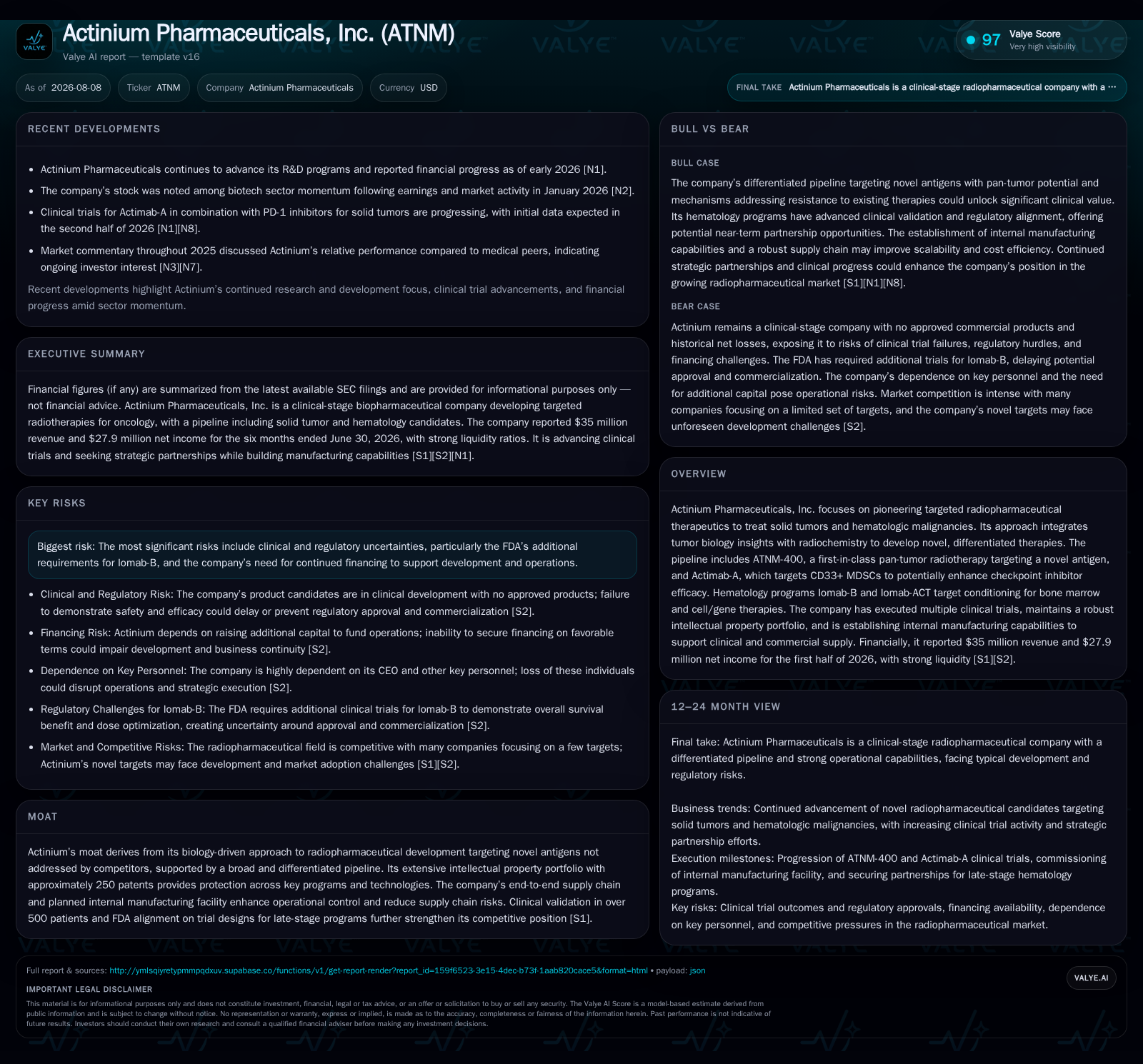
Actinium Pharmaceuticals, Inc. reported a net income turnaround in the first half of 2026 supported by its differentiated pipeline of targeted radiopharmaceutical therapies for solid tumors and hematologic malignancies. The company’s biology-driven approach targets novel antigens distinct from established competitors, enhancing competitive differentiation. Actinium is establishing internal manufacturing capabilities for Ac-225-based agents to augment supply chain control amid a generally complex regulatory environment that includes ongoing litigation and FDA scrutiny. Despite positive clinical progress, financing and regulatory uncertainties remain key challenges for sustained advancement.
Recent Operating Update
Actinium Pharmaceuticals’ latest quarterly report for Q2 2026 reveals a notable financial inflection point with reported net income of $22.4 million for the six-month period ending June 30, 2026, reversing previous multi-year net losses characteristic of clinical-stage biotechs [S2][F1]. This reflects milestone revenues linked to clinical progress and partnerships rather than commercial sales, as the company remains without FDA-approved products on the market. Despite limited commercial revenue history—a mere $90,000 recorded in 2025—the positive net income underscores improved operational leverage during advancing pipeline programs.
Concurrently, the company disclosed submission of a compliance plan to the NYSE American exchange following a notice of non-compliance with listing standards related primarily to shareholder equity thresholds. Management’s outlined remedial measures signal an important governance focus but also denote elevated execution scrutiny going forward [S3].
Business Model and Strategic Positioning
Actinium operates within the specialized biotech subsector of targeted radiopharmaceutical therapeutics—a high complexity area requiring integration of tumor biology insights with advanced radiochemistry to develop drugs delivering cytotoxic radiation precisely to cancer cells. The company monetizes through milestone payments from partnerships (notably with the National Cancer Institute), licensing arrangements, and ultimately aims for commercialization post-regulatory approval.
Its product pipeline reflects a differentiated biology-driven strategy oriented around novel antigen targets rather than crowded established niches. Lead candidates include ATNM-400, which targets a unique antigen distinct from PSMA (prostate-specific membrane antigen) thereby potentially addressing patients inadequately served by existing therapies like Novartis’ Pluvicto® [S1][S21]. Another core asset is Actimab-A targeting myeloid-derived suppressor cells (MDSCs) via CD33—thought to enhance checkpoint inhibitor responses—currently progressing under CRADA collaboration with NCI for various solid tumors and hematologic malignancies including AML/MDS [S1][S11]. Hematology-focused conditioning agents Iomab-B and Iomab-ACT target CD45 for preparative regimens in bone marrow transplants and emerging cell/gene therapy contexts; these programs benefit from clearer regulatory pathways given their advanced clinical readiness status following over 15 completed trials involving more than 500 patients [S1].
Revenue generation is principally anchored in achieving developmental milestones tied to trial progression or regulatory submissions/licensing, as commercial revenue remains nascent pending product approvals. This highly R&D-intensive model demands ongoing capital inflows supported by strong IP protections.
Industry Structure and Competitive Position
The competitive landscape features major pharmaceutical incumbents who have entered via acquisition or internal development—Novartis (Pluvicto®, Lutathera®), Eli Lilly, Bristol Myers Squibb—and numerous smaller firms pursuing radiopharmaceutical probands primarily directed at few dominant antigens such as PSMA, somatostatin receptor type 2 (SSTR2), and fibroblast activation protein (FAP) [S5][S21]. By contrast, Actinium’s unique focus on first-in-class targets with pan-tumor potential sets it apart, ostensibly reducing direct competition for its novel ATNM-400 antigen and hematology-focused antibodies.
Their robust intellectual property portfolio comprising roughly 250 patents covering product candidates as well as proprietary Ac-225 isotope production technology secures prolonged competitive moats beyond target novelty alone [S1][S22]. Notably, Actinium's proprietary cyclotron-based Ac-225 production technology offers high purity yields while avoiding contaminants prevalent in traditional thorium decay methods—this technological edge could translate into lowered costs and increased supply reliability versus external sourcing or peer approaches reliant solely on suppliers subject to global isotope scarcity challenges
Manufacturing also features strategic vertical integration uncommon among peers: construction of an internal radiopharmaceutical manufacturing facility specialized for alpha emitter handling is slated for commissioning in late 2026 [S22]. Combined with existing multi-source supplier agreements and contract manufacturing organization relationships spanning approximately 50 oncology centers across major metropolitan regions, this hybrid supply chain enhances resilience against disruptions—a critical factor given the sensitive nature of radioactive drug production and distribution complexities
Growth Drivers
Growth prospects hinge on several interrelated factors:
- Clinical advancement of differentiated pipeline candidates through pivotal Phase 2/3 studies that will determine regulatory approval viability and eventual market entry.
- Expansion of indications driven by pan-tumor applicability of novel antigen targeting beyond prostate cancer into NSCLC, breast cancer, AML/MDS, and other hard-to-treat cancers.
- Implementation of scalable internal manufacturing capability which can support late-stage trials transitioning into commercial supply improving margin profile versus outsourced reliance.
- Leveraging collaborations such as CRADA with NCI that not only fund development but confer scientific validation underpinning trial design robustness.
- Increasing validation of radiopharmaceutical modalities evidenced by blockbuster sales benchmarks like Pluvicto° ($2 billion sales in 2025), which signal strong market acceptance potential if Actinium’s products reach approval.
These drivers depend critically on execution milestones including patient enrollment completion rates in ongoing trials, Phase transitions confirmed by FDA feedback cycles, yield scaling at manufacturing sites, and protection from competitor entry afforded by patent defenses.
Risks and Constraints
Activating future growth faces substantial hurdles. Chief among these are clinical and regulatory uncertainties inherent in pioneering novel antigen targets in radiopharmaceuticals—complex trial protocols must adequately demonstrate safety/efficacy profiles acceptable to FDA standards which have lately imposed additional scrutiny especially around Iomab-B conditioning agents necessitating supplementary data submissions [S6][S23]
Financially, continuous financing remains imperative given sustained R&D expenses outpacing revenues though recent net income gains provide some cushion [S2]. Limitations under Form S-3 "baby shelf" filing restrictions may complicate capital raise timing or size potentially impacting runway or dilutive effects
Furthermore, litigation risks persist encompassing securities class action suits tied to prior disclosures about clinical trials (including motions pending decision) which impose operational distraction costs as well as reputational uncertainties [S20]. Dependence on key executives within a competitive talent marketplace poses an execution risk should retention or recruitment falter [S2][S4].
Manufacturing scale-up risks tied to novel captive facilities and isotope production may delay supply readiness impacting trial timelines or early commercial launches. The intricate supply chain dependencies on radioactive material logistics require meticulous regulatory compliance encompassing hazardous material handling laws adding cost layers and liability exposure [S17][S18]. Lastly, evolving healthcare legislative reforms aiming at drug price reductions could erode future reimbursement windows challenging eventual commercialization economics despite scientific breakthroughs.
What to Watch Next
Investors should monitor:
- Enrollment progression metrics for ATNM-400 and Actimab-A Phase 2/3 trials reflecting adoption velocity.
- Regulatory communications particularly FDA responses concerning additional data requests or trial design amendments impacting timing.
- Operational milestones regarding commissioning of internal manufacturing facility scheduled for second half 2026 indicating readiness for scalable supply.
- Cash flow statements illustrating burn rate aligned against milestone inflows evidencing financial sufficiency without onerous dilution.
- Outcome of pending litigation motions that may influence management bandwidth or stockholder confidence.
- Announcements related to strategic partnerships or licensing deals that may accelerate development cycles or share project risk.
Financial Profile Discussion
As of June 30, 2026, Actinium held $36.5 million in cash and equivalents against current liabilities approximating $9.3 million yielding a robust current ratio above 4.0—indicative of healthy short-term liquidity supporting near-term operations [F1]. Debt stands minimal at approximately $900,000 dating back to year-end 2019 underscoring low leverage levels permitting strategic financial flexibility. However despite recent net income positivity amounting to $22.4 million over H1 2026 compared with net loss in prior periods, the cash generation largely stems from milestone-related accounting recognition rather than recurring commercial sales given absence of product launch revenues [F1][S2]. Ongoing R&D expenditures remain substantial reflecting heavy investment required for continued clinical development typical within radiopharmaceutical biotech paradigms.
In summary, while Actinium’s balance sheet parameters show adequate liquidity positioning relative to liabilities permitting pipeline advancement without immediate financing distress risk remains due to prolonged development horizons intrinsic to its business model.
This analysis relies strictly on disclosed SEC filings through August 7, 2026 ([S1],[S2],[S3]) combined with financial snapshot data ([F1]). It does not encompass speculative forward-looking valuations or undisclosed corporate plans. The information herein is intended solely for analytical insights rather than investment guidance.
Disclaimer: This is research-only, informational analysis and not investment advice. It may include AI-generated interpretation and general industry context. Always verify important details using primary sources.

Comments