
California BanCorp Strengthens Strategic Footprint After Broadening Loan Portfolio
Q2 2026 results highlight diversified loan growth and deposit stability supporting BCAL’s community banking model amid evolving regional market dynamics.
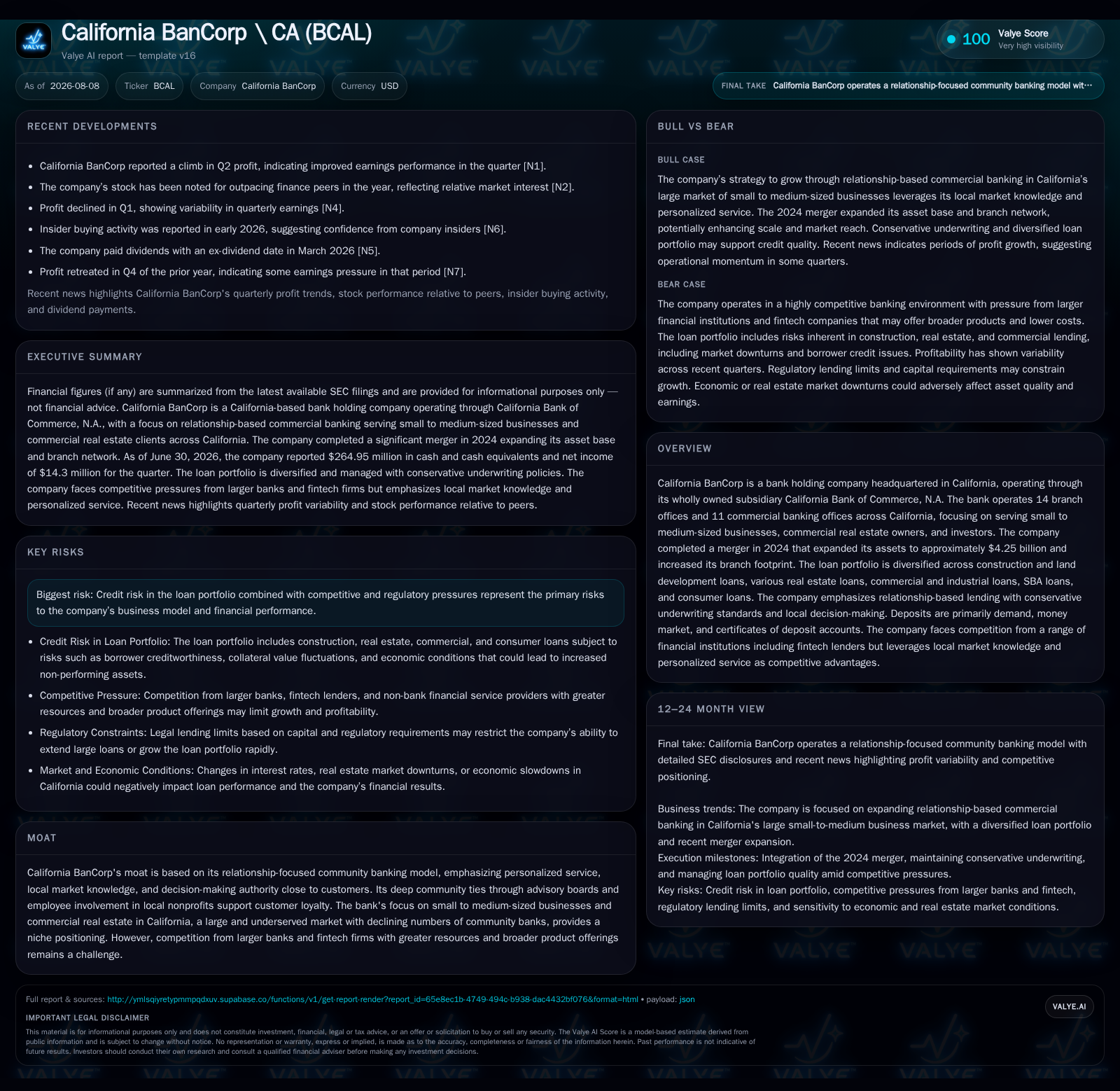
California BanCorp’s second quarter 2026 filing reveals steady expansion in its diversified loan portfolio alongside consistent deposit gathering, reinforcing its relationship-driven community banking presence in California. The bank maintains conservative credit risk management with stable allowance for loan losses coverage despite mounting uncertainties in the local real estate market. Following its 2024 merger-driven footprint increase, BCAL continues to leverage localized decision-making and branch expansion to sustain competitive positioning. However, the company remains exposed to risks from economic cycles, regulatory compliance obligations, and competition from larger banks and fintech entrants.
Second Quarter Operating Dynamics Signal Loan Portfolio Growth and Credit Discipline
California BanCorp (BCAL) reported a modest increase in its loan portfolio as of June 30, 2026, reaching roughly $3.095 billion in loans held for investment, up from $3.034 billion at year-end 2025 [S2]. This growth was underpinned by balanced expansion across key lending segments: construction and land development loans remained around $134 million while Commercial Real Estate (CRE) loans continued to form a substantial portion alongside growing Commercial & Industrial (C&I) and Small Business Administration (SBA) exposure. The inclusion of SBA loans adds a layer of diversification less correlated with CRE cycles. Notably, consumer lending also contributes to the portfolio mix but remains a smaller share compared to business-focused credits [S2][F1].
The bank's conservative underwriting approach is reflected in the allowance for credit losses which stands near $34.9 million—representing an allowance coverage ratio around 1.13% of loans held for investment [F1][S2]. Stability in this metric suggests management’s ongoing vigilance over credit risk amidst the cyclical uncertainty characterizing Californian commercial real estate markets. This compensates for BCAL’s material concentration in owner-occupied CRE collateralized loans where repayment depends on localized cash flow strength rather than broader real estate valuations alone [S1][S21]. The net interest margin (NIM) impact from loan mix shifts remains a critical barometer of franchise health given rising costs elsewhere in regional banking.
Relationship-Based Lending Powering Deposit Gathering Amid Competitive Pressures
BCAL’s funding base exhibits resilience with deposits hovering at $3.36 billion as of Q2 end—virtually flat sequentially but supported by strong retention within lower-cost transaction deposits including over $1.25 billion noninterest-bearing demand accounts [S2]. This deposit structure affirms the efficacy of relationship-based banking where clients maintain direct connectivity with local branches that offer quick access to decision makers. The product suite comprises demand deposits, money markets, savings accounts, and certificates of deposit (CDs), carefully tailored for California’s small-to-medium-sized enterprises (SMEs) that form BCAL’s core customer base [S1].
This depositor stickiness counters pressures from larger regional players offering scale-driven pricing benefits and fintech competitors applying technological efficiencies to challenge traditional deposit-gathering models. BCAL offsets this through its deep community integration — highlighted by advisory boards comprising local business leaders providing qualitative insights into regional economic conditions and facilitating client introductions. Employee participation in nonprofit organizations further embeds the bank within each served locale.
Loan Portfolio Diversification Shields Against Real Estate Market Volatility in California
The diversified composition of BCAL's loan book offers partial insulation against volatility typical of the Californian real estate sector. Construction and land development loans present elevated risk profiles due to dependence on project completions and fluctuating collateral values; these require stringent interest reserves during terms often lacking borrower payments [S19]. Exposure at approximately $134 million represents a relatively small fraction (~4.4%) of total loans but is closely monitored given potential for higher loss severity if markets soften.
Complementing this are CRE loans secured largely by owner-occupied properties with lower loan-to-value ratios capped near 75% based on independent appraisals [S21]. These lending criteria emphasize cash flow adequacy exceeding scheduled debt service payments by at least 125%, thereby mitigating default probability linked solely to collateral price swings. C&I lending extends financial support for operational needs or asset purchases with collateral often comprising short-term business assets rather than real estate alone.
Furthermore, SBA loans backed by government guarantees add a stable component less affected by commercial real estate cyclicality — offering a strategic lever within BCAL’s portfolio mix to smooth credit risk fluctuations over time [S1].
Branch Footprint Expansion Sustains Local Market Penetration Strategy After Merger Gains
Following the culmination of a transformative merger in July 2024 that expanded asset size to about $4.25 billion and supplemented branch presence across California, BCAL currently operates fourteen full-service bank branches alongside eleven commercial banking offices serving targeted regional markets [S1]. This expanded footprint enhances geographic reach across Northern and Southern California submarkets — critical for effective deposit gathering as well as origination of commercial lending relationships.
The physical branch network supports localized decision-making authority embedding credit adjudication close to borrowers—an attribute difficult for national or digital banks to replicate authentically. Peer mid-sized California community banks typically operate slightly fewer branches or have less comprehensive commercial office coverage post-acquisition; thus BCAL’s scale post-merger strengthens its position within its niche.
Credit Risk Framework Reflected in Allowance for Loan Losses Amid Economic Caution
Credit risk remains foremost among operating hazards given significant concentrations in CRE and construction exposures combined with local economic sensitivity [S1][S26]. BCAL maintains disciplined underwriting policies emphasizing thorough cash flow analysis, collateral appraisal prudence, personal guarantees from principal owners, and adherence to legal lending limits capped at 25%–35% of unimpaired capital depending on collateralization quality [S29].
Allowance for credit losses coverage remains stable despite a slight increase reflecting caution amid signs of softening property markets—particularly in speculative construction where forced sales risk is amplified due to project incompletion factors or lack of take-out financing commitments [S26]. Nonperforming assets remain closely tracked though detailed commentary on quarterly impairment trends was limited in the most recent filing.
Further conservative buffers arise from prudent capital adequacy levels meeting regulatory expectations as overseen by OCC supervision—a crucial safeguard enabling calibrated risk-taking without compromising solvency or raising liquidity stress concerns during downturn scenarios [S18]
Competition Landscape Includes Legacy Banks and Fintech — Implications for Niche Positioning
California BanCorp's community bank model faces dual competitive forces: large national banks offering broad product breadth including multi-channel digital platforms, extensive balance-sheet capacity, attractive treasury management products; alongside nimble fintech lenders utilizing lighter regulatory burdens and scalable digital underwriting solutions targeting small business segments more efficiently than traditional players [S1]
While BCAL leverages relationship depth via branch proximity and personalized services—factors appreciated especially by legacy SME customers—the tradeoff lies in scale economies absent at this mid-size level. Fintech lenders’ ability to undercut pricing or expedite approvals could erode some market share particularly within straightforward SBA or C&I product verticals.
Therefore, maintaining competitive advantage requires continued investments in local market intelligence tools coupled with expanding fee-rich services such as lockbox processing or remote deposit capture to enhance overall client value proposition beyond pure lending rate competition.
Growth Catalysts: SBA Lending Uptick, Fee Income Expansion, and Community Engagement Activities
Management highlights sustained growth opportunities linked to increased government-backed SBA lending volumes propelled by supportive federal programs aiming to stimulate California businesses—a favorable trend providing incremental revenue streams with mitigated loss characteristics [S2]
Additionally, fee income growth is targeted through treasury services enhancement encompassing analyzed accounts catering specifically to business clients intent on improving cash management efficiency—delivering sticky revenue sources relatively insusceptible to interest rate headwinds.
Community involvement remains deeply integrated via formal advisory boards whose members generate new referral flows while providing timely economic intelligence aiding underwriting judgment calls—strengthening the moat grounded on trust developed over decades among stakeholders embedded within Californian local economies.
Risks Center on Local Economic Downturns, Regulatory Compliance Burden, And Credit Concentrations
Risks articulated within official disclosures stress potential adverse impacts from an economic slowdown confined primarily within California reducing borrower repayment capacity especially concentrated among smaller businesses reliant on local commerce vitality [S1][S2]
Concentrated exposure towards CRE projects poses loss amplification risk if property valuations falter precipitously triggering nonperforming loan inflows beyond current allowance buffers. Regulatory compliance complexity also weighs heavily given evolving requirements encompassing capital ratios adjustments, anti-money laundering statutes enforcement escalation, information security mandates exposing operational vulnerabilities should failures occur.
Liquidity risks are monitored prudently though presently mitigated by stable core deposit bases; nevertheless unexpected rapid withdrawals amplified by social media or adverse news might strain funding elasticity necessitating reliance on more expensive backup sources such as Federal Home Loan Bank advances currently unused but available under secured agreements totaling upwards of $800 million capacity if needed [F1][S7][S18]
"Key Developments to Monitor: Dividend Stability, NIM Trends, Credit Quality Metrics" — What Investors Should Watch Next
Investors should track upcoming dividend payout slated for October 15, 2026 following board approval maintaining $0.12 per share latest quarter level—signaling confidence amidst cautious macro backdrop but constrained capital flexibility given subordinated debt obligations coming into variable rate resets later this year [S3][S28]
Net interest margin trajectory will serve as a bellwether indicating how interest rate movements combined with evolving deposit costs affect profitability—especially if competitive pressure forces yield compression across CRE or SBA portfolio components.
Credit quality indicators such as net charge-off rates versus provision levels will also be critical confirming whether conservative underwriting maintains efficacy during anticipated market headwinds affecting Californian SMEs reliant on cyclical commercial real estate sectors.
Monitoring these key metrics paired with execution on branch penetration initiatives can reveal foundational resilience essential for sustaining growth within an increasingly competitive regional banking landscape.
Financial Profile Discussion
Disclaimer: This is research-only, informational analysis and not investment advice. It may include AI-generated interpretation and general industry context. Always verify important details using primary sources.

Comments