
ONE Group Hospitality’s Q2 Highlights Expose Margin Strain Amid Liquidity Pressures
Latest quarterly filing reveals ongoing operational losses and liquidity challenges despite steady unit growth and menu pricing adjustments.
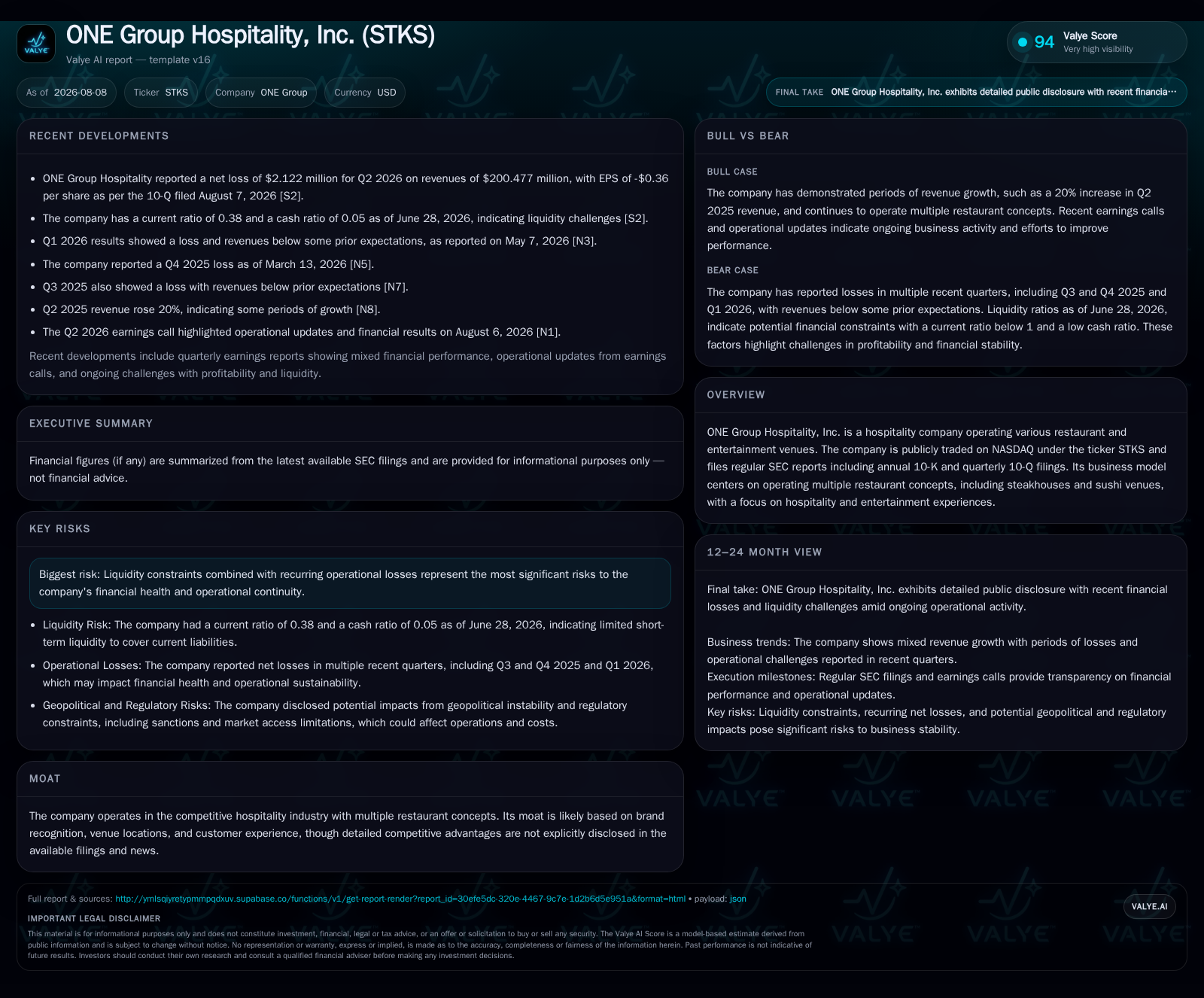
ONE Group Hospitality reported operational losses alongside tightening liquidity in its second quarter of 2026 despite continued expansion across its multi-concept portfolio including STK steakhouses and Benihana venues. The company's revenue growth driven by unit additions and menu price increases is offset by margin compression from labor and commodity inflation, pushing a current ratio notably below 1. Strategic execution risks remain elevated amid debt obligations and competitive pressures typical of the full-service upscale restaurant sector. Monitoring same-store sales trends, operating margins, and liquidity developments will be key to assessing recovery prospects.
Q2 Operating Performance Signals Margin Pressure and Cash Stretching Risks
ONE Group Hospitality's latest quarterly filing for the period ending June 28, 2026, spotlights ongoing operational challenges despite continued expansion efforts. While top-line revenue continues to grow primarily via increased unit count, the company disclosed net operating losses during the quarter coupled with a strained liquidity profile [S2][N1]. A key warning sign is the current ratio of approximately 0.38 as of quarter-end, indicating that current liabilities substantially exceed current assets and raising immediate concerns over working capital sufficiency [F1].
This low liquidity ratio suggests pressure on meeting short-term obligations without additional financing or significant cash flow improvements. Operating income has been challenged by rising labor costs and commodity inflation impacting food and beverage input prices; these costs appear to erode restaurant-level margins despite partial offsetting through menu price increases [S2][N1]. The combination of fixed lease commitments inherent in venue operations further compresses financial flexibility, as these mostly fixed costs do not scale down with volume declines.
Multi-Concept Venue Footprint: How ONE Group Balances Scale with Operational Complexity
The company’s business model centers around operating a multi-brand portfolio comprising upscale steakhouse (STK), Japanese dining experiences (Benihana), sushi-focused (RA Sushi), and casual grill concepts (Kona Grill). According to the latest annual filing, ONE Group operates a total of 158 venues globally—including company-owned, managed, franchised, and licensed locations—with expansion plans primarily focused on markets favorable to discretionary dining spending [S1].
The blend of ownership types affords some capital-efficient growth levers via food & beverage management agreements and franchise fees; however, a significant portion of revenue still comes from company-owned restaurants requiring substantial upfront investment and ongoing fixed cost absorption [S1]. This model exposes ONE Group to operating leverage constraints typical of full-service hospitality operators, particularly when comp store sales are soft or flat. Venue size also influences cost structure complexity; for example, STK locations average over 10,000 square feet with corresponding staffing needs and rent expense profiles far exceeding smaller footprint operations
Pricing Strategy and Consumer Traffic Trends Under Inflationary Pressures
To manage sustained commodity inflation—driven by volatile meat, seafood, and produce prices—the company has incrementally raised menu prices across concepts aiming to preserve gross margins without overly suppressing customer traffic [S1][N1]. However, this tradeoff remains delicate: while average check per customer has risen moderately with pricing actions (e.g., owned STK venues report average checks around $129), guest traffic figures exhibit vulnerability to higher price points potentially deterring discretionary visits in uncertain economic conditions [S1][N1].
The challenge lies in balancing throughput alongside maintaining price elasticity in premium segments where consumers have alternatives. Labor inflation further aggravates margin pressure since wage costs represent a high proportion of total operating expenses in large-format venues that rely on extensive service staff. Sustained inflationary headwinds combined with gradual consumer spending shifts could perpetuate structural margin compression absent successful operational efficiency gains or customer experience enhancements.
Competitive Environment: Peer Set Benchmarking Highlights Pricing and Throughput Challenges
ONE Group operates within a crowded full-service restaurant industry segment characterized by intense competition on price, service quality, location desirability, and brand experience. Multi-concept peers such as Darden Restaurants benefit from broader scale economies allowing more effective menu innovation investment and cost control systems. Upscale steakhouse peers like Del Frisco’s Restaurant Group similarly leverage established reputations translating into greater pricing power.
In contrast, ONE Group's smaller scale footprint limits bargaining power with suppliers—evident in their disclosure that no single food supplier exceeds only about 13% of purchases—while higher concentration in select cities raises regional economic sensitivity [S16][S26]. Brinker International’s casual dining focus highlights alternative unit growth strategies emphasizing faster rollout but lower average check sizes than premium brands.
Drivers Behind Unit Growth Versus Same-Store Sales Dynamics
Recent expansions have materially contributed to overall revenue increases for ONE Group rather than robust same-store sales growth alone [S1][N1]. The company opened seven new venues in 2025 across multiple concepts while focusing small-dollar capital investments ($1.5 million or less per new owned site) alongside leveraging licensing deals—particularly notable is an asset-light agreement targeting ten Benihana locations in the San Francisco Bay Area
While unit growth supports throughput gains scaling fixed costs such as rent and administrative overheads broadly across the portfolio, earnings remain vulnerable to fluctuations in comparable store sales performance which reflect underlying customer engagement. Weakness in same-store sales would dampen expected operating leverage benefits from new venue rollouts given persistent base-level expenses linked to staff wages and utilities. Future success thus hinges on balancing pipeline conversions with sustained comp store traffic metrics.
Risks From Debt Levels and Liquidity Constraints Threaten Recovery Pathway
The company’s financial position displays noteworthy risks stemming from elevated debt levels combined with limited cash reserves—$6.36 million in cash against an estimated total debt north of $48 million as per most recent available data—with net debt over $41 million posing refinancing uncertainties [F1]. Fixed lease commitments dominate operating expenses exposing ONE Group to inflexible cost structures against variable consumer demand cycles particularly sensitive during economic downturns or discretionary spending pullbacks. Any delays or inability to refinance maturing obligations or obtain credit facility extensions could force restructuring decisions detrimental to growth plans or jeopardize lease renewals pivotal for site continuity [S20][N1].
'What Investors Should Watch': Upcoming Milestones and Performance Indicators
Key operational milestones to monitor include timing and scale of planned new venue openings within their existing leased pipeline plus performance outcomes for recent launches exhibiting initial traffic patterns [N1]. Additionally, management’s communication regarding improvements in restaurant-level operating margins—with focus on containing labor cost ratios amid wage inflation—and capturing sustainable same-store sales growth will provide signals about operational turnaround capability.
Progress on loyalty program initiatives or digital ordering capabilities could also serve as differentiators enhancing customer retention metrics critical in the competitive upscale casual segment.
Financial Profile Discussion: Liquidity Crunch Undermines Operating Gains
As of June 28, 2026, cash and equivalents stood at approximately $6.36 million against current liabilities exceeding $124 million resulting in a distressingly low current ratio of roughly 0.38—a stark measure underscoring strained near-term liquidity dynamics [F1]
Disclaimer: This analysis is based solely on publicly available documents filed with the SEC and related news disclosures as of August 2026. It does not constitute investment advice or research views.
Disclaimer: This is research-only, informational analysis and not investment advice. It may include AI-generated interpretation and general industry context. Always verify important details using primary sources.

Comments