
Skyward Specialty Insurance Advances Niche Underwriting With Strategic Acquisition and Improving Loss Metrics
The latest quarterly disclosures highlight Skyward’s underwriting discipline, reinsurance strategy, and integration progress in a competitive specialty insurance market.
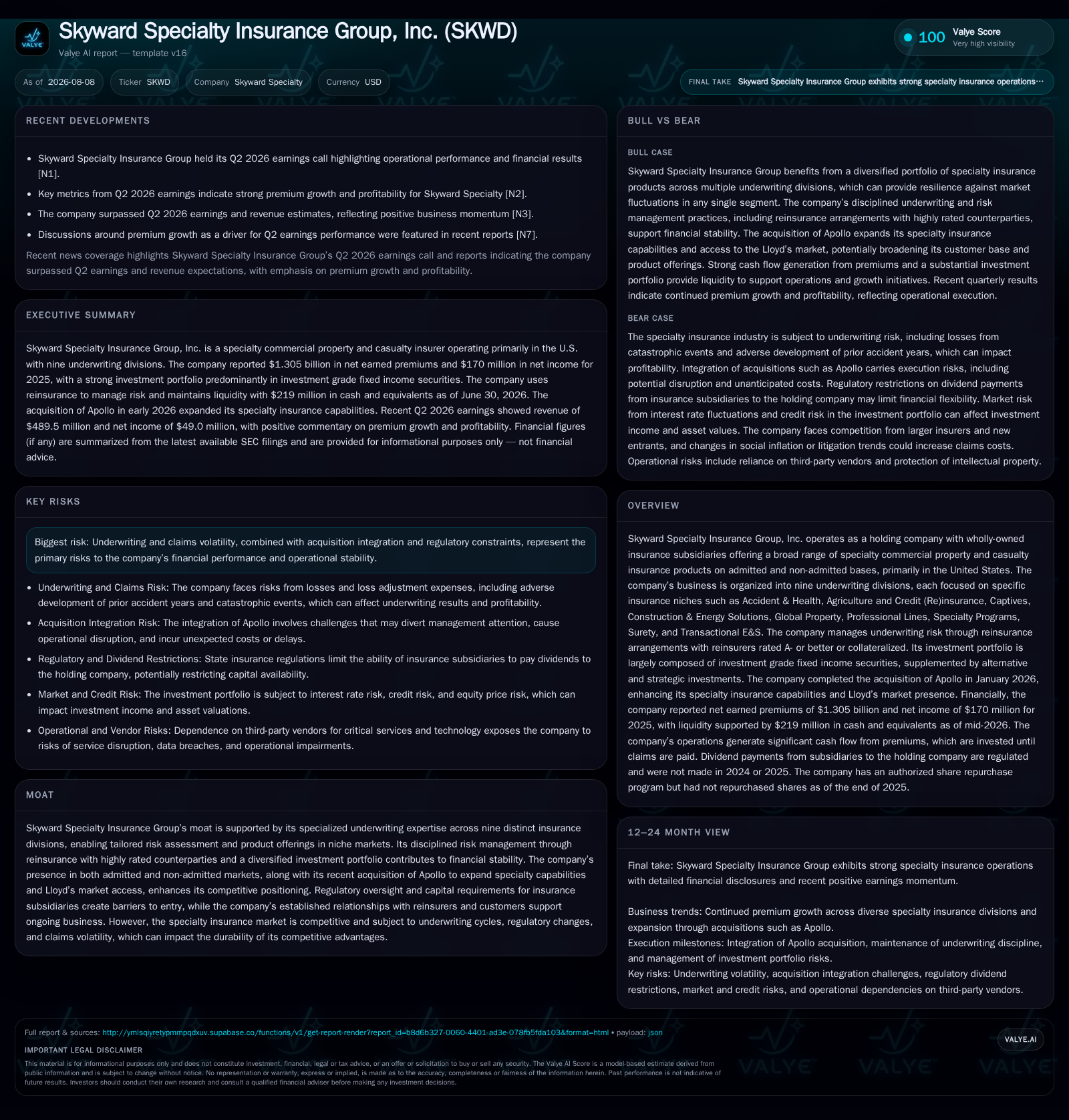
Skyward Specialty Insurance Group, Inc. leverages its nine underwriting divisions to target niche commercial specialty risks across admitted and non-admitted markets. Its Q2 2026 results reflect stable underwriting discipline with improved loss ratios and ongoing integration of the Apollo acquisition enhancing product breadth and Lloyd’s market access. Key growth drivers include expanded specialty capabilities and disciplined reinsurance arrangements with highly rated counterparties, while risks remain tied to claims volatility and regulatory complexity. Monitoring reserve development, premium growth in targeted divisions, and investment income will be critical for assessing execution ahead.
Recent Operating Update: Stabilizing Underwriting Amid Integration
Skyward Specialty Insurance Group’s Q2 2026 filing reveals a company executing its strategy with stabilized underwriting results alongside advancing acquisition integration. The reported Management Discussion highlights favorable reserve development related to prior accident years that helped improve the combined loss ratio compared to prior periods [S2]. This aligns with management commentary on disciplined pricing and selective risk appetite across its niche insurance segments. The August 4 event filing repeated results disclosure without signaling material changes but reaffirmed commitment to leveraging acquired specialty platforms such as Apollo [S3].
This recent quarter solidifies early signs of improved loss experience that partially offsets the historical volatility typical for companies operating substantial specialty lines portfolios focused on complex commercial risks.
Business Model: Multi-Divisional Specialty Underwriting With Reinsurance Discipline
Skyward operates through nine distinct underwriting divisions targeting specific niches including Accident & Health, Agriculture and Credit (Re)insurance, Captives, Construction & Energy, Global Property, Professional Lines, Specialty Programs, Surety, and Transactional Excess & Surplus (E&S) solutions [S1]. This segmentation enables deep expertise within each vertical to underwrite unique risk profiles that generalist insurers often avoid.
Revenue primarily derives from premiums collected from policyholders via brokers, agents, and program administrators. These are predominantly commercial clients seeking tailored coverage for exposures ranging from construction defects to captive insurance arrangements for corporate groups. Premiums represent gross written premium less ceded amounts to reinsurers. Net earned premium then yields the basis for loss ratio measurement.
Policy retention rates vary across divisions but retaining profitable renewal business is vital for long-term margin sustainability. Expense ratios integrate acquisition costs (commissions), underwriting expenses, general administrative charges, all absorbed in delivering specialized customer service.
To manage inherent underwriting risk exposure in volatile segments with potential large losses—such as surety or energy projects—the company relies heavily on reinsurance arrangements with reinsurers rated at least A- or backed by collateral. This protects capital adequacy while stabilizing earnings across cycles.
Investment income serves as an important complement to underwriting profitability especially during soft market conditions where premium pricing pressure may intensify.
Industry Structure: Navigating the Specialized Insurance Ecosystem
The specialty insurance industry synthesizes tailored underwriting innovation with strict risk-selection discipline within a highly cyclical environment marked by fluctuating claim frequencies and severities. Companies like Skyward compete alongside established peers—Chubb Limited, W.R. Berkley Corporation, RenaissanceRe Holdings, AXIS Capital Holdings—that either combine specialty insurance with reinsurance or focus heavily on E&S lines for complex risks.
Distribution channels remain broker-centric given the complexity of specialty policy placement requiring expert negotiation around coverage forms and pricing flexibility. Program administrators also act as intermediaries providing operational scalability.
Regulatory oversight affects admitted market operations requiring solvency margins and filings whereas non-admitted E&S lines offer more product freedom at higher risk tolerances but must compensate buyers with capacity breadth.
Reserve adequacy continues to be a focal metric industry-wide reflecting claims emergence timing challenges especially for latent or long-tail loss exposures common in professional liability or construction defect classes.
Growth Drivers
Skyward's growth hinges on multiple factors:
- Leveraging Apollo acquisition expands Lloyd’s market access allowing writing international risks and introducing complementary expertise enhancing product mix diversification [S1]
- Penetrating growing niche segments like construction & energy solutions where higher complexity supports premium pricing power
- Pursuing both admitted regulated markets for blue-chip accounts alongside flexibly priced excess & surplus lines capturing emerging or hard-to-place risks broadens market reach
- Continuous refinement of data analytics enhances underwriting accuracy reducing loss ratio variability
- Maintaining strong reinsurer relationships ensures continued risk appetite support crucial amid competitive market conditions
- Incremental investment income generation supplements margins particularly if interest rates remain favorable
Risks and Watchpoints
Key risks include:
- Underwriting volatility arising from mispriced risks or unexpected claim emergence can materially impact combined ratios given specialty exposure profiles [S1]
- Reserve inadequacy or adverse development remains an ever-present danger warranting close actuarial scrutiny; recent quarters showed improvement but always warrants forward vigilance
- Dependence on third-party reinsurance needs continuous evaluation given counterparty credit exposures; inability to secure favorable terms could constrain growth or elevate capital costs
- Regulatory complexities may hamper some operational agility especially for admitted business sensitive to state-level changes
- Competitive pressures via brokers/program managers can compress margins if client options increase without commensurate value differentiation
- Integration challenges post-Apollo acquisition could disrupt operational efficiencies or cultural cohesion if not managed proactively
- Investment portfolio carries interest rate risk amid evolving macroeconomic conditions potentially impacting net investment income contribution
What To Watch Next
Investors and stakeholders should focus on several measurable milestones:
- Quarterly net earned premium trends by division indicative of successful new business capture versus retention dynamics
- Combined ratio trajectory specifically evolution of loss plus expense ratios reflecting underwriting discipline sustainability
- Reserve development patterns each quarter signaling actuarial adequacy progress or emerging issues
- Reinsurance renewal terms disclosures which may affect cost structure or retained limits
- Integration cadence updates around Apollo synergy realization including Lloyd’s platform utilization
- Net investment income trends in context of changing fixed income yields or alternative asset performance
- Regulatory developments impacting either admitted licensing or E&S line market participation
Monitoring these KPIs will chart Skyward’s path toward establishing durable profitable growth while managing inherent volatility typical of the specialty insurance sector.
Financial Profile Discussion
As of June 30, 2026, Skyward reported cash and equivalents totaling approximately $219 million providing liquidity flexibility to support ongoing operations including premium growth funding and claims settlement obligations [F1]. The absence of new debt disclosures in recent filings suggests a conservative leverage posture consistent with industry norms prioritizing balance sheet strength given regulatory capital demands.
In summary, Skyward Specialty Insurance combines focused niche commercial underwriting expertise supported by strong reinsurer relationships and progressive capability expansion via strategic acquisitions like Apollo. While challenged by inherent claim volatility risks typical in specialty lines segments and external regulatory pressures, the company is positioning itself with diversified offerings across multiple verticals paired with improving reserve metrics. Execution monitoring around premium growth trajectories, combined ratio trends, reinsurance renewals, reserve developments, and integration milestones will reveal how effectively management navigates competing demands toward sustainable performance.
Disclaimer: This is research-only, informational analysis and not investment advice. It may include AI-generated interpretation and general industry context. Always verify important details using primary sources.

Comments