
Cadre Holdings Expands Through Acquisitions and Innovation Amid Government-Driven Demand
Cadre Holdings advances its leadership in safety equipment by leveraging acquisitions, product innovation, and a broad distribution network focused on government and responder markets.
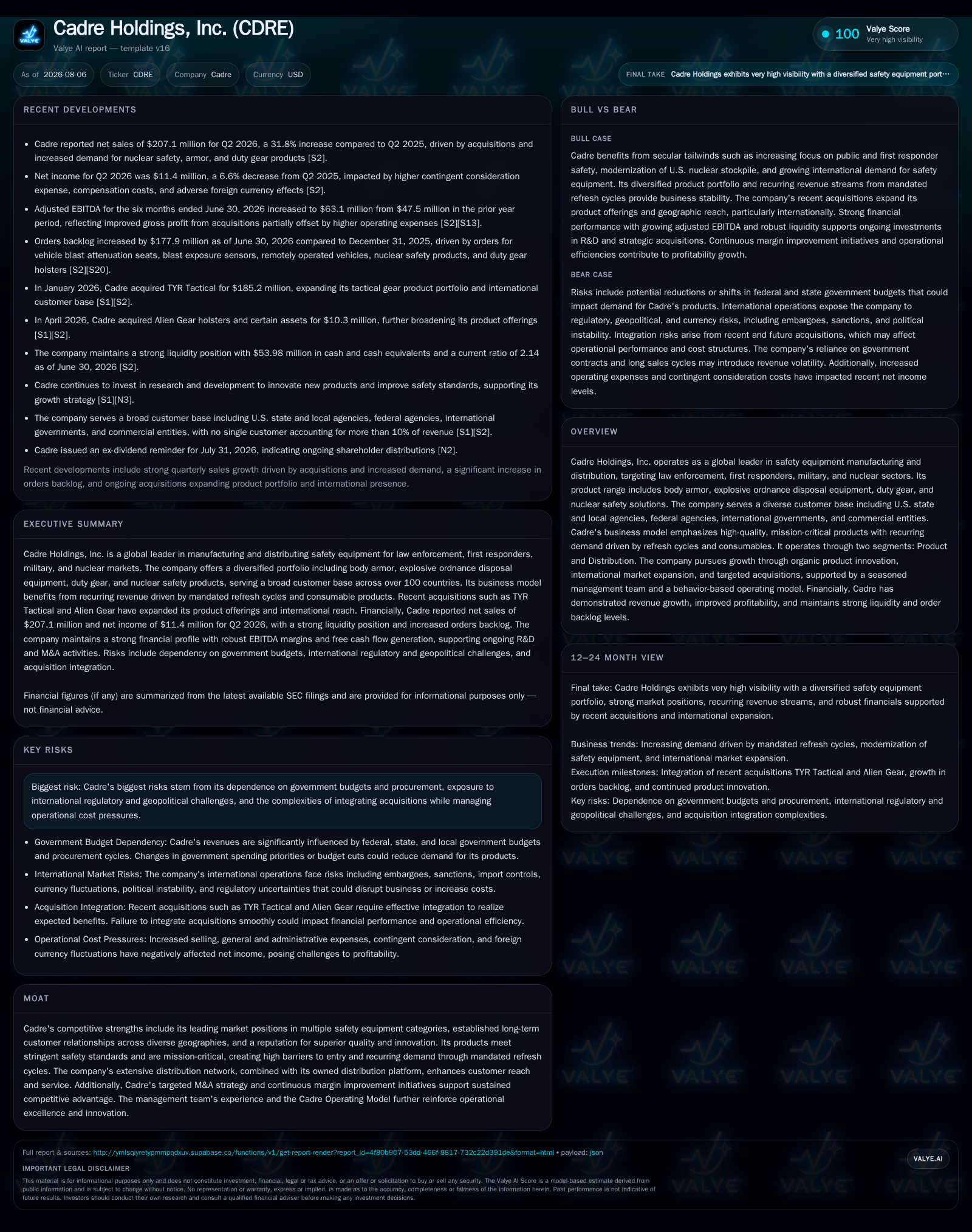
In its latest quarterly filing, Cadre Holdings continues to solidify its position as a premier global supplier of mission-critical safety equipment for law enforcement, military, first responders, and nuclear sectors. The company’s strategy emphasizes organic growth through technological advancement and targeted acquisitions like TYR Tactical and Alien Gear holsters, which broaden product offerings and enhance geographic reach. Recurring demand is supported by mandated equipment refresh cycles across government clients worldwide. While Cadre benefits from strong customer relationships and rigorous safety standards, it faces risks tied to government budget cycles, acquisition integration challenges, and geopolitical complexities.
Recent Operating Update
ing many contracts [S3].
Business Model Analysis
Cadre Holdings operates at the intersection of manufacturing and distribution of specialized safety equipment designed primarily for mission-critical applications involving law enforcement officers, first responders such as explosive ordnance disposal technicians (EOD), military personnel, and nuclear industry customers. The core products include body armor with ballistic protection capabilities, EOD containment gear that requires high technical performance standards, duty gear including holsters and uniforms, as well as nuclear safety solutions addressing compliance with regulatory demands around radioactive materials handling [S1][S2].
Revenue is generated chiefly through direct sales contracts with U.S. state and local agencies (including police departments), U.S. federal agencies such as DoD components (Army, Navy, Air Force), DoJ, DHS, DoE along with international governments spread across more than 100 countries [S1][S21]. Commercial sales via e-commerce platforms add a smaller but complementary revenue stream. A unique competitive advantage arises from Cadre’s ownership of a distribution platform serving as a one-stop shop that supplies both proprietary products manufactured in-house as well as third-party gear like boots, firearms accessories, optics, ammunition — enhancing customer convenience and retention [S1][S21].
Recurring revenue characteristics are anchored by mandated product refresh cycles which require frequent replacement or modernization of protective equipment to maintain efficacy against evolving threats and regulatory standards. Additionally, consumables such as spare parts or maintenance kits generate aftermarket demand adding to revenue stability. Pricing power is supported by the high technical standards products must meet combined with direct relationships that create switching challenges for customers reliant on mission-critical gear.
Industry Structure and Competitive Position
The safety equipment manufacturing sector is characterized by high barriers to entry due to stringent safety certifications needed for body armor or EOD products plus complex procurement dynamics involving lengthy public-sector bidding processes. Cadre’s scale positions it among market leaders who can invest substantially in R&D while managing complex supply chains optimized through continuous margin improvement initiatives including lean manufacturing practices and supply chain rationalization [S1][S19]
Its peers typically include other PPE manufacturers servicing law enforcement and military sectors such as Armor Holdings competitors or firms focusing on personal protective apparel integrated with advanced materials technology. What sets Cadre apart is its balanced vertical integration — combining owned manufacturing capabilities alongside an extensive distribution network capable of delivering a broad portfolio of both proprietary and third-party products directly to end users enhancing channel penetration.
The company also leverages targeted M&A to supplement organic growth — broadening offerings into adjacent tactical gear fields or geographies while relying on operational expertise to integrate acquisitions efficiently without eroding margins substantially [S19]. Its diversified customer base reduces exposure concentration risk; no single customer accounts for over 10% of revenues which spreads procurement risk across multiple government segments domestically and internationally.
Growth Drivers
Multiple structural factors underpin long-term demand for Cadre’s offering:
- Sustained government safety mandates require regular replacement of tactical body armor or hazardous material handling equipment ensuring recurring purchase cycles.
- Technological advancements drive end-user demand for newer lightweight ballistic materials or innovative EOD containment solutions facilitating market share gains amongst agencies upgrading legacy inventory.
- Increasing international security concerns expand opportunity funnels into global markets where Cadre already sells into over 100 countries via direct agency contracts or distribution partnerships.
- Strategic acquisitions extend product line breadth (as exemplified by TYR Tactical acquisition) allowing penetration into new market niches within tactical apparel.
- Rising regulatory emphasis on worker health & safety coupled with public scrutiny ensures persistent market focus on premium certified protective gear.
- The integration of owned distribution platforms enhances customer engagement through bundled product offerings improving average order size while reducing channel friction.
Risks and Watchpoints
Despite these tailwinds Cadre faces notable risks:
- Dependence on variable government budgets exposes revenue visibility to cyclical fiscal policy changes at municipal, state, federal levels especially amidst economic uncertainty or shifting political priorities.
- Acquisition integration presents operational hazards; ineffective melding of acquired businesses could disrupt supply chains or inflate SG&A diluting profitability.
- Product liability risk is intrinsic given life-and-death scenarios reliant on product performance; ongoing insurance costs coupled with potential litigation claims pose earnings volatility threats.
- Global geopolitical tensions can affect international trade policies influencing sales to certain regions or exposing the supply chain to tariffs impacting cost structures.
- Raw material inflationary pressures—such as specialty textiles or metals—may erode gross margin unless offset by pricing adjustments.
- Rapid technological obsolescence mandates continuous R&D investment; failure to innovate could cede ground to competitors developing next-generation protective solutions.
Monitoring backlog trends — an indicator informing future revenue prospects — will be critical alongside contract renewal rates within core government accounts. Additionally tracking margin progression post-integration will shed light on operational execution effectiveness.
What to Watch Next
Key upcoming milestones include:
- Updates on Q3 operating performance particularly orders backlog fluctuations indicating demand strength amidst budget cycles.
- Progress reports from newly acquired entities regarding product launch synergies or distribution channel expansions.
- Further margin enhancement efforts via cost optimization programs announced historically remain KPIs for profitability sustainability.
- Any breakout in international contract wins or expansion into emerging defense/security markets could accelerate growth trajectory.
- Management commentary on exposure mitigation strategies related to geopolitical risks or raw material cost volatility would clarify risk management stance.
Continued evolution in R&D spending aimed at technical certification upgrades across product lines will serve as an important innovation barometer tracking future competitive positioning.
Financial Profile Discussion
As of June 30, 2026, Cadre held $53.98 million in cash equivalents against current liabilities approximating $162.4 million yielding a current ratio of about 2.14 — indicating comfortable near-term liquidity supported by operating cash flows and available credit facilities [F1]. Total debt stood at approximately $131.6 million as of September 30, 2023, with net debt around $77.6 million at that date [F1].
Profitability metrics reveal operating income at approximately $67 million at latest annual reporting date with net income near $44 million reflecting steady margin improvements aided by scale economics and cost control measures implemented post past acquisition waves [F1][S1]. Adjusted EBITDA shows upward momentum driven by contributions from acquired firms balancing incremental SG&A increases necessary for successful integration efforts [S18].
Cash flow generation appears adequate against capital expenditure needs primarily targeting manufacturing automation investments underscoring commitment to continuous operational refinements fostering margin resilience amid competitive pricing challenges common within PPE manufacturing broadly.
This analysis synthesizes filings through August 5, 2026 ([S1]-[S3], [F1]) combined with sector knowledge relevant to industrial hardware providers focused on mission-critical safety gear serving public-sector markets globally. It aims solely to provide informed insights without suggesting investment actions or price expectations.
Disclaimer: This is research-only, informational analysis and not investment advice. It may include AI-generated interpretation and general industry context. Always verify important details using primary sources.

Comments