
ThredUp Advances U.S. Apparel Resale with Stable Margins and RaaS Expansion
ThredUp's Q2 2026 results emphasize growing marketplace scale, technology-driven efficiencies, and cautious cost management amidst liquidity constraints.
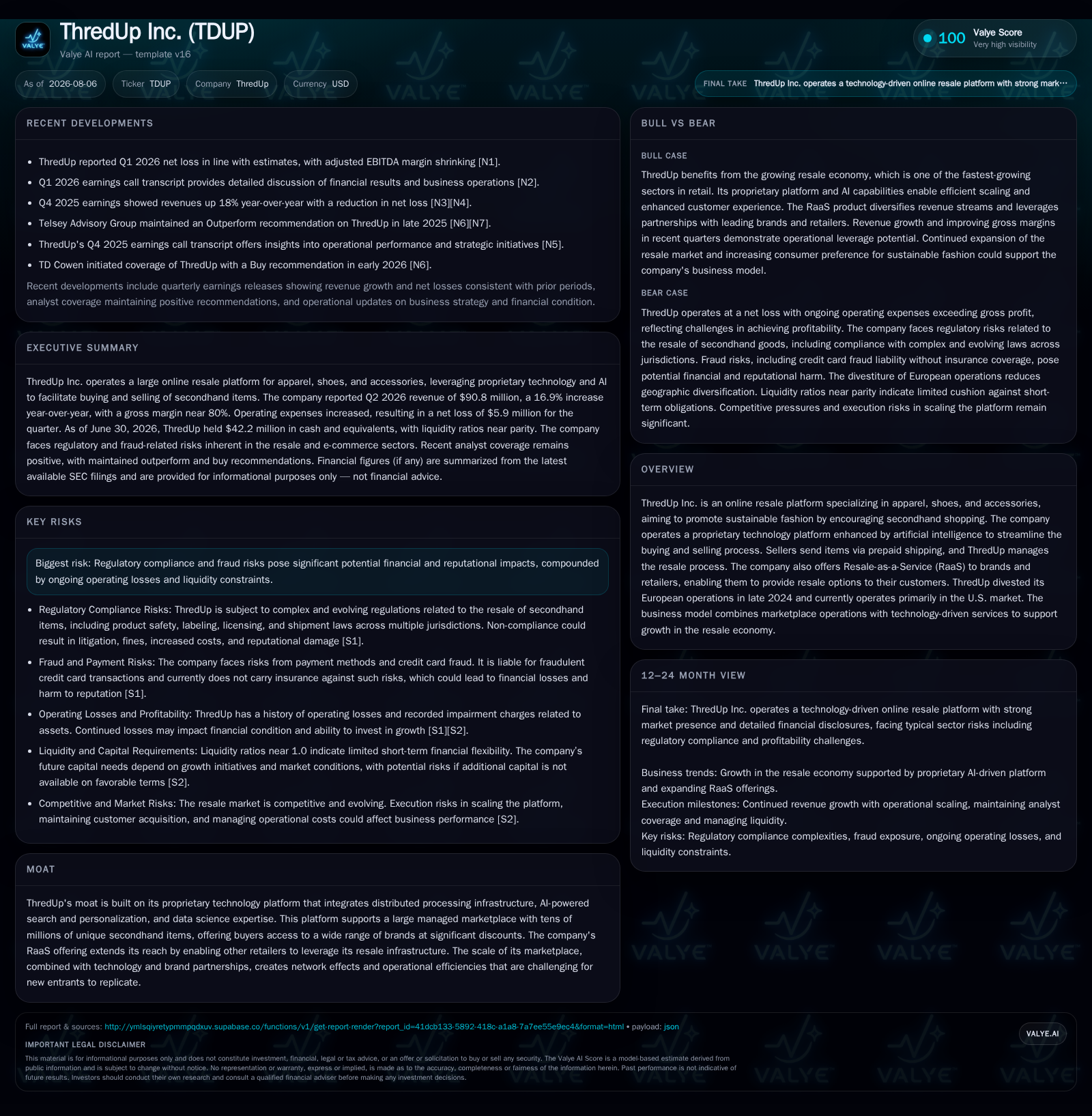
ThredUp Inc. reported solid growth in revenue and buyer engagement for the second quarter of 2026, driven by its AI-powered resale platform targeting sustainable fashion consumers in the U.S. The company’s gross margins remain stable near 80%, supported by an integrated marketplace and scalable Resale-as-a-Service offerings to retail partners. Incremental volume has pushed operations and technology costs higher but reflects investments in fulfillment capacity and personalization tools. Liquidity is balanced with $42 million cash against $18 million debt, preserving runway amid ongoing losses. The divestiture of European operations has sharpened focus on the large U.S. market, where consumer appetite for circular fashion underpins long-term growth. Risks include operational leverage pressures, regulatory compliance, and competitive dynamics within online resale.
Recent Operating Update: Q2 2026 Highlights
Non-GAAP Adjusted EBITDA rose over 58% year-over-year to $4.8 million or roughly 5.3% of revenue, signalling improved operational leverage despite ongoing net losses (-$5.9 million) albeit slightly wider than last year's comparable period [S21]. The increase in losses is partially attributable to reinvestment into growth platforms and fulfillment automation.
Business Model: Dual Marketplace & Technology-Enabled Resale Service
ThredUp operates a large-scale online resale marketplace primarily focused on secondhand apparel, footwear, and accessories targeted at sustainability-conscious consumers seeking brand variety at discounted prices. Sellers send items via prepaid shipping kits; ThredUp manages inventory intake, authentication, pricing algorithms powered by proprietary AI data science models, marketing outreach, and logistics fulfillment [S1]. This managed consignor model differentiates ThredUp from pure peer-to-peer marketplaces by controlling quality and customer experience factors central to trust and repeat purchase behavior.
Concurrently, ThredUp offers Resale-as-a-Service (RaaS) solutions enabling brick-and-mortar retailers and brands to incorporate resale options within their channels using ThredUp's technology platform. This B2B line broadens addressable market exposure while leveraging existing infrastructure—an increasingly important diversification vector as traditional retail faces sustainable commerce pressures [S1].
Revenue predominantly derives from commission fees on completed sales plus incremental fees for value-added services like authentication and logistics handling. Pricing power hinges on sourcing attractive branded inventory at scale while delivering frictionless buyer engagement through AI-driven product personalization and optimized search functionality.
Industry Structure & Competitive Positioning
The online apparel resale industry is characterized by network effects: larger marketplaces offer comprehensive assortments attracting more buyers who draw more consignors supplying inventory varieties that increase buyer choice further. ThredUp's moat is anchored in its proprietary technology stack combining distributed processing systems with AI personalization engines that aid efficient item intake management and consumer targeting across tens of millions of unique SKUs,[S1].
Peers such as Poshmark and The RealReal compete on scale, brand partnerships, user interface quality, authentication rigor, and geographic coverage—ThredUp’s exit from European markets focuses it strategically on the more mature yet growth-rich U.S. domain [S1],. Its blend of direct consumer commerce with RaaS enriches revenue diversification compared to platforms solely dependent on marketplace commissions.
Operational scale permits investment in logistics automation essential for improving fulfillment cost per order metrics—a major margin determinant given apparel’s high volume but relatively low average order value nature. Customer acquisition cost remains a critical KPI but is not explicitly disclosed; however, active buyer growth coupled with rising orders suggests effective marketing spend leveraging both organic loyalty and paid assessment channels.
Growth Drivers
Several structural tailwinds underpin ThredUp’s growth:
- Consumer Shift Toward Sustainable Fashion: Increasing awareness around environmental impact fuels demand for circular economy options like secondhand apparel.
- Technology Enhancements: Continuous AI improvements refine search relevance and product research views boosting buyer conversion rates.
- Expansion of RaaS Partnerships: Enabling retailers to tap into resale without heavy capex offers a gateway into new customer cohorts.
- Marketplace Scaling: Higher active buyer counts stimulate seller consignor participation amplifying total merchandise value (GMV).
- Fulfillment Automation: Investments improve inventory turn rates reducing carrying costs.
Together these factors support sustained elevated take rates (commission percentages) without compromising buyer willingness — crucial in a price-sensitive apparel segment.
Risks & Watchpoints
Persisting operating losses amplify concerns regarding cash burn and reliance on capital markets for funding expansion programs [S1],[S2]. While current cash position ($42 million) substantially exceeds debt obligations ($18 million), the amended loan facility increases interest rate sensitivity due to SOFR-based floating rates plus a considerable margin hiking borrowing costs relative to prior prime rate floors [S14],[F1].
Regulatory complexities stemming from e-commerce laws covering consumer protection, counterfeit detection obligations, gift card rules (site credits), data privacy, and advertising standards impose compliance burdens carrying financial penalties or reputational damage risk if mishandled [S1]. Fraud mitigation remains paramount given high exposure potential inherent in reselling used goods.
Intense competition from established platforms could pressure pricing or require stepped investments in marketing escalating customer acquisition cost beyond sustainable levels absent proportional order frequency gains.
Lastly, supply chain constraints or logistics disruptions could inflate fulfillment expenses adversely affecting gross margins given the tight cost structure maintained currently around 50% of revenue spent on operations plus technology [S27]
What to Watch Next
Key operational markers include:
- Trends in active buyer growth rates relative to historical performance.
- Order volume expansion combined with average order value shifts indicating changing purchasing behavior.
- Gross margin stability especially as fulfillment automation scales or inflationary pressures emerge.
- Progression of RaaS client onboarding and contribution to overall GMV.
- Monitoring liquidity ratios against restrictive loan covenants given modest current ratio (~0.99) risks subtle short-term stress points [F1],[S14].
- Company disclosures regarding regulatory developments or litigation impacting operational continuity.
Absent explicit forward guidance disclosure this remains an area requiring attentive tracking through quarterly releases.
Financial Profile Discussion
As of June 30, 2026, ThredUp held approximately $42 million in cash and equivalents against total debt of $18 million under its amended term loan facility — producing a net cash position supportive of ongoing operating needs amid recent losses [F1],[S2],[S14]. The loan has extended maturity through July 2030 but carries increased interest expense exposure due to migration from prime-rate referencing toward SOFR plus a higher margin floor now at 5.75% effective interest rate down from almost 9% last year reflecting prevailing rate shifts [S2],[S14].
Operating cash flow generation for the first half of 2026 improved to $9.2 million versus $6.1 million a year earlier driven by better working capital management despite rising operational spend supporting volume increases [S7]
The company maintains compliance with all debt covenants though daily minimum cash requirements heighten risk tolerance limits calling for careful treasury oversight moving forward [S14]. Maintaining disciplined expense control while scaling marketplace liquidity will be essential to improving net profitability metrics beyond the modest adjusted EBITDA margins currently reported just above 5% of revenue [F1],[S21].
This analysis draws exclusively on reported SEC filings through August 5, 2026 and publicly available information for ThredUp Inc., complemented by industry knowledge of online apparel resale marketplaces including typical business model dynamics, competitive forces, risks inherent in e-commerce resale platforms, and growth path assumptions implicit in current operating trends. This report is intended solely for informational purposes without investment research view or advice.
Disclaimer: This is research-only, informational analysis and not investment advice. It may include AI-generated interpretation and general industry context. Always verify important details using primary sources.

Comments