
TeraWulf’s Capacity Buildout and Contract Stability Signal a Critical Phase in HPC Data Center Growth
TeraWulf’s Q2 results highlight increasing leased capacity driven by robust power infrastructure investments, underpinning long-term revenue visibility amidst capital-intensive expansion challenges.
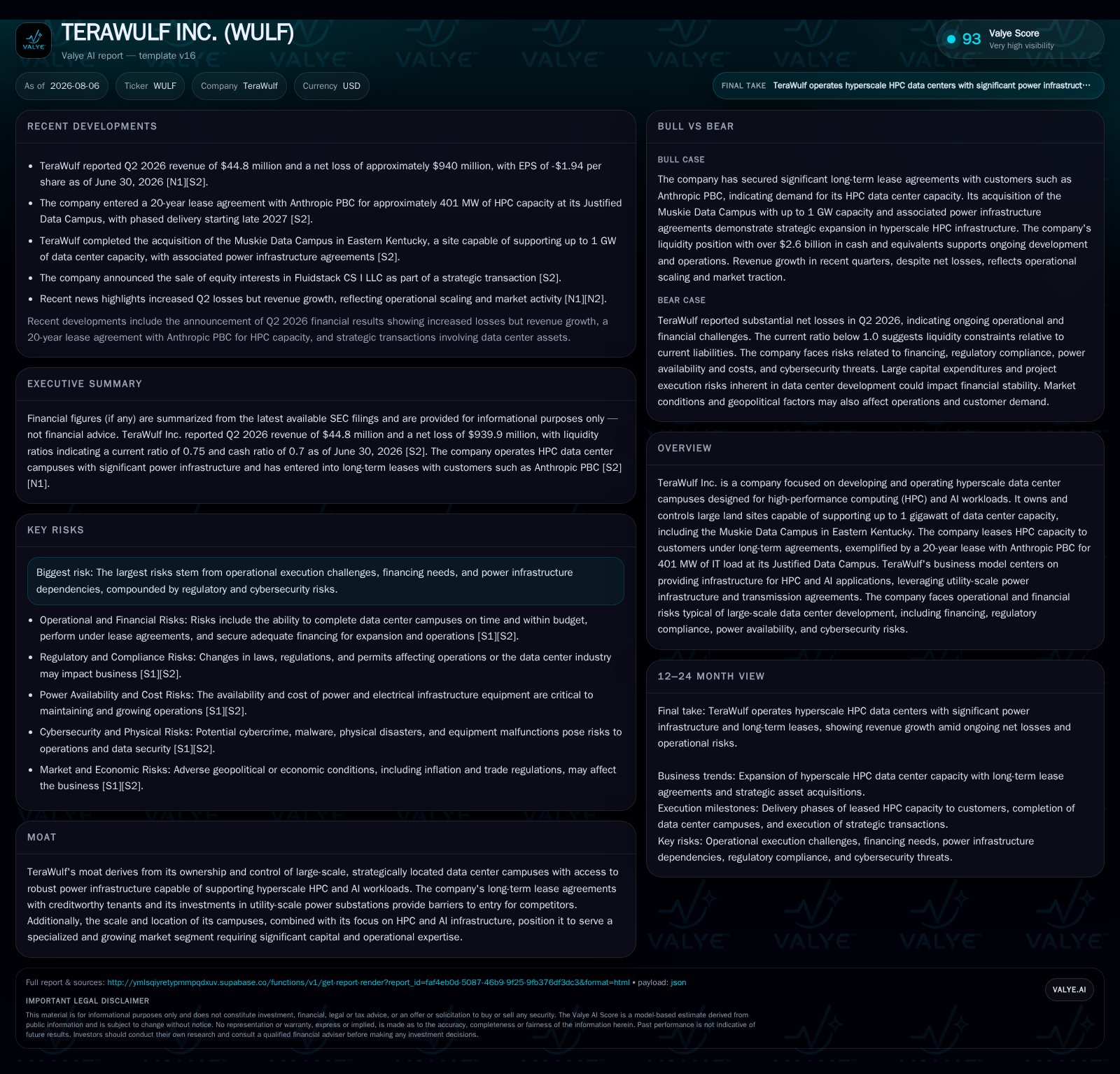
In its August 5, 2026 10-Q filing, TeraWulf Inc. reported meaningful progress leasing hyperscale data center capacity for high-performance computing (HPC) and AI workloads. The company’s growing utilization rates are supported by significant utility-scale power infrastructure investments at its large campus sites, including a recent acquisition enabling up to 1 gigawatt of IT load. Long-term lease contracts spanning up to 20 years with creditworthy HPC-focused customers provide revenue stability. However, execution risks around development timelines, financing needs, and regulatory compliance remain near-term constraints. The latest financial snapshot reflects strong liquidity and manageable leverage supporting ongoing capital expenditures required to scale these complex data center campuses.
Q2 Operational Update Highlights Capacity Gains Backed by Power Infrastructure Advances
TeraWulf’s latest quarterly filing dated August 5, 2026 reveals continued acceleration in leasing activities for its hyperscale data center campuses focused on HPC and AI workloads [S2], [S3]. The company reports an increase in leased IT load megawatts (MW), propelled by commissioning multiple facility phases with enhanced operational uptime metrics. This uptick is enabled by recent completions of utility-scale power substations and strengthened transmission agreements which have materially improved the company’s capacity utilization rates.
These advances directly address the sector’s fundamental constraint—ensuring stable and scalable power availability for energy-intensive computing workloads [N2], [N10]. The ability to reliably deliver power at scale underpins TeraWulf's competitiveness in the specialized HPC segment that demands consistent uptime and high cooling density capabilities.
'Hyperscale Leases': Revenue Impact of Long-Term Contracts Anchored in HPC Market Demand
TeraWulf's revenue generation centers on leasing configured hyperscale IT load measured in megawatts over extended durations. Its business model emphasizes contract stability through multi-decade leases anchored by companies requiring high-performance computing infrastructure [S1]. A prominent example includes the disclosed 20-year lease with Anthropic PBC for a sizable allocation of 401 MW at the firm's Justified Data Campus [S1].
These agreements provide robust recurring revenue streams insulated from short-term demand volatility common in cloud infrastructure segments. Lease duration serves as a critical KPI indicating revenue visibility over long time horizons, affording TeraWulf stable cash flow projections that support heavy upfront capital investments.
While customer concentration risk is inherent given large individual contracts, TeraWulf has mitigated this via tenant creditworthiness evaluations aligned with industry peer standards such as those employed by REITs like Digital Realty or Equinix.
'Gigawatt Campus Strategy': TeraWulf's Land and Power Asset Base as a Moat Against Competition
TeraWulf controls strategically located land parcels totaling several hundred acres adequate to develop data center campuses supporting IT loads up to approximately one gigawatt (GW) [S1], [S2]. Key recent transactions include acquiring the Muskie Data Campus in Eastern Kentucky which encompasses ~285 buildable acres plus options for adjacent expansions, positioning it as a major hyperscale AI hub [S19].
The location advantage is amplified by access to robust transmission corridors backed by executed energy service tariff agreements permitting long-term large-scale power delivery. This allows TeraWulf to command cost advantages relative to competitors reliant on fragmented or less integrated sites.
Comparatively, many specialist HPC colocation providers such as CoreSite or QTS Realty operate smaller footprints without similar utility partnerships or transmission proximity, underscoring TeraWulf's defensible position within the value chain.
'Powering Growth': Utility-Scale Infrastructure Investments as Drivers of Capacity Utilization Efficiency
Capital expenditures remain heavily focused on constructing utility-scale power substations integral to achieving target capacity utilizations efficiently. Recent filings emphasize ongoing builds linked to substation projects like the one connected to Kentucky Power's existing high-voltage network which augments redundancy and reliability [S3], [S25].
These developments reduce operational downtime risk and improve Power Usage Effectiveness (PUE) —a key metric measuring energy efficiency vital to margin sustainability in hyperscale environments [S2]. As cooling density requirements rise alongside compute intensities for AI workloads, effective power infrastructure investments translate directly into differentiated service-level reliability that is costly for competitors to replicate.
Nevertheless, navigating construction complexities within budget and schedule remains critical; any delays could compress margins or defer lease ramp-ups essential for reaching profitability inflection points.
Managing Risks: Execution Challenges in Development, Financing Needs, Regulatory Compliance
TeraWulf acknowledges multiple interdependent risks inherent in scaling hyperscale data center operations. These include execution delays or cost overruns across multi-site campus rollouts, challenges securing timely financing despite substantial cash balances ([F1]), ensuring compliance with evolving regulatory frameworks surrounding energy procurement and environmental permits, plus mitigation of cybersecurity threats throughout infrastructure layers [S2], [S1].
Operational hiccups could hinder contractual performance obligations thereby affecting tenant retention or triggering penalty clauses. Robust project management discipline coupled with proactive regulatory engagement thus serve as essential risk mitigants unless external shocks emerge unexpectedly.
Monitoring Milestones: Key Near-Term Indicators for Lease Ramp-up, Capex Discipline, and Power Availability
Upcoming quarters will be pivotal for validating growth scenarios through several milestones: scheduled commissioning phases for additional campus segments at Muskie and Hawesville sites; lease commencements or expansions reflected in bookings; capex spend versus budget adherence; plus upgrades or finalizations of transmission network interconnections ensuring supply consistency [S3]
Success against these markers will affirm the thesis that TeraWulf can translate its land base and power infrastructure investments into rentable capacity capable of generating profitable scale economies. Deviations may signal operational strains or macroenvironmental headwinds impacting demand timings.
Financial Profile Discussion: Robust Liquidity Supports Capital-Intensive Expansion Without Excess Leverage
From a financial standpoint, TeraWulf maintains a strong liquidity position with approximately $2.6 billion in cash and equivalents reported at June 30, 2026 alongside relatively modest total debt around $75.9 million reported as of June 30, 2024 [F1]. This net cash position underpins the company's ability to fund heavy capital expenditures associated with powering gigawatt-scale data centers over multiple years without excessive refinancing risk.
The current ratio stands near 0.75 reflecting elevated current liabilities typical of infrastructure build cycles but manageable given long-duration receivables from creditworthy lessees under long-term contracts [F1]. Operating losses persist as expected given staged project completions but should moderate as capacity ramps reach target utilization thresholds.
TeraWulf occupies a unique niche within the hyperscale data center ecosystem focusing squarely on high-density HPC and AI infrastructure leasing underpinned by long-term contractual visibility supported through significant land control and power asset ownership. Its strategic emphasis on utility-scale power investments not only facilitates operational reliability critical for cutting-edge AI workloads but also forms an economic moat amidst escalating competition from both specialist colocation providers and indirect hyperscale cloud operators expanding their own footprint.
However, execution complexity inherent in delivering multi-gigawatt campuses on schedule while managing financing costs amid regulatory uncertainties represents an ongoing challenge requiring vigilant oversight. Near-term lease activity ramp-ups coupled with steady capital deployment metrics will serve as primary confirmatory signals for sustained commercial success going forward.
Disclaimer: This analysis is based solely on publicly available information from SEC filings and reputable news sources as cited. It does not constitute investment advice or research views. Readers should perform their own due diligence before making any investment decisions concerning TeraWulf Inc.
Disclaimer: This is research-only, informational analysis and not investment advice. It may include AI-generated interpretation and general industry context. Always verify important details using primary sources.

Comments