
Diversified Energy’s Transition to Development Marks a Strategic Growth Inflection
Diversified Energy’s Q2 2026 update highlights early-stage development risks amid sustained acquisition-driven production growth and stable cash flows.
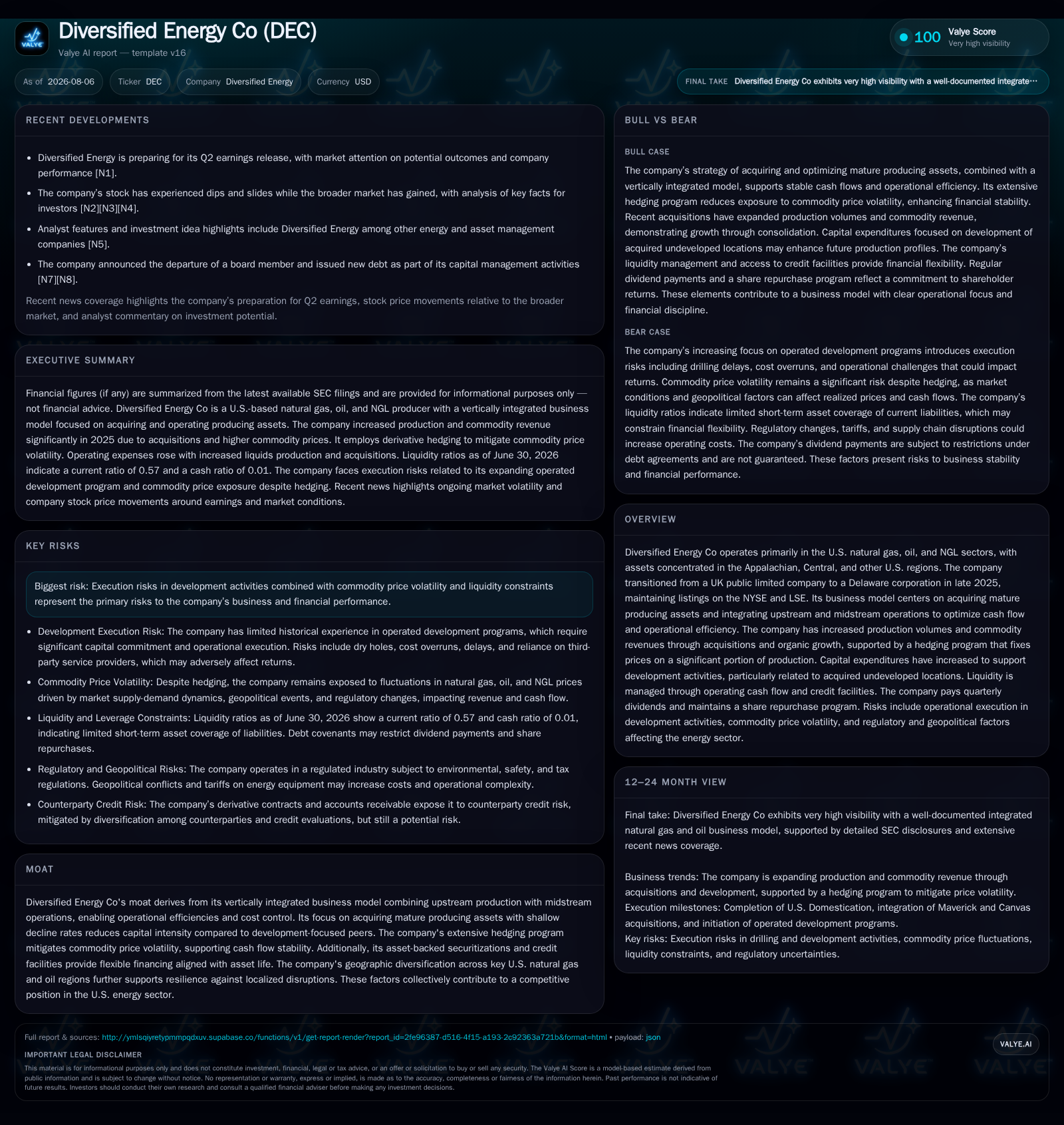
Diversified Energy Company is advancing from a primarily acquisition-based model toward operating its own development drilling programs, signaling a strategic pivot in its growth approach. The company’s vertically integrated upstream and midstream operations, supported by a comprehensive commodity hedging program, underpin steady cash flows despite inherent commodity price volatility. Recent quarterly disclosures reveal increased capital expenditures driven by development activities alongside mature asset optimization. While leverage remains elevated near $3 billion with tight liquidity metrics, asset-backed financing aligned with long-lived reserves and disciplined capital management support ongoing dividend payments and share repurchases within covenant limits. Execution success in development drilling, reserve replacement effectiveness, and maintenance of hedging coverage are key factors that will influence future earnings stability and cash flow durability.
Recent Operating Update: Strategic Shift Toward Development
Diversified Energy Company’s Q2 2026 Form 10-Q filing confirms that the company has launched an operated drilling and completion program—a strategic shift away from its traditional acquisition-centric business model focused on mature producing assets with shallow decline rates [S2]. This transition introduces new operational complexities requiring upfront capital commitments prior to realizing production and cash flow returns. The company acknowledges limited direct experience in development but benefits from personnel including a Chief Operating Officer experienced in overseeing drilling programs at Maverick Natural Resources.
The filing details multiple execution risks associated with this new focus: well planning challenges, potential drilling delays, budget overruns, geological uncertainties, dependency on third-party oilfield service providers (rigs, pressure pumping crews, materials), regulatory permitting requirements, environmental compliance costs, and weather-related disruptions [S2], [S16]. Early well performance will be critical; dry holes or wells underperforming expectations could increase earnings variability compared to prior acquisition-stabilized cash flows.
Business Model: Integrated Operator with Emerging Development Focus
Diversified Energy operates primarily in the upstream sector producing natural gas, oil, and natural gas liquids (NGLs), complemented by midstream operations including gathering pipelines and compression facilities that enhance margin capture and reduce reliance on third-party transportation [S1]. This vertical integration affords greater operational control over production volumes and throughput reliability.
Revenue is principally volume- and price-driven [S1]. The company mitigates commodity price risk through a comprehensive hedging program covering a substantial portion of anticipated production volumes. This strategy smooths revenue volatility typical in the sector and supports predictable cash flows
Historically focused on acquiring mature fields with low capital intensity due to shallow decline profiles, the company has increased capital expenditures significantly—$185 million in 2025 versus $52 million in 2024—primarily due to participation in non-operated development wells on undeveloped acreage acquired via the Maverick transaction along with continued optimization of existing assets [S4], [S9].
Financially, Diversified Energy employs long-term fixed-rate asset-backed securitizations secured by natural gas and oil assets. Equity raises have historically supplemented larger acquisitions to manage leverage profiles.
Industry Structure & Competitive Positioning
Operating mainly across U.S. Appalachian and Central basins places Diversified among mature dry-gas-focused upstream operators like EQT Corporation or Cabot Oil & Gas. Its ownership of midstream infrastructure provides operational advantages akin to firms such as Williams Companies or Kinder Morgan but on a smaller scale tailored to its asset base.
Unlike fully integrated supermajors spanning exploration through refining and marketing (e.g., ConocoPhillips), Diversified’s scope centers on domestic upstream production paired with selective midstream ownership aimed at enhancing margins rather than full vertical integration.
Its hedging program is more extensive than some peers’, smoothing earnings amid volatile Henry Hub pricing influenced recently by LNG export demand fluctuations and geopolitical disruptions noted during 2025–2026 [S1]
The company’s acquisition strategy prioritizes proven producing assets over exploration ventures—reducing execution risk but limiting upside potential tied to new discoveries. The recent foray into operated development introduces operational risk-return tradeoffs familiar among peers balancing capital discipline with reserve replacement imperatives.
Growth Drivers
Growth is expected from several vectors:
- Incremental acquisitions of mature producing properties augmenting overall production volumes.
- Increased capital investment targeting reserve replacement through development drilling on undeveloped acreage acquired primarily via Maverick.
- Expansion of owned midstream pipeline networks improving throughput capacity and controlling transportation costs.
- Stable commodity pricing supported by hedging programs that underpin reliable operating cash flow.
- Geographic diversification mitigating basin-specific risks including regulatory or operational disruptions.
These drivers mirror broader industry trends where operators seek balance between securing long-life reserves via acquisitions while pursuing organic growth through targeted well developments offering higher return potential albeit with added operational risk exposure [S1], [S4].
Risks & Watchpoints
The nascent operated development program introduces execution risks absent from the historical acquisition-based strategy: dry holes or suboptimal well performance could dampen returns; inflationary pressures on oilfield services supply chains may increase costs; delays or curtailments in drilling activity could affect timing; environmental compliance obligations may add unexpected expenses; dependence on third-party contractors exposes the company to availability constraints; title or leasing disputes could impede project progress [S2], [S16].
Financially, total debt approaches $3 billion against current assets below $600 million resulting in a current ratio near 0.57—indicating tight liquidity requiring careful working capital management especially amid commodity price cycles or operational setbacks [F1]. Large acquisitions may necessitate equity issuances that dilute shareholders if leverage limits are challenged.
Commodity price volatility remains an inherent risk despite hedging coverage.
What To Watch Next
Investors should track:
- Quarterly production volumes for indications that combined acquisition plus organic development sustains or accelerates output growth.
- Reserve replacement ratios reflecting success converting undeveloped acreage into productive wells without excessive capital consumption.
- Updates on hedging positions clarifying whether coverage remains adequate amid evolving price conditions.
- Progress reports on operated drilling including well counts, initial productivity metrics, completion costs reflecting operational execution discipline.
- Liquidity metrics assessing working capital management amid rising capex commitments alongside adherence to dividend policies within credit facility covenant limits.
- Potential equity raises signaling funding needs for future acquisitions or development expansion without breaching leverage covenants.
Financial Profile Discussion
As of June 30, 2026, Diversified Energy reported approximately $8.2 million in cash equivalents against nearly $3 billion in total debt yielding net debt close to $3 billion and a current ratio of approximately 0.57—highlighting constrained short-term liquidity requiring strong operating cash flow generation coupled with credit facility availability for working capital needs [F1]
Overall, Diversified Energy maintains a leveraged but strategically structured financial profile supported by stable cash flows derived from vertical integration and commodity price hedging. The recent pivot toward operated development adds operational risk but offers potential for sustainable reserve replacement if executed successfully.
Disclaimer: This is research-only, informational analysis and not investment advice. It may include AI-generated interpretation and general industry context. Always verify important details using primary sources.

Comments