
East West Ave Acquisition Corp. Commences Nasdaq Listing with $100 Million IPO Trust
Newly formed SPAC East West Ave Acquisition Corp. closes IPO and establishes governance amid market entry.
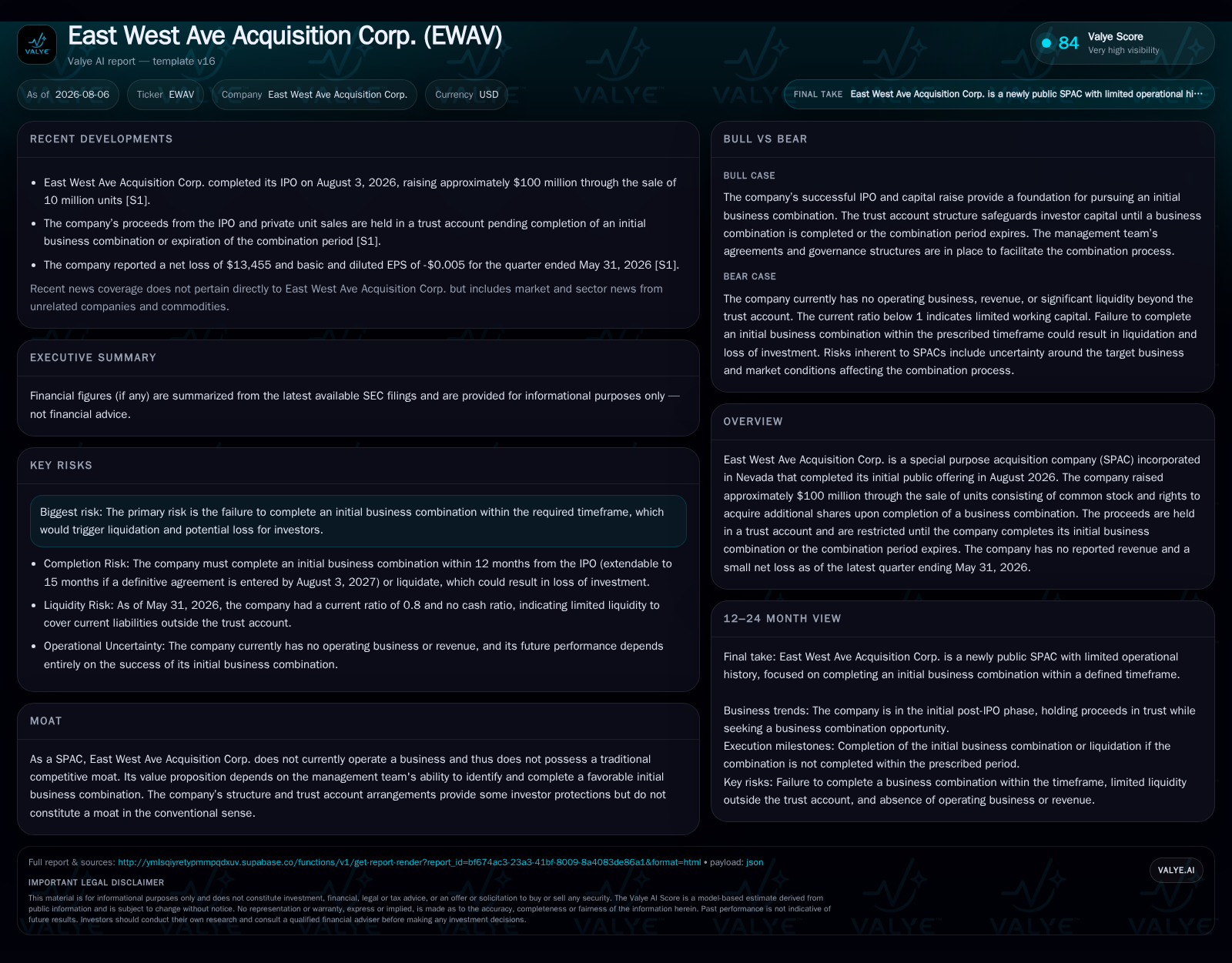
East West Ave Acquisition Corp. launched its initial public offering in August 2026, raising approximately $100.5 million through issuance of units consisting of common stock and rights to acquire shares post-merger. The proceeds are placed in a trust account, restricted until a business combination occurs or the merger deadline elapses. The company recently appointed independent directors and established an audit committee with identified financial expertise, setting governance foundations as it prepares for de-SPAC activities. As a blank-check company, its value hinges on executing a timely and favorable business combination within mandated deadlines.
Recent Operating Update
East West Ave Acquisition Corp. (EWAV) officially closed its initial public offering on August 3, 2026, issuing 10 million units priced at $10 each and raising gross proceeds of $100 million [S7], [S9]. Alongside this, private units totaling approximately $2.7 million were sold concurrently to the company’s sponsors, East West Avenue LLC and NFR Capital Limited, further bolstering available capital [S9]. The net proceeds after transaction fees amounted to roughly $100.5 million, now held in a trust account under strict regulatory restrictions until the completion of an initial business combination or expiration of the combination period [S4], [S8].
The trust account protects public investors by preserving raised funds until a deal is consummated or the company liquidates. It allows for limited release of interest income solely for dissolution expenses capped at $100,000 [S4]. Sponsor loans are arranged separately to cover Nevada incorporation-related tax obligations, preventing dilution of trust principal through operational taxes [S4].
Governance structure has been formalized with the appointment of three independent directors — Samir Parikh, Irfan Verjee, and Masahiro Honna — who meet Nasdaq listing independence requirements [S12]. Notably, Mr. Honna qualifies as an audit committee financial expert under SEC definitions and chairs that committee alongside his peers [S12]. This aligns with best practices in SPAC governance emphasizing oversight capabilities prior to de-SPAC transactions.
Underwriting compensation issued included restricted representative shares given to D. Boral Capital LLC, the underwriting representative, which are subject to a customary six-month lock-up period plus certain transfer limitations consistent with FINRA requirements [S9], [S11]. The underwriting syndicate also waived its over-allotment option causing forfeiture of certain founder shares allocated initially to Sponsor A upon IPO closing [S11].
No revenue generation exists yet, consistent with a shell entity awaiting de-SPAC activities; net loss reported was minimal ($13 thousand) through May 31, 2026, primarily reflecting general administrative and offering-related expenditures [F1]. The balance sheet shows current assets around $0.93 million versus current liabilities slightly exceeding at $1.16 million — typical pre-combination working capital dynamics for newly public SPACs along with modest reported debt (~$0.5 million) related largely to corporate obligations prior to merger activity [F1].
Business Model Overview
East West Ave Acquisition Corp.’s business model embodies the archetypal SPAC structure: raise capital from public investors via an IPO that sells units comprised of common stock shares coupled legally with rights allowing holders to purchase fractional shares upon consummation of a qualifying merger (business combination) [S7]. The funds raised flow into a highly regulated trust account segregated from operating cash flows and only accessible upon successful transaction closure or liquidation upon failure.
Revenue mechanics differ fundamentally from conventional companies since EWAV itself does not generate recurring sales or product revenue before its de-SPAC deal closes. Instead, value accrues through management's ability to identify promising private targets suitable for public listing via merger—commonly private firms seeking expedited access to public markets bypassing traditional time-consuming IPO processes.
Units sold incorporate rights which potentially dilute equity holders post-merger when exercised but also serve as incentives for investors—this layered equity structure is common among SPACs yet imposes potential dilution risks engaging investor scrutiny at vote time.
Sponsor involvement includes pre-IPO private unit acquisitions at par value and potential promote shares granted post-merger implementation—common levers aligned with sponsor incentives but requiring alignment with shareholder interests.
Investor protections derive substantially from trust account arrangements restricting premature spending and redemption rights allowing shareholders to opt out during proxy votes approving mergers or amendments affecting voting/shareholder terms.
Industry Context and Competitive Positioning
As a newly minted SPAC in mid-2026, EWAV enters an established yet evolving niche within capital markets designed specifically for alternative public listings.
Top-tier peer examples include Pershing Square Tontine Holdings (PSTH), Social Capital Hedosophia Holdings series (IPOA/IPOB), and Churchill Capital Corp series—all representing diverse sponsor track records that influence investor confidence differently based on reputation and deal pipelines.
SPACs compete not only against each other but also against traditional IPO routes facilitated by underwriters and direct listings that appeal due to cost efficiency or market timing advantages.
EWAV’s governance decisions — appointing independent directors early and establishing an audit committee chaired by a designated financial expert — mirror industry best practices responsible for enhancing credibility in nascent stages before shareholder votes on combinations commence.
Its capital raise size (~$100 million plus sponsors’ private placement) positions it among smaller-to-mid cap SPACs compared with mega transactions seen in some recent cycles but sufficient scale for many target sectors typically pursued.
Growth Prospects and Drivers
While EWAV does not currently have announced acquisition targets or disclosed sector focus as per filings up through August 2026 [S2], growth potential is intrinsically tied to several levers:
- Market conditions: Favorable capital markets buoy SPAC attractiveness as private companies seek faster, more certain liquidity routes than traditional IPOs.
- Sponsor expertise: Effectiveness depends heavily on management’s pipeline, sector knowledge, network access, and execution capabilities sourcing viable quality targets attractive enough for investors’ approval.
- Regulatory clarity: Continued SEC guidance on disclosure rules and governance frameworks underpin investor protections that can indirectly accelerate deal completion rates across the industry.
- Innovative financing structures: Inclusion of PIPE financing alongside mergers can ensure ample capital while mitigating redemption risks impacting deal viability.
- Sector trends: Technology-enabled sectors such as software, biotech/healthcare innovation, and renewable energy remain favored acquisition domains capturing demand drivers beyond cyclicality.
A successful execution within the allowed timeframe would transition EWAV from a shell entity into an operating publicly-listed enterprise with emergent revenue streams post-merger — unlocking formerly latent value trapped in trust account holdings.
Risks and Watchpoints
The paramount risk remains failure to consummate an initial business combination within the prescribed window (12 months extendable up to 15 months conditional on agreements) resulting in mandatory liquidation where public shareholders receive pro-rata return of IPO proceeds minus expenses — commonly leading to small losses due primarily to underwriting costs and operational spendings [S4], [S2].
Other foreseeable risks include:
- Shareholder redemptions: Excessive tendering of shares during merger votes can starve available deal financing rendering transaction collapse more likely.
- Dilution mechanics: Warrants/rights exercised post-merger dilute equity bases impacting long-term shareholder returns if valuations misalign.
- Sponsor conflicts: Misaligned incentives may arise if sponsors prioritize closing deals over optimal valuation maximizing shareholder value.
- Target quality: Overpaying for acquisition targets or insufficient diligence could expose investors post-de-SPAC transactions to underperformance penalties not reflected pre-deal.
- Regulatory shifts: Ongoing SEC scrutiny over SPAC disclosure standards may impose additional operational burdens or delay timelines.
Investors monitoring EWAV should track forthcoming announcements regarding potential target companies evaluated as well as shareholder meeting votes approving deal terms once such become available.—these milestones mark inflection points determining trajectory away from low-return shell status toward active operations.
What To Watch Next
Key near-term developments commanding attention include:
- Identification or announcement of any definitive business combination agreements addressing target company sector focus and financial terms—as these initiate the proxy voting cycle activating redemptions/reorganizations.
- Shareholder vote outcomes reflecting redemption levels indicating market confidence or skepticism concerning proposed deals.
- Updates on PIPE financing commitments accompanying announced mergers which provide vital supplementary funding support reducing redemption pressure risks.
- Any amendments proposed or approved adjusting timeframes or rights clauses embedded within Articles incorporated post-IPO reflecting evolving deal negotiation dynamics [S4], [S11].
- The potential impact of market-wide capital conditions influencing trading prices of units (EWAVU), common stock (EWAV), and rights (EWAVR) preceding de-SPAC events impacting investor sentiment broadly.[S3]
Financial Profile Discussion
Although detailed operating financials are not meaningful pre-business combination given lack of ongoing revenue operations, East West Ave Acquisition Corp.’s balance sheet situation through May 31, 2026 shows total current assets including cash equivalents at roughly $0.93 million compared against current liabilities about $1.16 million yielding a current ratio below unity (0.8), indicative mostly of short-term expenses funded by authorized working capital arrangements typical for SPACs in setup phase [F1]. Total debt stands minimal ($0.5 million), reflecting no material leverage beyond corporate obligations prior to transactional activity [F1].
The pivotal financial safeguard remains the trust account arrangement holding approximately $100.5 million insulated from usage except under narrow conditions related to completed business combinations or liquidation events providing strong investor principal protection amidst transactional uncertainties [S4]
All underwriting fees have been expensed upfront reducing net proceeds accordingly; recurring operating costs remain limited pending deal closure resulting in nominal net loss ($13 thousand) reflecting controlled expense discipline appropriate for a blank-check vehicle stage [F1], [S2].
This profile exemplifies standard SPAC financial characteristics prioritizing capital preservation while building managerial capacity toward deploying raised funds efficiently upon signing definitive agreements directing future growth phases.
Disclaimer: This analysis presents factual information extracted from East West Ave Acquisition Corp.'s recent filings combined with industry context relating to SPAC operations. It does not constitute investment advice or research views related thereto.
Disclaimer: This is research-only, informational analysis and not investment advice. It may include AI-generated interpretation and general industry context. Always verify important details using primary sources.

Comments