
Artius II Acquisition Inc. Faces Crucial August Deadline Amid Trust Account Pressure
With a looming mandatory liquidation deadline and tight liquidity metrics, Artius II Acquisition’s ability to finalize a business combination is under significant strain.
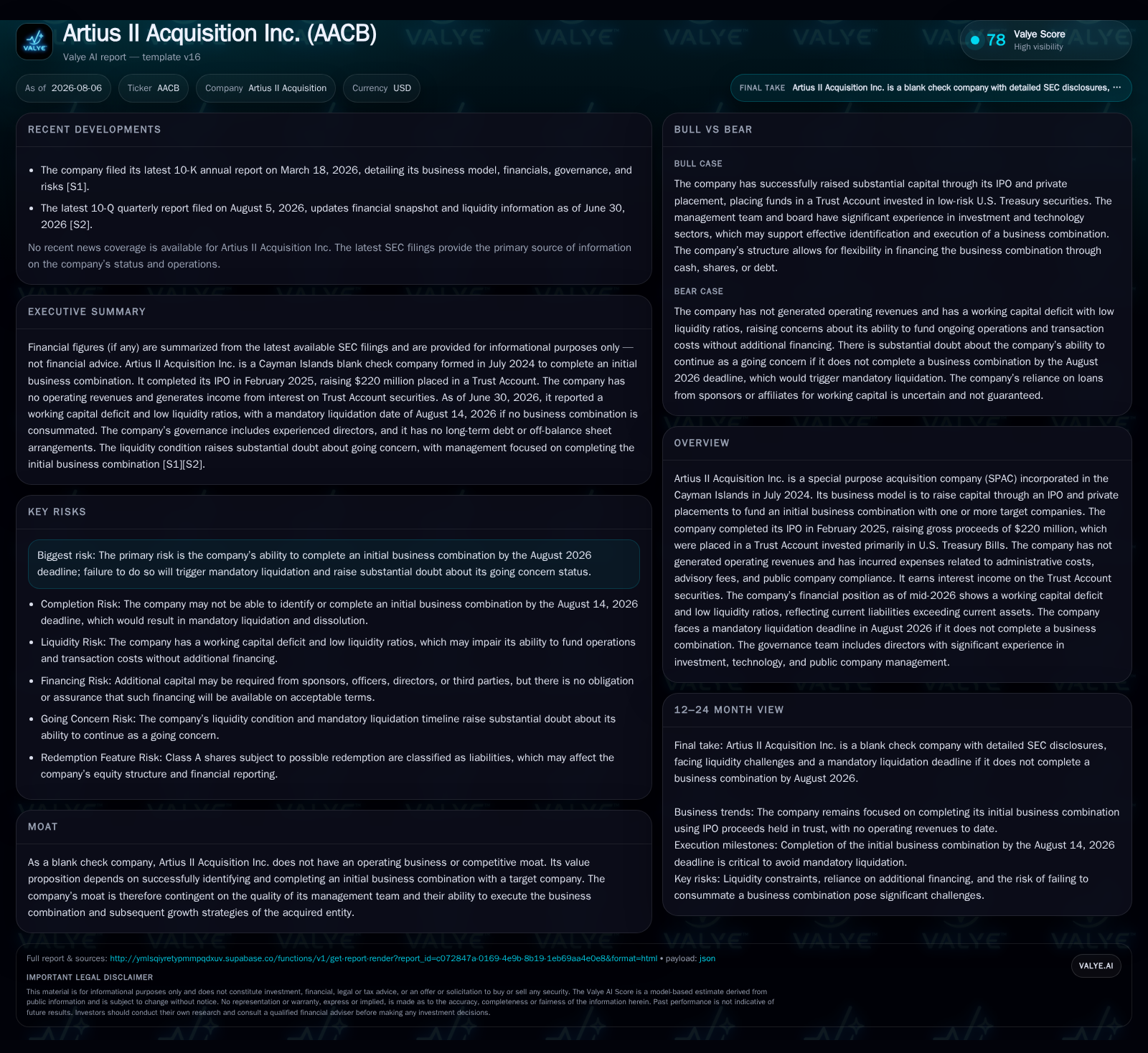
Artius II Acquisition Inc., a Cayman Islands-based blank check company formed in mid-2024, completed its IPO in early 2025 raising approximately $220 million primarily held in a trust account invested in short-term U.S. Treasury Bills. As of mid-2026, the company faces critical liquidity challenges, including a severe working capital deficit and $900,000 of debt against limited cash. The August 2026 deadline to complete its initial business combination or face mandatory liquidation intensifies pressure on management to source and close a deal promptly. This analysis examines the SPAC’s structural financial constraints, competitive positioning among peer blank check companies, and key risk factors shaping its path forward.
Critical Deadline Pressure Evident in Latest Quarterly Update
Artius II Acquisition Inc.'s most recent quarterly filing for the period ending June 30, 2026 exposes critical financial stress as the company approaches its August 14, 2026 deadline to complete its initial business combination or face mandatory liquidation [S2][F1]. Current assets stand at approximately $161,879 against current liabilities totaling roughly $4,709,711, yielding an alarmingly low current ratio around 0.03 [F1]. This disproportion highlights a severe liquidity gap that constrains operational flexibility and raises existential concerns as obligations far outstrip readily available resources.
In addition to the working capital deficit, the balance sheet reveals total debt near $900,000 predominantly reflecting a recently amended unsecured promissory note from the Sponsor aimed at bridging working capital shortfalls [F1]. Cash and equivalents remain limited at roughly $141,921 (prior quarter end September 2025), marking minimal immediate reserves outside debt facilities [F1]. The combined picture underscores how Artius II's financial runway is sharply eroding during ongoing administrative expenses with little offsetting operational revenue.
SPAC Model Constraints: Financial Engineering Without Operating Revenues
As a blank check company incorporated in July 2024 expressly for effecting an initial business combination via merger or acquisition, Artius II’s fundamental value proposition is contingent on completing such a transaction within its allotted timeframe [S1]. Raising gross proceeds of approximately $220 million from its February 2025 IPO plus private placements at $10 per unit enabled placement of these funds into a dedicated trust account invested primarily in short-term U.S. Treasury Bills to generate interest income until deal completion or liquidation [S1].
This trust account structure aligns with industry norms wherein SPACs generate negligible operating earnings prior to acquisition, relying instead on interest income which mitigates administrative expense burn but does not produce positive cash flow from operations [S1]. Artius II has recorded net income principally attributed to this interest income ($8.08 million in 2025) offset by significant advisory fees ($6 million) and general administrative costs ($1.94 million) [S1]. Importantly, this balance tilts as the deadline approaches with administrative costs continuing to accrue absent revenue-generating operations.
Competitive Landscape: How Does Artius II Stack Up Among Peers?
Within the broader SPAC ecosystem—characterized by entities such as Pershing Square Tontine Holdings and Churchill Capital Corp—deal timing pressures and shareholder redemption dynamics frequently dominate strategic outcomes. Common challenges include high redemption rates which erode transaction proceeds and compress deal financing viability alongside compressed windows for identifying suitable targets.
Compared to peers often managing longer timelines or larger trust balances relative to IPO proceeds, Artius II’s dwindling working capital ratio (~0.03) signals more acute liquidity stress than many contemporaries have experienced prior to de-SPAC transactions concluding successfully. While details on Artius II’s specific target pipeline remain undisclosed, peer experience suggests that tightening deadlines without announced deals increase likelihood of liquidation or suboptimal deal terms.
Growth Outlook Hinges on Swift Business Combination Execution
Absent operating activities or revenue streams beyond interest on trust monies, prudent growth prospects rest squarely on management’s capacity to consummate an initial business combination timely. The latest filings suggest no new public disclosures regarding identified acquisition targets as of mid-2026 [S1], indicating that time is running short within the company’s roughly two-year window established at inception.
Growth drivers common across successful SPACs include seasoned sponsor teams with robust deal sourcing networks coupled with favorable capital market appetite among investors for alternative public market entry vehicles. However, these forces are counterbalanced here by near-term forced urgency driven by impending liquidation deadlines constraining negotiation leverage and due diligence depth.
A failure to pivot effectively toward executable deals would materially impair Artius II's ability to avoid dissolution while securing shareholder value.
Key Risks: Forced Liquidation, Redemption Impacts, and Sponsor Incentives
Three principal risks exert outsized influence:
Mandatory Liquidation: Failure to close an initial business combination by August 14, 2026 obligates statutory winding up of Artius II’s affairs causing complete shareholder value erosion [S2]
Redemption Risk: Public shareholders holding Class A ordinary shares have redemption rights that can dilute transaction proceeds available for investment resulting in less capital upon de-SPAC merger closure.
Dilution From Sponsor Promote/Private Placements: Post-merger economics are affected by sponsor ownership structures including promote arrangements and private placement shares complicating long-term equity interests.
Combined with prevailing liquidity deficits highlighted earlier [F1], these factors restrict strategic flexibility in financing negotiations and heighten pressure for swift deal completion.
Upcoming Events: What To Track As Deadline Looms
Monitoring Artius II’s trajectory necessitates focused attention on several forward-looking indicators:
- Official announcement(s) (if any) disclosing identified acquisition targets or preliminary agreements signal active progress toward de-SPAC milestones.
- Shareholder approval outcomes related to proposed combinations gauge transaction viability within governance frameworks.
- Redemption activity disclosures reveal investor confidence levels and directly implicate net transaction proceeds.
- Subsequent quarterly filings providing updated liquidity snapshots clarify survivability through final weeks before deadline.
- Regulatory developments impacting SPAC formations or merger logistics could adjust timeline feasibility or compliance costs.
Confirming any one or more would affirm continued viability whereas delays or escalated redemptions without deal announcements would challenge the potential for successful combination.
Financial Profile Discussion: Liquidity And Working Capital In The Final Stretch
Consolidating the latest available financial data reveals pronounced fragility: cash equivalents of approximately $141,921 reported at September 30, 2025 contrast starkly with total debt approximating $900,000 as of June 30, 2026 producing an implied net debt near $758,079 [F1]. Coupled with current liabilities amounting to over $4.7 million dwarfing current assets just shy of $162k yields an exceptionally weak current ratio around 0.03 risking default or insolvency absent fresh capital inflows or imminent transaction-induced liquidity events [F1].
This constrained working capital situation translates operationally into limited capacity to fund overhead expenses without adverse impact and raises serious questions regarding sustainability through closing weeks before mandated wind-down if no initial business combination transpires [S2][S9]
Overall, financial metrics paint a stark portrait where survival hinges almost entirely on rapid execution rather than cyclical recovery or operational improvement typical of other corporate models.
Disclaimer: This analysis is conducted for informational purposes only based on publicly available SEC filings and does not constitute investment advice or research view.
Disclaimer: This is research-only, informational analysis and not investment advice. It may include AI-generated interpretation and general industry context. Always verify important details using primary sources.

Comments