
Everspin Technologies Advances MRAM Design Wins Amid Margin and Licensing Revenue Pressures
Latest quarterly update highlights growing design wins and product sales, while licensing revenues decline and margins face mix challenges.
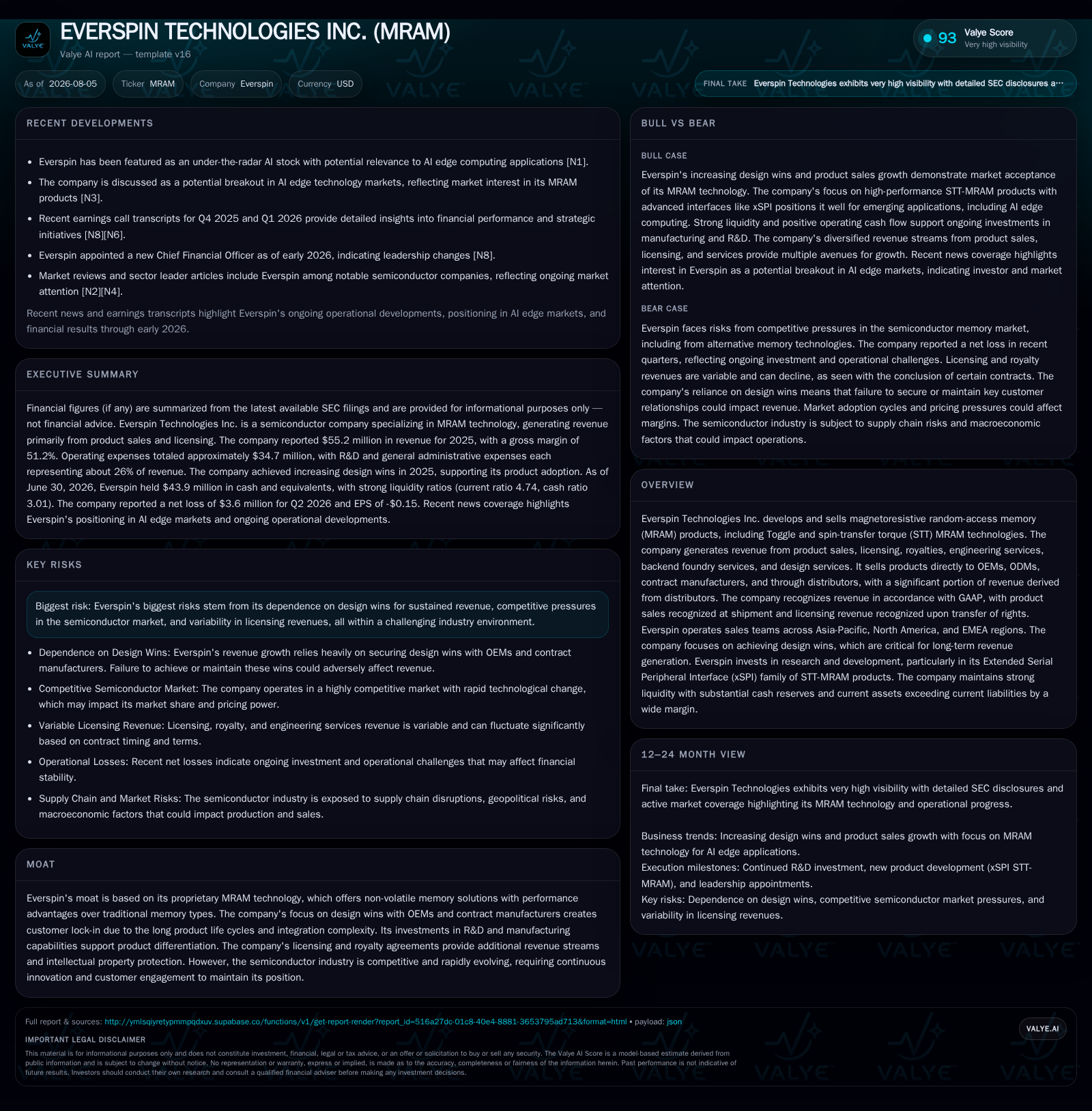
Everspin Technologies reported in its latest quarterly filing continued momentum in securing magnetoresistive random-access memory (MRAM) design wins, which remain critical for its long-term revenue base. Product sales grew steadily, driven mainly through distributor channels, but licensing and royalty revenues declined due to contract conclusions, presenting near-term variability. The company’s gross margin faced slight pressure from changing revenue mix despite improvements in manufacturing yield. With a strong cash position and low debt, Everspin invests consistently in R&D to sustain technology leadership amid competitive semiconductor memory dynamics.
Latest Operating Update
Everspin Technologies’ Q2 2026 quarterly filing provides critical insights into the company’s near-term operating trajectory. The firm continues to emphasize the fundamental role of design wins as the core driver underpinning future revenue streams. Design wins occur when OEMs or contract manufacturers confirm qualification of Everspin's MRAM products within their production systems—a prerequisite to multi-year revenue contracts given product life spans [S1]. Notably, new design wins ramped sharply through 2025 quarters from 44 to 85, signaling an accelerated customer adoption trend.
Conversely, licensing, royalty, patent fees, engineering services and other revenues declined to $6.9 million from $8.2 million primarily due to completion of specific contractual work on radiation-hardened MRAM models [S1], [S7]. This variability underscores the episodic nature of this income stream relative to more stable product sales.
Gross margins experienced a slight erosion to approximately 51.2% in fiscal 2025 compared to prior periods [S4]. The margin pressure can be attributed largely to a changed revenue mix weighted more toward product sales with somewhat lower unit economics. However, Everspin reported yield improvements across both internal manufacturing sites and external foundry partners that enabled sustaining existing margin levels [S1], reflecting continuous operational efficiency efforts critical in capital-intensive semiconductor fabrication sectors.
Business Model Deep Dive
Everspin's business hinges on selling proprietary MRAM technologies—specifically Toggle MRAM and spin-transfer torque (STT) MRAM—to OEMs and contract manufacturers (CMs), as well as through third-party distributors who themselves sell downstream [S1]. Product sales are recognized at point-of-shipment under GAAP.
The company also monetizes its intellectual property via licensing agreements and royalties tied to end-device sales incorporating licensed MRAM designs. These payments typically fluctuate based on customer product cycles and licensing milestones [S7], highlighting a mixed but complementary revenue approach combining hardware sales with IP monetization.
Engineering services and backend foundry offerings further complement the model by assisting customers in product qualification phases—critical for securing long-term embedded system integration. This multi-pronged approach aligns with industry norms where emerging memory players must balance direct hardware production with IP licensing to fuel scale.
Revenue concentration is notable around distributors—accounting for roughly three-quarters of sales—which introduces price protection provisions allowing credits if downstream prices decline after shipment [S1]. While expanding reach through distribution channels boosts volume potential and customer breadth, it simultaneously incorporates pricing risk requiring active channel management.
Operating expenses skew heavily toward research and development (R&D), consuming approximately one-quarter of revenues ($14.1 million or 26% in fiscal 2025) [S4]. This reflects the continuous innovation imperative within the semiconductor memory sector where competitive technology advances and fabrication process improvements underpin differentiation and defensibility.
Industry Structure & Competitive Positioning
The semiconductor memory landscape is characterized by intense competition from legacy technologies (DRAM/NAND) and peer emerging non-volatile memories such as Phase Change Memory (PCM) or Resistive RAM (ReRAM). Within this bracket, Everspin’s proprietary Toggle MRAM and STT-MRAM products provide compelling tradeoffs around speed, endurance, and persistent storage without power requirements.
Key barriers arise from high capital intensity for wafer fabrication capability, stringent product qualification protocols by OEMs/ODMs operating complex supply chains, intellectual property ownership stakes, and entrenched relationships with foundries like GLOBALFOUNDRIES—the latter holding exclusivity over manufacturing certain STT-MRAM nodes per joint agreements that extend exclusivity timelines post-qualification [S9], [S16].
Everspin leverages these facets to carve out niches in aerospace, industrial control systems requiring radiation-hardened memory solutions, automotive safety electronics demanding reliability under harsh conditions, plus expanding data center cache or storage applications needing durable non-volatile memory.
Compared with large-scale memory manufacturers such as Micron or Samsung dominating commodity DRAM/NAND markets, Everspin occupies a technology-specialized segment targeting embedded solutions where MRAM advantages favor power-efficiency or ruggedization demands rather than raw capacity at scale.
Growth Drivers
Several growth drivers underlie Everspin's market opportunity:
- Design Win Acceleration: Increasing new design wins increases visibility into multi-year production revenue flows due to long product cycles typical of embedded systems [S1].
- Market Expansion: Growing use cases including IoT endpoints requiring low-power persistent memory, automotive electronics needing radiation tolerance, aerospace defense sectors seeking reliability under extreme conditions drive broader MRAM adoption.
- Product Innovation: Ongoing R&D advances improve MRAM density scaling and cost competitiveness relative to incumbent technologies enabling penetration into broader commercial consumer electronics segments.
- Strategic Manufacturing Partnerships: Collaboration with foundries such as GLOBALFOUNDRIES facilitates access to advanced semiconductor nodes necessary for high-density STT-MRAM integration—critical for roadmap execution [S16].
- Geographic Diversification: Asia-Pacific remains the largest geography with ~63% revenue share as OEMs expand production locally; North American customers contribute ~20%, balancing regional exposure risks [S7].
Risks & Constraints
Despite these tailwinds several risks temper outlook:
- Revenue Concentration & Channel Pricing Risks: Heavy reliance on limited distributors with price protection mechanisms introduces volatility; end-customer demand shifts can result in subsequent distributor credits impacting reported revenues [S1].
- Licensing Revenue Variability: Contractual milestones underpinning licensing income can result in lumpy recognition patterns complicating earnings predictability [S7].
- Competitive Technology Trends: Rapid innovation cycles or emergence of alternative non-volatile memories could erode MRAM’s competitive positioning if technological breakthroughs or cost reductions surpass Everspin’s roadmap expectations.
- Manufacturing Yield & Capacity: Despite recent yield improvements supporting margin stability, any setbacks would directly pressure gross profitability given fixed fab costs embedded within product costs [S4].
- Legal/IP Risk: The patent infringement lawsuit filed early in 2026 exemplifies typical industry IP litigation threats which could impose legal costs or licensing restrictions if adverse outcomes occurred [S26].
- Macroeconomic & Geopolitical Factors: Semiconductor demand sensitivity to global economic cycles combined with supply chain disruptions poses execution risk across regions particularly APAC exposures.
What To Watch Next
Key markers that will provide clarity on Everspin’s trajectory include:
- Quarterly updates on number of new design wins relative to historical acceleration trends indicating uptake breadth.
- Product shipment volumes along with gross margin changes will indicate whether yield improvement efforts sustain profitability against pricing pressures.
- Licensing agreements announcements or renewals revealing stability or growth prospects beyond standard product sales.
- Developments related to patent litigation outcomes influencing risk perception.
- Capital expenditure deployments on manufacturing tooling expansion supporting capacity scaling aligned with design win ramp timing.
Financial Profile Discussion
As of June 30, 2026, Everspin held approximately $43.9 million in cash and equivalents against nominal total debt near $905,000, providing ample liquidity headroom for operational needs including sustained R&D spending measured at about a quarter of revenues annually [F1], [S4]. Current assets stood at $69.0 million versus current liabilities approximating $14.6 million, yielding a strong current ratio near 4.74x evidencing robust short-term balance sheet health supportive of working capital flexibility [F1].
Although the firm recorded an operating loss near $6.5 million for full-year 2025 credited partly by other income arising from government strategic awards related to aerospace/defense manufacturing planning [$4.4 million] [S10], ongoing investment prioritization balances near-term profitability challenges against longer-term market opportunity capture potential.
In this capital-intensive semiconductor sub-sector niche focused on emerging MRAM technologies rather than commodity bulk memory products typical of larger peers like Micron Technology or GlobalFoundries' foundry services segments, strong cash reserves minimize refinancing concerns while still enabling technology-focused investments necessary for sustained moat reinforcement.
This analysis is grounded exclusively on publicly available regulatory filings as of August 2026 without conjecture beyond documented disclosures. It aims to contextualize Everspin Technologies’ operational developments within semiconductor memory industry dynamics without offering investment advice.
Disclaimer: This is research-only, informational analysis and not investment advice. It may include AI-generated interpretation and general industry context. Always verify important details using primary sources.

Comments