
AbCellera’s Strategic Shift to Internal Drug Development Tests Platform Monetization Model
AbCellera Biologics balances growing internal clinical pipeline investments with the variability inherent in partnership milestone and royalty revenues as it expands its operational footprint to include GMP manufacturing.
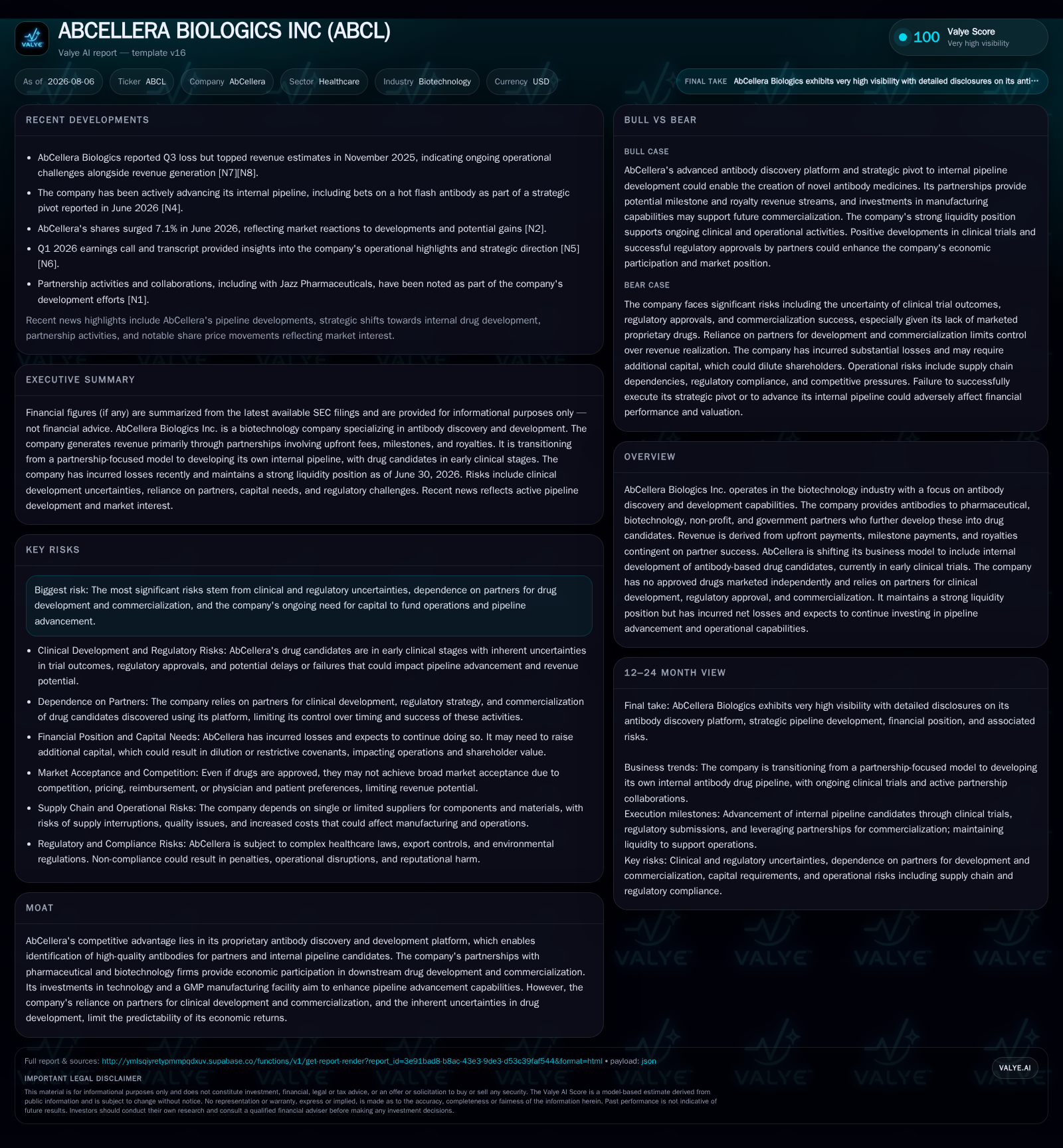
In its August 2026 quarterly filing, AbCellera Biologics detailed progress in advancing its early-stage internal drug candidates alongside ongoing revenue fluctuations tied to partnership milestones. The company is strategically transitioning from a pure antibody discovery service provider to an integrated developer with proprietary GMP manufacturing capacity, which increases fixed costs but aims to support future pipeline growth. Despite strong liquidity, AbCellera continues to incur substantial operating losses reflecting significant R&D and manufacturing expansion, underscoring dependency on successful partnerships and clinical execution for sustainable profitability.
Quarterly Progress Highlights: Operational Developments and Revenue Variability
AbCellera’s Q2 2026 financial disclosures reveal continued fluctuation in milestone payments underpinning revenue instability characteristic of platform companies reliant on partner-driven downstream success [S2], [S3]. While upfront research fees provide some baseline revenue, the bulk of economic participation depends on partners' successful advancement of antibodies discovered via AbCellera’s platform into clinical development and ultimately commercialization. This dependency manifests as unpredictable quarter-to-quarter revenue swings linked to variable milestone achievement timing. Notably, the company confirmed net losses persist, reflective of intensifying investments both in R&D aimed at internal candidate progression and expanding operational capabilities including GMP manufacturing [S2]. Such revenue volatility underscores how financial planning remains challenged by external factors outside AbCellera’s control — primarily its partners’ development decisions. Confirmation of stabilization or upward revenue trends would require sustained milestone payments or emerging royalty streams as partnered programs achieve market approval.
Dual-Engine Business Model: Balancing Platform Partnerships with Internal Pipeline Growth
Historically a pure-play antibody discovery platform provider monetizing through upfront fees, engineered research services, milestones, and royalties under partnership contract structures [S1], AbCellera is augmenting this model by investing significantly in developing proprietary antibody-based drug candidates internally [S2]. These early clinical pipeline activities mark a strategic pivot that rebalances revenue sources from largely variable partnership flows toward potential own-product commercial upside. However, this shift introduces new complexities: internally driven drug development demands higher R&D expenditures and operational infrastructure commitments before material returns are possible. Therefore, the company grapples with an elevated cost base while still awaiting predictable milestone inflows from partners. Success in progressing candidates through clinical trial phases—numbering multiple programs now—is pivotal for altering the risk profile toward internal value creation. This transition mirrors biopharma peers such as Morphic Therapeutic or IGM Biosciences navigating from discovery platforms toward dual service plus owned-pipeline biotech companies.
Competitive Dynamics: AbCellera’s Position Among Antibody Discovery Innovators
AbCellera leverages a proprietary combinatorial antibody discovery platform combining high-throughput screening and computational modeling to identify promising therapeutic antibodies rapidly [S1]. This technical moat differentiates it among antibody discovery platform providers by throughput efficiency and candidate quality metrics benchmarked industry-wide. Compared with peer efforts aiming for similar dual-model evolutions—including firms deploying next-generation sequencing or AI-driven design—AbCellera maintains competitive platform robustness. Nevertheless, the sector-wide challenges remain consistent: downstream regulatory approvals rest largely outside direct control; competitive pressures from biosimilar entrants and alternative biologics escalate; and innovation cycles demand continuous technological renewal. Thus, technological advantage sustains entry barriers but does not insulate completely against external uncertainties affecting timing and scale of realized revenues.
Manufacturing Investment: Building GMP Capacity to Support Clinical Advancement
Emerging from reliance solely on external manufacturing partners or CROs for antibody supply during early clinical phases, AbCellera recently prioritized the construction and capitalization of an internal GMP biologics manufacturing facility [S1], [S2]. This infrastructure investment is designed to reduce bottlenecks that traditionally slow candidate advancement due to third-party scheduling constraints or scale limitations. Owning GMP capacity offers potential margin improvement opportunities over time by enabling more integrated control over supply chain logistics critical for early-stage clinical material production. However, the tradeoff involves elevated fixed costs prominently contributing to quarterly operating loss magnitudes until fuller utilization is reached. The balancing act requires achieving efficient capacity usage rates measured via GMP manufacturing throughput KPIs while ensuring facility flexibility supports diverse candidate needs without excess overhead.
Growth Catalysts: Pipeline Expansion, New Partnerships, and Platform Enhancements
AbCellera’s forward growth vectors combine broadening its pipeline with invigorated partnership throughput. The number of internally progressed drug candidates entering or advancing through clinical trials has increased relative to prior periods [S2]. Simultaneously, new collaboration agreements continue supplementing topline via research service fees plus prospective milestone opportunities contingent on developmental achievements. In parallel, ongoing enhancements to computational discovery algorithms and automated screening platforms further improve candidate identification quality and speed — crucial for scaling collaboration value propositions [S1]. Together these drivers manifest in rising R&D spend aligned with expanding program breadth and long-term product development ambition. However, inherent industry uncertainties impose caution around projected timelines or probability-weighted success.
Risk Analysis: Clinical, Commercial, Regulatory Dependencies, and Financial Burn
Key risks confronting AbCellera crystallize around inherent biotechnology development uncertainties compounded by structural dependencies on third parties. With no approved drugs marketed independently yet [S1], the company’s commercial viability hinges partly on partner execution of regulatory filings, pivotal trial successes, eventual market access hurdles including reimbursement landscapes altered by evolving US healthcare regulations [S12], [S21], plus intellectual property contests settled only recently but illustrating exposure [S1]. Simultaneously, persistent operating losses driven by aggressive pipeline investment mandate sufficient capital access; absent recurring prepayment streams or milestone visibility raises funding uncertainty risks requiring equity or debt capital raises with attendant dilution effects contemplated openly [S2], [S9]. Moreover, biosimilar competition generating pricing pressure post-approval adds structural margin limitation threats.
Monitoring Indicators: Milestones, Cash Runway, and Clinical Readouts To Watch Next
For observers following execution momentum closely, several KPIs stand out: timing and magnitude of milestone payments signaling tangible partnership program advancements; emergence or growth of royalty revenues indicating commercialized product success; progression markers involving candidate transitions between clinical trial phases; R&D expense trajectories reflecting pipeline expansion pace; utilization rates at GMP manufacturing approximating facility integration efficiency; liquidity trends confirming runway sufficiency beyond near-term burn rates [S2], [F1]. Upcoming clinical data readouts or regulatory submissions represent binary inflection points warranting explicit attention given their outsized influence on valuation perceptions.
Financial Profile Discussion: Liquidity Strength Amid High Operating Losses
As of June 30, 2026, AbCellera held $120 million in cash and equivalents with current assets of $679 million and current liabilities of $53 million, resulting in a strong current ratio of approximately 12.77, indicating solid liquidity cushions supporting ongoing operations [F1]. These liquidity metrics reflect a robust balance sheet position despite ongoing net losses and high operating expenses driven by R&D investments and GMP infrastructure costs [S2]. Maintaining adequate financing access remains an operational imperative aligned with pipeline progression milestones.
This analysis synthesizes recent disclosures accentuating AbCellera’s strategic transition pressures balanced against competitive platform strengths and anticipates that future updates should be carefully interrogated along concrete KPI lines delineated above given prevailing biotech sector cyclicality combined with firm-specific investment baselines.
Disclaimer: This analysis is provided solely for informational purposes. It does not constitute investment advice or a research view regarding any securities or financial instruments.
Disclaimer: This is research-only, informational analysis and not investment advice. It may include AI-generated interpretation and general industry context. Always verify important details using primary sources.

Comments