
Coursera’s Post-Udemy Merger Focuses on AI-Driven Personalization amid Integration Challenges
Coursera’s latest quarter underscores operational alignment efforts following its merger with Udemy, reinforced by strategic AI investments and cost structure optimization.
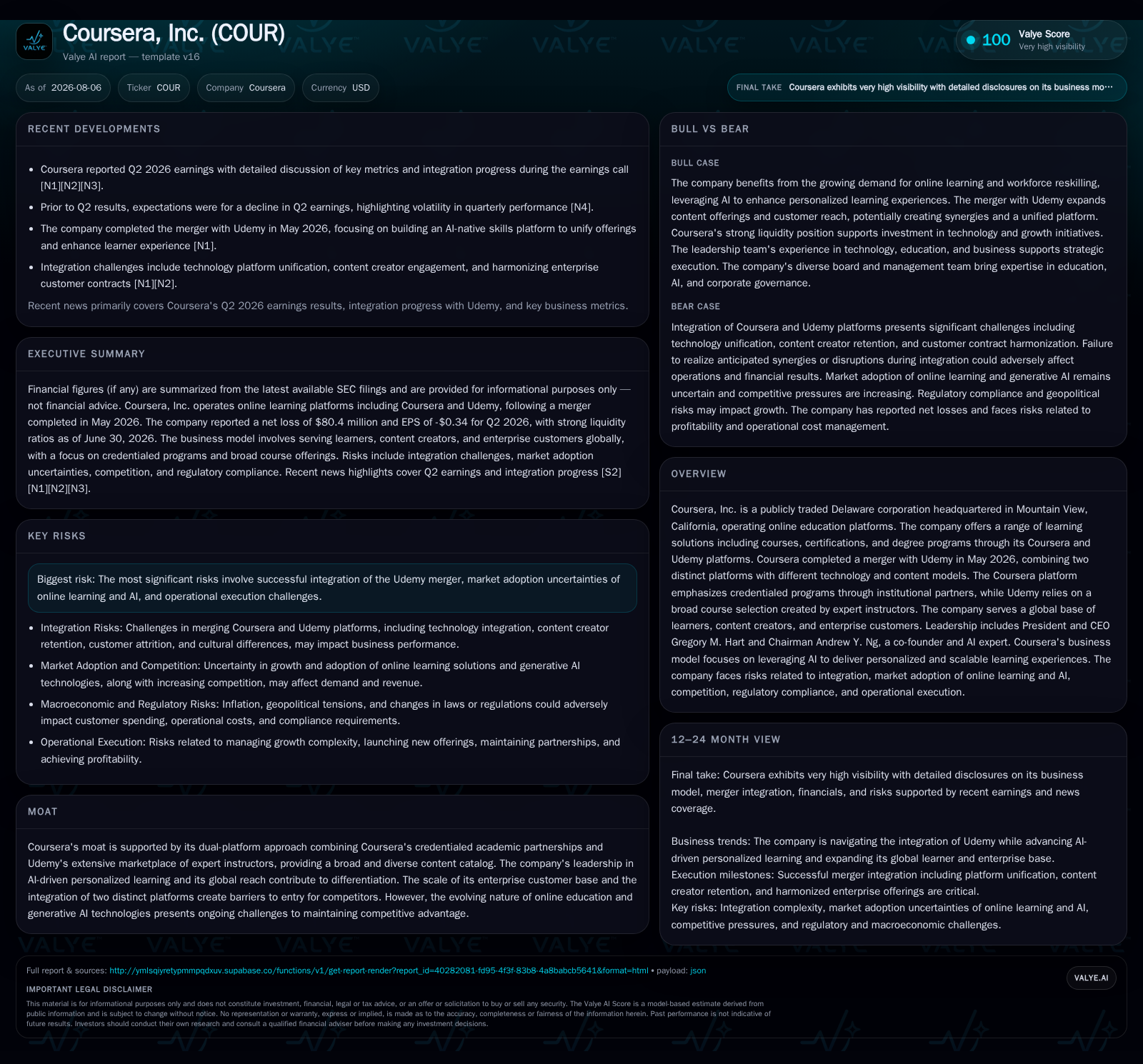
In Q2 2026, Coursera reported early stage integration activities following its May 2026 merger with Udemy, aiming to blend two distinct online education platforms: one credential-focused and the other marketplace-driven. The company is prioritizing AI-enhanced personalized learning experiences, leveraging its dual-platform content breadth to target both individual learners and enterprises globally. Despite notable cash reserves, Coursera faces execution risks in merging operating models and converting free users to paid customers amid evolving regulatory and market conditions. Its recent $100 million equity investment in AI-native LearnVector signals a push to deepen technological differentiation. Financially, it sustains a solid liquidity position but continues to operate at a net loss while undertaking workforce realignments to streamline costs.
Recent Operating Update: Merger Integration and Strategic Investments
Coursera’s Q2 2026 disclosures reflect operational headwinds typical of merging two large but technologically distinct online education platforms. The merger with Udemy, completed in May 2026, brings together Coursera’s credentialed academic partnerships with Udemy’s extensive marketplace of expert-created courses [S2][S8]. This dual-platform approach offers a broad course catalog that spans both formal degrees and flexible skill acquisition.
Notably, the company announced a $100 million equity investment in LearnVector Inc., an AI-native learning startup chaired by Andrew Ng—also Coursera’s board chairman—highlighting a strategic emphasis on advancing AI personalization capabilities [S3][S15]. The investment aims to bolster Coursera's long-term competitive moat by embedding cutting-edge adaptive learning technology but also underscores governance complexities due to intertwined leadership.
Parallel with these growth moves, Coursera committed to workforce reductions targeting $8 million to $11 million in severance-related expenses aimed at aligning the cost structure more closely with its evolving business objectives post-merger [S17]. These adjustments signal management attention towards driving operational efficiencies during integration complexity.
Business Model: Dual-Platform Education Marketplace
Coursera operates as a digital intermediary connecting learners worldwide with educational content providers via two complementary platforms. The traditional Coursera platform partners with accredited universities and institutions, offering MOOCs (Massive Open Online Courses), professional certifications, and fully credentialed degree programs. Revenue flows from subscription fees for specializations or degrees, certification payments from learners, and substantial enterprise learning contracts providing tailored training solutions for corporate clients [S1]
Udemy supplements this with a marketplace model where expert instructors create diverse courses spanning technical skills, creative arts, and personal development. Its monetization relies on course enrollments often driven by freemium-to-paid conversions on demand. This diversity enhances product breadth and learner choice but tends toward variable revenue quality due to differing pricing power and retention profiles compared to institutional credentials.
Monetization mechanics hinge on increasing Monthly Active Learners (MAL) and converting freemium users into paying subscribers or purchasers. Enterprise contracts contribute recurring revenue streams with potentially higher Average Contract Values (ACV) and better retention rates—key drivers behind accelerated investments in AI personalization tools that can boost learner engagement and completion rates.
The company also invests heavily in its Learning Management System infrastructure and AI engines that personalize research views based on user behavior data. While promising differentiation, these investments require rigorous execution to translate into sustainable revenue growth without diluting profitability amid competitive pressures from peers like edX (credentialed MOOCs) or LinkedIn Learning (enterprise skill platforms).
Industry Structure and Competitive Positioning
Online education platforms form a fragmented sector where scale, content credibility, technological sophistication (especially AI personalization), and enterprise penetration are critical moats. Coursera’s distinctive asset is the merged entity incorporating both high-credentialed academic content via university partners and the expansive catalogue breadth of Udemy’s expert-course marketplace [N1][S8]. This positions the company uniquely compared to single-focus peers such as Udacity focusing purely on nano-degree tech skills or LinkedIn Learning emphasizing corporate subscriptions.
However, such dual-platform complexity introduces integration risk at the technology stack level as well as customer experience friction points between credential-seeking learners versus casual market buyers. In particular, achieving consistent learner engagement metrics—such as Course Completion Rate—and maintaining positive Net Revenue Retention amid shifts in subscription pricing or contract terms will be closely watched by stakeholders.
Competitors face similar challenges balancing free or lower-cost alternatives prevalent in open content distribution with enterprise clients’ rising expectations for measurable outcomes and talent development linkage. Regulation around credential authenticity also shapes competitive dynamics; Coursera’s institutional partnerships provide defensible differentiation here but require navigating evolving laws around higher education accreditation standards globally.
Growth Drivers
Several structural trends underpin growth opportunities for Coursera:
- Global Demand for Flexible Education: Rising internet penetration outside mature markets fuels demand for scalable digital learning accessible anytime.
- Enterprise Digital Transformation: Corporate budgets expanding for upskilling workers favor integrated learning solutions aligned with business outcomes.
- AI Personalization Advances: Improvements in adaptive learning algorithms can enhance learner engagement and reduce churn through tailored pathways.
- Shift Towards Lifelong Learning: Workers increasingly prioritize continuous skill updating over traditional degrees, expanding addressable markets.
- Credential Acceptance Growth: Greater employer recognition of online credentials propels enrollment in programs affiliated with universities.
- Mobile/On-Demand Consumption: Increasing use of mobile devices enables microlearning formats favored by younger demographics.
Coursera’s investment in LearnVector aligns directly with exploiting advances in AI-driven personalization expected to screen as one of the strongest competitive differentiators going forward [S3], reinforcing underlying content offerings while enhancing learner conversion rates.
Risks and Watchpoints
The primary risks revolve around:
- Merger Integration Complexity: Blending different technology architectures, culture norms, customer bases, pricing models, and operational processes could slow synergy realization or disrupt service levels [S2][S8].
- Market Adoption Uncertainty: Uptake of innovative AI features alongside established offerings remains uncertain; failure may weaken conversion or retention gains.
- Regulatory Environment: New laws targeting AI deployment (e.g., EU’s AI Act effective by 2027) may increase compliance costs or constrain usage scenarios critical for platform differentiation [S23].
- Content Partner Dependence: Changes in relationships or terms with universities or marketplace instructors could reduce access to premium content or increase costs.
- Competition from Free/Low-cost Alternatives: Easily accessible alternatives raise pressure on pricing power and conversion economics.
- Talent Retention Amid Restructuring: Workforce reductions risk morale erosion impacting productivity during delicate integration phases [S17].
- International Expansion Challenges: Scaling localized versions while managing compliance risks across jurisdictions remain operationally demanding.
Continuous monitoring of learner engagement KPIs like churn rate trends, paid learner conversion velocity, enterprise renewal rates, ARPU shifts, and cost synergies achieved post-merger will be crucial markers for management effectiveness.
What To Watch Next
Key upcoming milestones and indicators include:
- Quarterly updates addressing merger synergy realization progress,
- Detailed reporting on LearnVector collaboration outcomes,
- Changes in monthly active learner counts including funnel conversion data from freemium users,
- Enterprise client additions or expansions measured through average contract value,
- Adjustments to subscription pricing regimes reflective of market feedback,
- Regulatory developments impacting AI deployment or credential recognition,
- Workforce change impact assessment especially regarding operating cost improvements versus talent loss,
- Product feature rollouts blending Coursera’s credential offering with Udemy’s marketplace capabilities,
- Progress on international market penetration including new country launches or localization enhancements.
Financial Profile Discussion
As of Q2 2026 ending June 30th, Coursera maintains robust liquidity metrics with cash and cash equivalents totaling approximately $872 million against current liabilities of $768 million yielding a comfortable current ratio near 1.59 [F1]. This financial footing provides headroom to fund ongoing merger integration expenses including the announced workforce realignment estimated between $8 million to $11 million payable mainly across H2 2026 [S17].
Despite solid cash reserves, profitability remains a challenge; last full-year-end reported operating income was negative $77.4 million while net loss stood at $51 million at December 31, 2025 [F1]. Continued investments into technology platforms—particularly AI innovation—and marketing efforts to drive consumer upgrades weigh heavily on margins during this scale phase [S1][N3].
This financial profile aligns broadly with SaaS-like KPIs seen among online education peers balancing recurring revenue growth ambitions against still-maturing unit economics under continued consolidation pressures.
This analysis is prepared solely for informational purposes based on publicly available filings as of August 2026. It does not constitute investment advice nor an endorsement of the company’s securities.
Disclaimer: This is research-only, informational analysis and not investment advice. It may include AI-generated interpretation and general industry context. Always verify important details using primary sources.

Comments