
Norwegian Cruise Line Strengthens Margins Despite Shipyard Capacity Hurdles
Q2 2026 results highlight improved profitability amid operational constraints from limited shipyard availability and liquidity pressures.
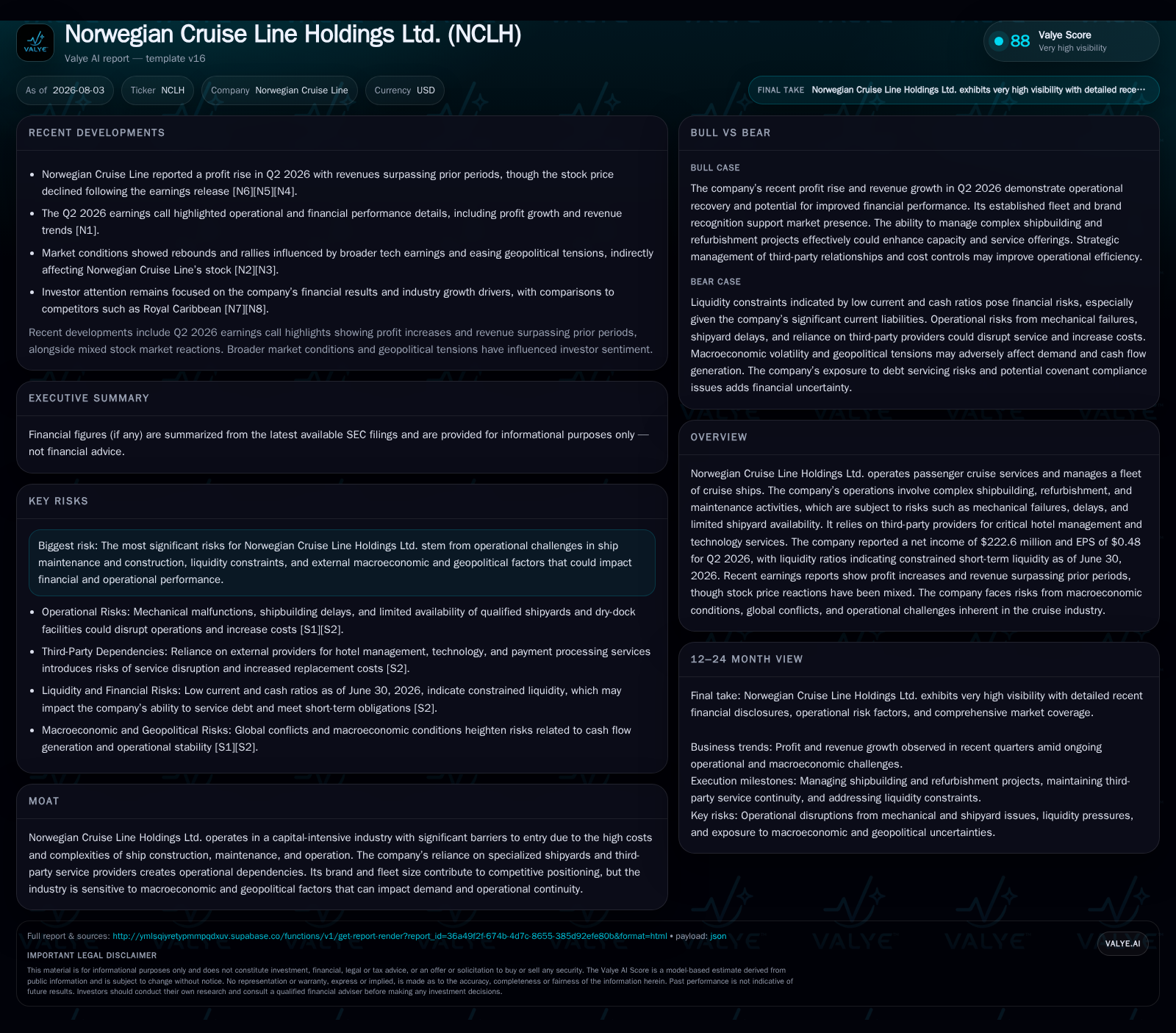
Norwegian Cruise Line Holdings Ltd. (NCLH) reported a net income of $222.6 million and EPS of $0.48 for Q2 2026, exceeding prior periods, driven by rising revenue and improved operating margins [S2][S3]. However, the company faces ongoing operational challenges related to mechanical failures and constrained shipyard capacity, limiting its ability to maintain and expand its fleet efficiently [S2][S1]. Liquidity remains tight with a current ratio near 0.2, underscoring capital structure strain in a capital-intensive industry [F1]. Competitive pressures persist from peers like Royal Caribbean and Carnival, especially concerning fleet modernization and cost control. Growth opportunities are anchored in increasing experiential travel demand and premium onboard offerings, yet realized growth depends on managing refurbishment cycles and booking momentum.
Q2 Earnings Beat Amid Operational Tightness
Norwegian Cruise Line Holdings Ltd. delivered solid second-quarter 2026 results with net income reported at $222.6 million and earnings per share of $0.48 [S2][S3]. This marks a clear profitability improvement over comparable prior periods driven by stronger revenue flows and operating margin expansion. Yet the stock's mixed market reaction indicates investor wariness about persistent underlying operational challenges — chiefly liquidity constraints and pressures from limited shipyard capacities curtailing maintenance flexibility. While top-line growth highlights resilient demand for cruise experiences post-pandemic recovery, these bottlenecks temper confidence in sustained margin momentum.
Complex Fleet Economics Underpinning Revenue Growth
NCLH's business model centers on monetizing its fleet capacity through multi-day passenger voyages sold primarily via direct bookings and travel agency partnerships [S1]. Revenue streams weigh heavily on ticket sales complemented by onboard spending encompassing food & beverage, entertainment, retail stores, shore excursions, and premium upgrades. Occupancy rate—the proportion of available berths filled—alongside average daily rate (ADR) are primary levers driving passenger yield (revenue per available passenger day), which ultimately governs revenue quality and margin trajectory.
Third-party service providers manage critical hotel operations and technology infrastructure onboard providing lodging-like experiences but creating dependence exposure if disruptions occur [S1][S2]. Improved occupancy amplifies profitability but only if managed alongside effective cost control.
Shipyard Constraints Crimp Refurbishment and Expansion Capacity
A material operational risk disclosed in the quarterly filing relates to mechanical failures coupled with scarce shipyard availability—particularly in the Western Hemisphere—that disrupt ship refurbishment cycles crucial to safety compliance and guest experience enhancements [S2]. Dry-docking ships for maintenance or refurbishment is time-consuming and resource-intensive, requiring advance scheduling within an already congested global shipbuilding backlog.
Mechanical faults involving specialized maritime systems like propulsion pods or steering gear can trigger unexpected voyage cancellations or costly unplanned repairs. The limited number of qualified shipyards means delays propagate across the fleet’s refurbishment schedule, impacting overall operational continuity [S1][S2]. This restricts Norwegian's ability to timely modernize its aging vessels or expand fleet capacity through new builds or charter agreements—both key for competitive relevance.
Marketplace Dynamics: Competitive Context within Passenger Cruise Lines
Within the highly consolidated cruise industry where Carnival Corporation and Royal Caribbean dominate global scale, NCLH maintains a smaller fleet footprint compelling it to rely on brand differentiation strategies involving differentiated itineraries spanning North America into emerging markets as well as enhancements in onboard premium amenities.
Pricing power relative to peers benefits from targeted customer loyalty programs but remains sensitive to macroeconomic headwinds affecting discretionary travel budgets. Operating efficiency gains lagging those of larger peers constrain margin expansion potential but also position NCLH to capitalize on specialized niche segments focused on experiential travel demands informed by shifting consumer preferences.
Growth Catalysts: Leveraging Demand, Fleet Modernization, and Premiumization
Structural tailwinds supporting growth include rising disposable incomes globally fueling greater leisure travel expenditure among middle-class consumers seeking immersive experiences. NCLH’s investments in newer ship classes with enhanced fuel efficiencies alongside starboard luxury offerings such as upscale dining venues or exclusive shore excursions cater directly to this trend.
Expansion into less saturated regions combined with alliances with booking platforms augments distribution reach enhancing booking velocity reflected in occupancy upticks—a concrete KPI investors should track closely. Current ratio near 0.2 illustrates constrained short-term financial flexibility due mostly to high current liabilities outpacing assets as of June 30, 2026 [F1]. This status limits buffer against unforeseen disruptions such as voyage cancellations due to mechanical failures or geopolitical events constraining port access or consumer willingness to cruise certain routes [S2].
Fuel price volatility further complicates operating cost predictability given large bunkering expenses comprising a significant share of variable costs. Additionally, reliance on third-party providers injects execution risk impacting guest satisfaction scores—a key qualitative KPI underpinning repeat bookings.
These risks collectively justify cautious market sentiment despite demonstrated earnings improvements.
Monitoring Points Ahead: Bookings, Dry-Dock Schedules, Capital Spending
Going forward, several execution milestones will significantly affect Norwegian’s trajectory:
- Booking momentum: early-year reservation trends provide forward visibility into demand resilience amidst inflationary pressures.
- Dry-dock planning: adherence to scheduled maintenance windows without prolonged downtime will maintain vessel availability maximizing revenue days.
- Capital expenditures discipline: balancing investments between refurbishments versus new builds will signal strategic prioritization amid limited liquidity. Analysis of these metrics against disclosed timelines can affirm or challenge assumptions about sustainable profitability enhancement versus margin compression due to deferred maintenance or lost revenue days.
Financial Profile Discussion: Capital Structure Pressures Amid Profit Gains
As of June 30, 2026, Norwegian Cruise Line held approximately $218 million in cash and equivalents against nearly $6.32 billion in current liabilities resulting in a critically low current ratio of about 0.2 reflecting persistent liquidity strain inherent in this capital-intensive sector [F1]. Total debt data is not confirmed for the current period, but prior figures indicated roughly $1.7 billion outstanding [F1]. Despite this tight financial posture, net income improvements reinforce operational efficiency gains realized throughout Q2 2026 [S2][S3].
The confluence of strengthened earnings alongside capital structure pressure underscores a pivotal operational tradeoff common among cruise lines: scaling profitable growth via fleet modernization while managing refinancing risks amid demanding credit markets. This dynamic necessitates meticulous balance sheet stewardship coupled with focused cash flow generation from core operations including sustained occupancy rate improvements and ramped onboard revenue capture.
Disclaimer: This is research-only, informational analysis and not investment advice. It may include AI-generated interpretation and general industry context. Always verify important details using primary sources.

Comments