
Home Bancorp Strengthens Regional Position with Solid Capital and Loan Growth
Q2 2026 results highlight Home Bancorp's stable equity gains and continued expansion in deposit and loan balances across its multi-state regional footprint.
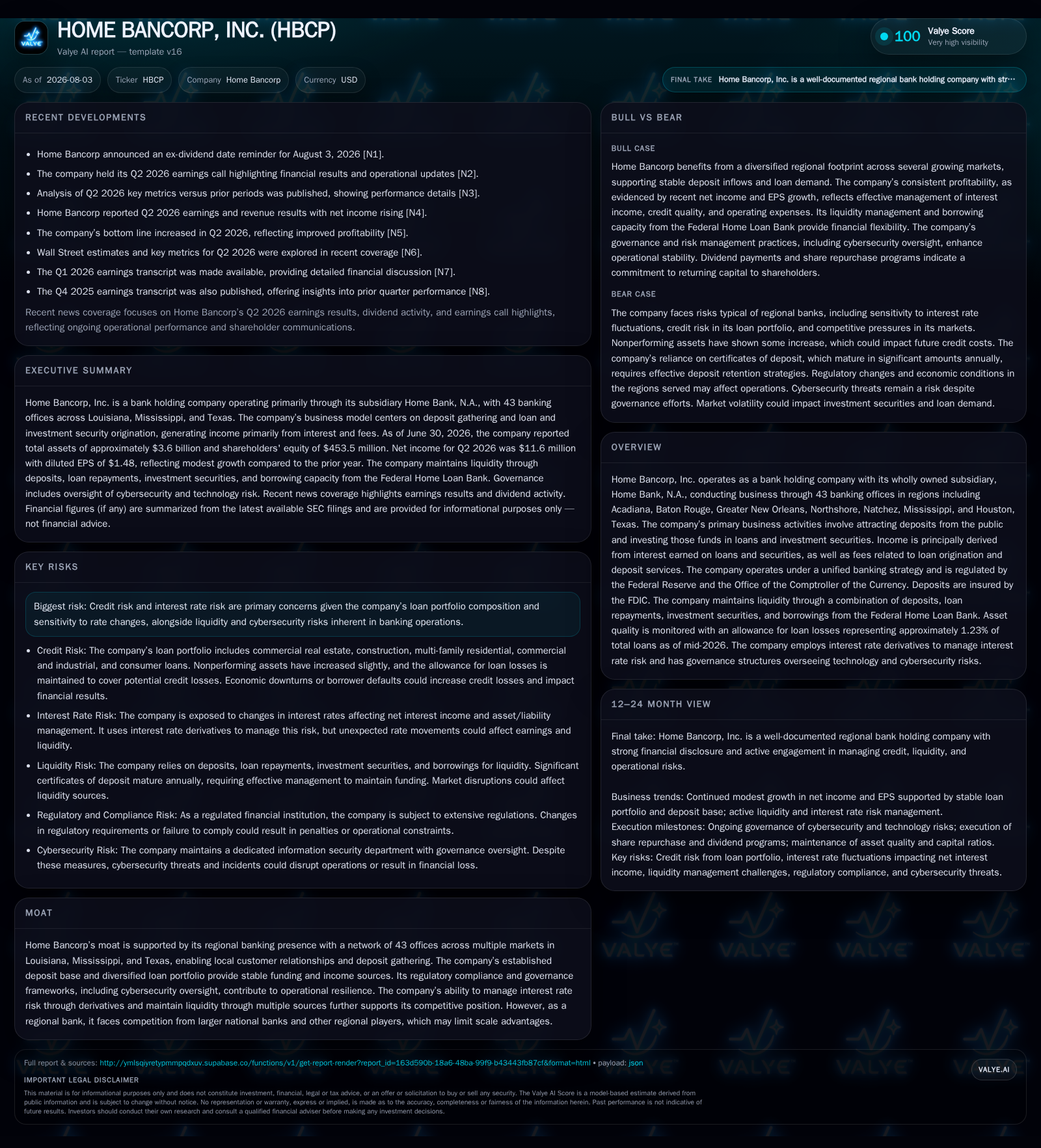
Home Bancorp, Inc. reported a 4.2% increase in shareholders’ equity in H1 2026, driven by $23 million in net income and offset slightly by other comprehensive losses and dividends [S2]. The company continues to grow deposits and loans steadily across its Louisiana, Mississippi, and Texas markets, supported by a diversified loan portfolio and a robust deposit base [S1][S2]. Its regulatory capital remains well above minimum thresholds, reflecting prudent risk management amid interest rate sensitivity monitoring [S2]. While competitive pressures from larger national banks persist, Home Bancorp leverages its localized branch network and sound governance framework including dedicated cybersecurity oversight to maintain operational resilience [S1]. Loan quality metrics and liquidity profiles remain solid as the bank navigates a complex regional economic environment.
Recent Operating Update: Q2 2026 Financial Snapshot
Home Bancorp's latest quarterly filing reports a 4.2% increase in shareholders' equity over six months ending June 30, 2026, rising to $453.5 million from $435.1 million at December-end 2025 [S2]. This gain primarily reflects net income generation of $23 million during the period, partially offset by accumulated other comprehensive loss on available-for-sale investment securities and dividend payouts. The bank's capital position remains comfortably above regulatory minimums for both the holding company and Home Bank subsidiary, affirming sound capitalization amidst evolving interest rate conditions.
Loan portfolios reached approximately $2.78 billion gross with an allowance for loan losses totaling nearly $34 million (about a 1.22% coverage relative to gross loans), demonstrating conservative credit risk buffers [S2]. Deposit balances exceeded $3 billion at quarter-end, with growth predominantly driven by core noninterest-bearing and interest-bearing accounts totaling roughly $835 million and $2.23 billion respectively. Such a deposit base provides stable funding vital for sustaining lending activities in Home Bancorp’s chosen markets across Louisiana, Mississippi, and Texas [S1][S2].
Interest rate sensitivity is actively managed through scenario testing primarily focused on net interest income projections over the near term [S2]. This proactive asset/liability strategy aims to maximize profitability while containing risk exposure—critical given fluctuating rate environments impacting regional bank margins.
Business Model: Regional Banking with Local Roots
Home Bancorp functions as a classic regional bank holding company anchored by its subsidiary Home Bank N.A., which administers retail and commercial banking across a geographically focused network of 43 branches spread over multiple territories including Acadiana, Baton Rouge, Greater New Orleans areas in Louisiana; Natchez in Mississippi; Northshore Louisiana; and Houston Texas hubs [S1]. Owning most branch real estate enhances operational control versus leased facilities.
The core business is intermediary banking: mobilizing customer deposits insured by FDIC into productive loans supporting local consumers and businesses. Income is chiefly derived from net interest margin—the spread between interest earned on loans/securities minus funding costs—and supplemented by fee income related to loan origination and deposit services [S1][N3]
Revenue drivers depend on sustained deposit gathering coupled with measured loan growth balanced against credit quality maintenance through allowances for potential losses. Fee income adds diversification but comprises a smaller portion relative to interest income typical for regional banks.
This model emphasizes relationship banking within communities where localized knowledge aids underwriting precision and customer retention but competes against larger national institutions offering broader product suites or digital-first fintech providers appealing to convenience-driven customers.
Industry Structure and Competitive Landscape
Regional banks like Home Bancorp occupy mid-tier segments between large national banks with scale advantages (e.g., Wells Fargo or Regions Financial) and community banks with tighter hyperlocal footprints. They benefit from regulation that balances safety requirements without unduly restricting growth potential but face structural challenges including compressed net interest margins amid low or volatile rates.
Competition broadly stems from:
- Larger national banks able to leverage scale for technology investments,
- Community banks competing fiercely via personalized service,
- Credit unions attracting deposits with preferential rates,
- Fintech entities disrupting traditional channels offering streamlined digital products.
Home Bancorp’s competitive edge lies in its extensive regional branch coverage facilitating intimate customer relationships conducive to cross-selling opportunities of loans, deposit products, treasury management services, and wallet share capture among small-to-medium enterprises—core clientele within its markets.
Growth Drivers
Growth prospects hinge on multiple factors:
- Regional economic expansion in Louisiana, Mississippi, Texas fuels demand for commercial lending tied to oil & gas services, agriculture, manufacturing sectors alongside consumer credit needs;
- Continued deposit growth driven by population trends particularly in urban hubs like Houston;
- Favorable interest rate environments that expand net interest margins enhancing lending economics;
- Technology adoption efforts improving online/mobile banking experience aiding customer retention;
- Potential branch network optimization balancing physical presence while expanding digital channels;
- Regulatory adaptations enabling new financial products or fee structures.
Concrete KPIs include sustained loan-to-deposit ratios sufficient for margin optimization without liquidity stress; stable nonperforming asset ratios signaling controlled credit risk; allowance levels aligned with emerging charge-offs; efficiency ratios reflecting cost management; plus return on assets/equity measures monitoring profitability health.
Risks and Watchpoints
Prominent risks facing Home Bancorp encompass:
- Credit risk escalation if borrower defaults rise due to localized economic downturns or sectoral distress;
- Interest rate risk affecting both the bank’s net interest income sensitivity and securities portfolio fair values;
- Liquidity concerns triggered by atypical depositor withdrawals or funding mismatches;
- Cybersecurity threats necessitating robust governance frameworks highlighted by executive-level oversight boards;
- Increasing competition eroding pricing power or market share especially from technologically advanced peers;
- Regulatory compliance burdens including capital adequacy standards requiring vigilant balance sheet management.
Monitoring key metrics such as rising nonperforming assets ratios or unusual shifts in allowance for credit losses will be critical early indicators of stress. Furthermore, tracking changes in deposit composition or volatility offers insight into underlying liquidity dynamics.
What To Watch Next
Investors should look closely at upcoming quarterly releases for:
- Loan portfolio quality trends including new delinquencies or charge-offs;
- Net interest margin trajectory influenced by evolving Fed policy actions;
- Deposit growth sustainability amid competitive pressures;
- Efficiency ratio progress indicative of expense management relative to revenue gains;
- Updates on technology investments or cybersecurity initiatives reflecting strategic positioning.
Economic indicators within Home Bancorp’s served regions—such as employment growth rates or industrial output—can serve as leading signals for demand shifts impacting its core lending activities.
Financial Profile Discussion
As of June 30, 2026, Home Bancorp demonstrated a fortified financial profile characterized by an enhanced capital base surpassing regulatory minima comfortably [S2]. The quarterly increase in shareholders’ equity by $18.4 million (or 4.2%) underscores ongoing profitability combined with prudent dividend policy balancing shareholder returns against capital preservation
Liquidity remains adequate supported by $188 million in cash equivalents alongside diversified funding sources including stable deposit inflows (over $3 billion total) supplemented internally via loan repayments plus modest borrowings from Federal Home Loan Bank advances—which stood at zero at quarter-end after paying down previous notes—showing balance sheet flexibility [S2]
The allowance for loan losses maintains roughly a one percent-plus coverage level reflecting cautious provisioning consonant with peer regional banks operating within similarly cyclical markets. Efficiency metrics were not detailed explicitly but remain a crucial area given industry-wide pressure on cost control against revenue fluctuations.
Overall leverage ratios align with conservative thresholds typical of well-managed regional companies regulated under Federal Reserve supervision paired with OCC oversight ensuring soundness.
This analysis synthesizes publicly disclosed regulatory filings with market knowledge pertinent to the regional banking sector but does not constitute investment advice nor an endorsement of any security mentioned herein.
Disclaimer: This is research-only, informational analysis and not investment advice. It may include AI-generated interpretation and general industry context. Always verify important details using primary sources.

Comments