
Arthur J. Gallagher Expands Global Footprint with Acquisition-Fueled Growth and Technology Integration
Gallagher leverages acquisitions and technology platforms to reinforce its position as a top-tier global insurance broker and risk management firm amid intense competition and regulatory complexity.
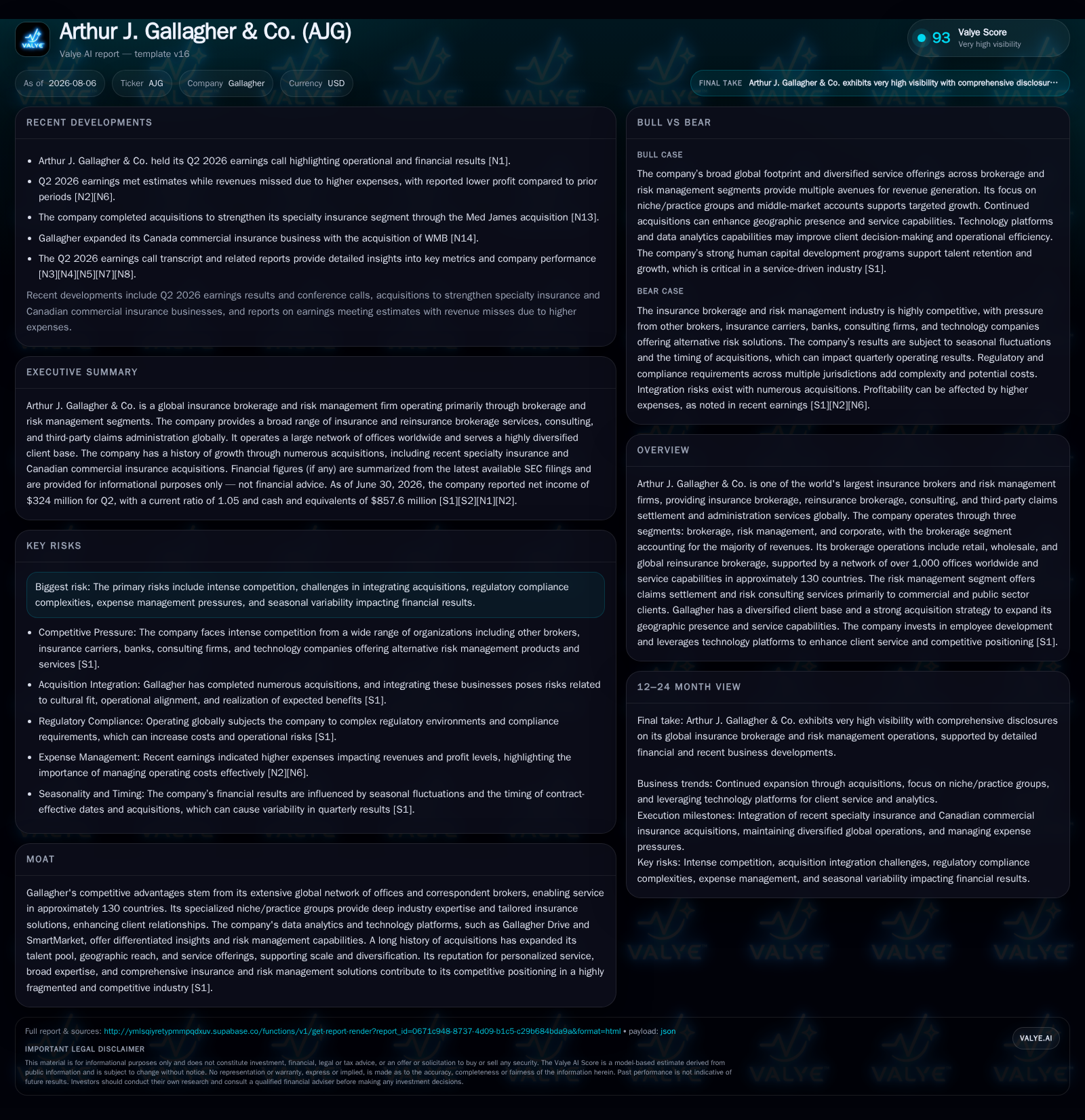
Arthur J. Gallagher & Co. reported steady organic revenue growth alongside acquisition-driven expansion in Q2 2026, supported by its diversified brokerage and risk management segments. The firm’s broad geographic reach across approximately 130 countries and specialized niche groups underpin client retention and cross-selling opportunities. Continued investments in technology platforms enhance client advisory capabilities while integration costs weigh on near-term margins. Key risks include competitive pressure, complexity in acquisition integration, regulatory challenges, and talent retention. Financially, the company maintains a solid liquidity profile with manageable leverage following sizable recent acquisition financings.
Recent Operating Update
The company's brokerage segment remains the primary revenue source—approximately 87% of total revenues in 2025—with a broad product mix spanning commercial insurance lines (property/casualty, health & welfare) alongside specialty practices supporting sectors like life sciences, real estate/hospitality, technology & communications, among others [S1][S23]. This specialization enables more tailored client solutions enhancing retention and lending competitive advantage against peers reliant on less differentiated offerings.
Complementing brokerage operations is the risk management segment contributing about 13% to overall revenues. It focuses on claims settlement and administration services for clients opting for self-insurance or third-party claims management over traditional underwriting enterprise processes. Fee structures here are diverse—ranging from per-service fees to cost-plus or performance-based models—which provide some revenue stability even as premium volumes may fluctuate with economic cycles [S1][S24]
Business Model Deep Dive
Gallagher operates as an intermediary connecting clients—commercial enterprises, public sector bodies, nonprofits—and underwriting enterprises such as insurance carriers globally. The firm's revenue predominantly derives from brokerage commissions earned on placing insurance or reinsurance policies tailored to client risk profiles along with consulting fees for risk management advice and claims administration charges.
This mixed monetization model benefits from globalization; Gallagher's network spans over 1,000 offices covering roughly 130 countries via direct operations and correspondent brokers offering local expertise while ensuring global service continuity. The segmentation into retail brokerage with strong niche/practice groups permits targeted marketing and product development aligned with specific industry risk exposures.
Acquisitions remain a strategic lever enabling geographic expansion into high-growth markets (e.g., Canada via WMB acquisition) and augmenting specialty capabilities particularly in complex lines or captive insurance advisory. Such deals increase average premium volume managed—a critical KPI reflecting scale—and broaden the client base for cross-selling complementary risk solutions [S15][S22]. However, these acquisitions come at integration costs which temporarily compress adjusted EBITDAC margins
Technology underpins Gallagher's service differentiation; proprietary platforms like Gallagher Drive provide granular data analytics enabling clients to optimize insurance portfolios effectively while SmartMarket assists carrier partners with underwriting intelligence enhancing placement precision—a competitive edge in an otherwise fragmented industry dominated by global peers like Marsh McLennan or Aon [S20].
Industry Structure and Competitive Position
The insurance brokerage landscape is characterized by intense competition involving global players striving to offer end-to-end risk management solutions beyond traditional placements—encompassing reinsurance brokerage, risk consulting, claims administration, and benefits consulting. Gallagher ranks as the world's third-largest broker based on recent industry evaluations and benefits from its vast office network bridging mature markets such as the U.S., U.K., Australia with emerging jurisdictions.
Differentiation arises through specialized niche teams which deepen technical expertise delivering tailored industry-specific solutions—a requirement given rising risk complexity globally including cyber liability, political risk/trade credit exposures, environmental liability etc. Client retention hinges on demonstrated value-add through superior claims outcomes combined with technology-enabled insights.
Peer comparisons (Marsh McLennan, Aon) show similar reliance on acquisition-driven growth balanced by organic expansion strategies; however, Gallagher's focused investment in data-centric platforms could enable better client advisory velocity if successfully scaled across newly acquired units post-integration.
Growth Drivers
Key growth avenues include:
- Continued consolidation of regional/specialty brokers bolstering scale effects across multiple geographies.
- Increasing demand for specialized insurance products spurred by complex risk environments encouraging corporate clients to seek bundled brokerage plus consulting plus claims outsourcing solutions.
- Expansion of self-insurance arrangements elevating third-party claims administration requirements fosters recurring fee income streams.
- Incremental cross-selling enabled by broad service spectrum amplifying wallet share per client account.
- Technological innovation offering clients enhanced transparency into risk exposures accelerates adoption of advanced analytic tools enhancing retention.
- Regulatory changes globally increasing compliance costs benefit brokers providing advisory services mitigating non-compliance risks.
- Economic growth trends supporting rising premium volumes underpin commission base expansion, all partially evidenced by recent reported organic revenue gains between 5-6 % within brokerage and risk management divisions despite macroeconomic uncertainties [S1][N3]
Risks / Watchpoints / Growth Constraints
While Gallagher exhibits robust prospects, key constraints include:
- Intense competition pressuring commission rates necessitates continuous innovation in client value propositions.
- Integration risks inherent in frequent acquisitions may dilute near-term profitability or distract managerial focus if not managed effectively.
- Regulatory complexities requiring multinational compliance impose operational overhead; any failures can set off reputational damage.
- Ongoing IRS investigations into captive advisory operations highlight legal uncertainties that could result in material penalties or business restrictions affecting future revenues [S9][S24].
- Dependence on talent retention amid increased compensation pressures raises sustainability questions for service quality particularly given specialist nature of many practice areas.
- Foreign exchange volatility impacts international earnings translating into income statement fluctuations given 33% international revenue exposure.
- Variability in contingent revenue streams linked to underwriting enterprise performance adds unpredictability compared to steady commissions.
Monitoring client retention metrics and progress on acquisition integrations will be instrumental for assessing sustainable long-term growth trajectory against these headwinds.
What to Watch Next
Investors should track upcoming quarterly disclosures to discern organic revenue growth versus acquisition impact—a vital indicator whether underlying core business continues solid momentum independent of M&A activity [N3]. Progress updates concerning integration expenses tied to Woodruff Sawyer will shed light on cost absorption timelines relative to original $150 million target over three years announced during deal closure in early 2025 [S15].
Enhanced clarity around regulatory developments pertaining captive advisory business remains critical given ongoing investigations dating back several years—any adverse rulings warrant close scrutiny due to potential earnings volatility implications.[S9]
Moreover, technological platform adoption rates among new subsidiaries will be telling for scalability potential of data analytics differentiators underpinning competitive moats long term.[S20]
Finally, cash flow generation trends relative to debt servicing capacity should be observed considering $12 billion net debt load primarily driven by transformative acquisitions completed recently [F1]
Financial Profile Discussion
As of June 30, 2026, Gallagher's balance sheet shows a current ratio of approximately 1.05, reflecting adequate short-term liquidity with current assets of $45.5 billion and current liabilities of $43.2 billion [F1]. The company holds cash and equivalents of $857 million as of September 30, 2023, and total debt estimated at $12.9 billion with net debt near $12.0 billion as of December 31, 2025 [F1]. Undrawn revolving credit facilities total $2.5 billion, extended through April 2030, with no borrowings currently outstanding under this line. Additionally, premium financing facilities in Australia/New Zealand have about $226 million borrowings outstanding [F1][S4][S5].
Disclaimer: This analysis is based exclusively on publicly available filings from Arthur J. Gallagher & Co., supplemented by recent financial news reports. It aims solely to illuminate company fundamentals and sector context rather than offer investment research views.
Disclaimer: This is research-only, informational analysis and not investment advice. It may include AI-generated interpretation and general industry context. Always verify important details using primary sources.

Comments