
Western New England Bancorp Battles Margin Pressures with Stable Credit Quality in Q2
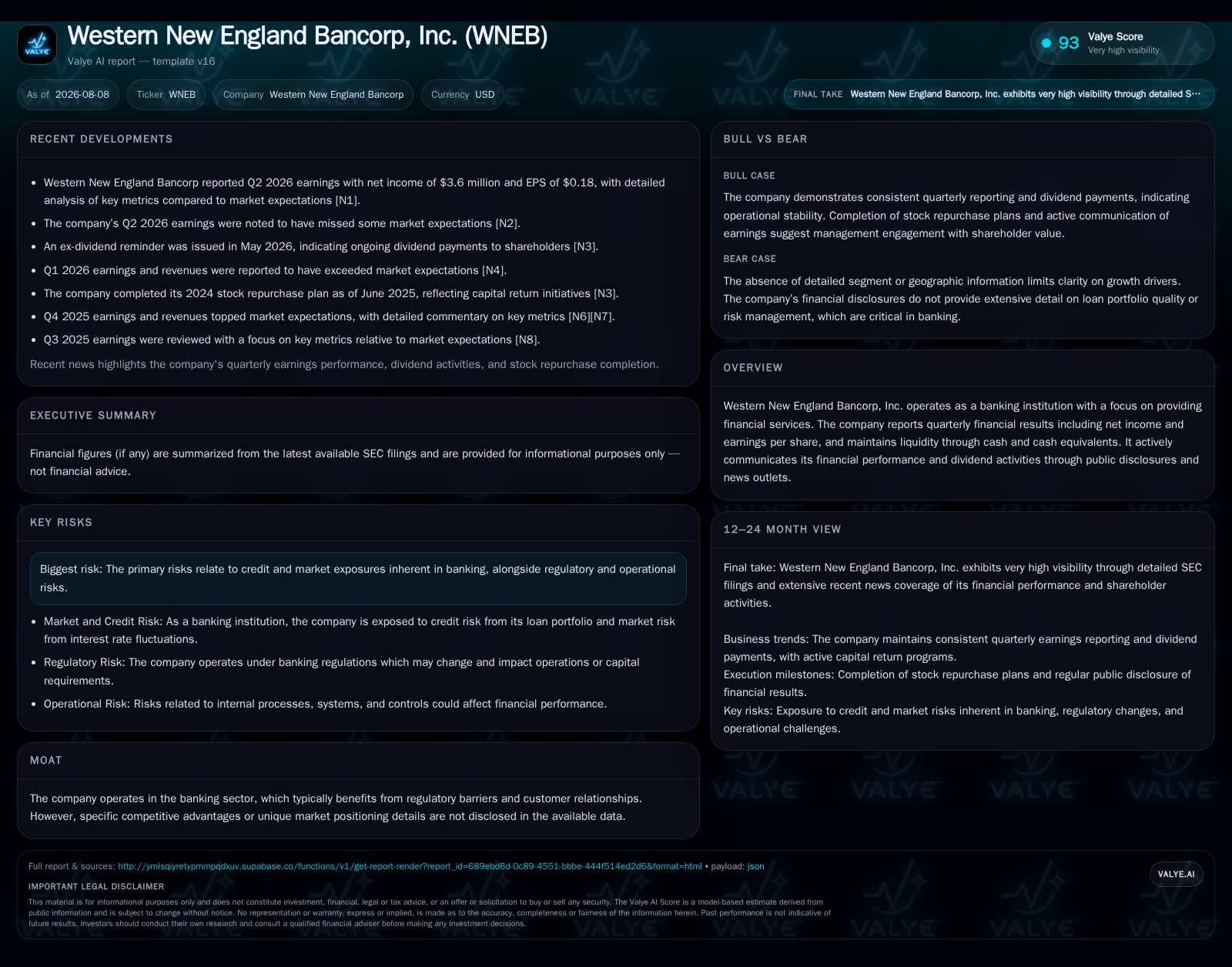
In Q2 2026, Western New England Bancorp faced compressing net interest margins amid rising funding costs, while maintaining solid credit metrics and disciplined cost controls.
Western New England Bancorp's 2026 second-quarter results reveal net interest margin compression primarily driven by increased funding costs and deposit beta adjustments. Despite margin pressures, the bank maintained loan portfolio growth and exhibited stable credit quality with measured allowances for loan losses. Operating expenses remained controlled, signaling operational discipline in a challenging regional banking landscape. These dynamics underscore the balance regional banks must strike between capturing loan growth and managing profitability amid evolving interest rate conditions.
Q2 Operational Results: Margin Dynamics Under Pressure from Funding Cost Changes
Western New England Bancorp's latest quarterly filing for Q2 2026 reveals a contraction in its net interest margin (NIM), a key profitability lever for regional banks [S2][S3]. The decline is attributed largely to elevated funding costs stemming from an increased deposit beta––the sensitivity of deposit rates to broader market interest rate movements. As interest rates rose through the recent quarters, the bank faced pressure passing on these costs fully to borrowers given competitive local market conditions. This dynamic leads to squeezed spreads between loan yields and deposit costs, challenging net interest income growth.
This margin pressure is typical among regional banks navigating a rising rate environment where customer deposits reprice more quickly than loan yields adjust [N1]. Western New England Bancorp's experience mirrors peers such as M&T Bank or KeyCorp, which have reported similar NIM compression due to deposit beta effects amidst competitive deposit markets. The significance lies in how the bank manages this compression without sacrificing loan growth or credit quality.
Interpreting Western New England Bancorp’s Business Model within Regional Banking Economics
Western New England Bancorp operates as a traditional regional banking institution focused on community-anchored lending and deposit-taking activities [S1]. Its revenue derives primarily from net interest income—interest earned on a loan portfolio extended to individuals, small businesses, and regional commercial clients minus interest paid on customer deposits. Complementary fee income streams exist but constitute a smaller proportion relative to core lending margins.
Loan portfolio expansion remains central to growth strategies; however, profitability pivots on sustaining favorable net interest spreads amid fluctuating funding costs. The allowance for credit losses methodology incorporates quantitative modeling of historical loss trends alongside forecasted economic factors affecting borrower risk profiles [S1]. This prudent approach helps maintain stable credit quality indicators even when macroeconomic headwinds emerge.
Operating expenses are controlled through efficient branch operations and leveraging technology where feasible, supporting disciplined cost structures which impact the efficiency ratio—the measure of operating expenses relative to revenues. This ratio is critical in regional banks as it reflects operational leverage potential amid fixed-cost branch networks.
Competitive Landscape: Benchmarking Margins, Credit Quality, and Efficiency Ratios Among Peers
Benchmarking Western New England Bancorp against community bank peers affirms common sector challenges. Net interest margin compression parallels trends seen across regional banks facing higher deposit betas due to competitive deposit markets [N1]. While peers often expand fee incomes as offsetting mechanisms, Western New England Bancorp continues focusing on core lending disciplines.
Credit quality metrics remain reassuring—non-performing assets ratios and provision coverage appear stable without unexpected upticks in problem loans [S2]. This stability suggests the bank’s credit underwriting standards and risk management continue effectively filtering borrower defaults despite macroeconomic uncertainty affecting some sectors.
Furthermore, Western New England Bancorp’s efficiency ratio shows modest improvement or maintenance, benchmarked against similarly sized regional peers who face operating expense inflation [S3]. This signals proactive cost control efforts that partially cushion the bottom line against margin erosions.
Loan Portfolio Growth Versus Credit Quality: Early Signals on Risk Management Effectiveness
The bank sustained positive loan growth during Q2 2026 despite challenging yield circumstances [S2]. This indicates healthy client demand within its geographic footprint and an ability to capture incremental business without diluting underwriting standards—a delicate balance for mid-sized regional lenders.
Importantly, the allowance for loan losses methodology combines multiple input factors including expected life-of-loan losses with present value discounting reflecting probability of default and potential recovery dynamics [S1]. Such sophistication enables responsive provisioning aligned with evolving economic forecasts rather than reactive adjustments alone.
Non-performing assets showed no material increase, reinforcing prudent credit risk management practices. A steady allowance coverage ratio bolsters confidence in loss absorption capacity should localized economic stress emerge.
Drivers Accelerating or Limiting Growth within Local Lending and Deposit Markets
Economic conditions within the bank’s primary service areas influence lending volumes and deposit behaviors materially. Despite some headwinds from broader economic volatility potentially dampening borrower appetite or causing delayed capital expenditures by customers, regional growth pockets sustain loan demand.
On deposits, customer stickiness supported stable balances; however, rising market rates induce greater sensitivity among depositors prompting upward repricing pressures (deposit beta) that weigh on funding costs [S2]. This dynamic constrains margin expansion unless balanced by yield improvements or new low-cost funding sources.
Fee income diversification remains limited relative to larger peers actively expanding wealth management or payment processing offerings. Thus, growth levers focus heavily on core banking spreads and volume increases in the loan book.
Emerging Risks: Interest Rate Sensitivity, Credit Exposure, and Regulatory Compliance Watchpoints
Primary risks include continued net interest margin compression should deposit beta accelerate beyond historic norms or if competitive pressures intensify pricing wars for deposits [S1][S2]. Additionally, credit risk persists as a perennial concern; adverse local economic shifts could test the robustness of allowances.
The bank must manage capital ratios vigilantly to satisfy regulators while supporting organic growth initiatives.
Operational risks such as cybersecurity threats are elevated across community banks but were not specifically highlighted in recent disclosures. Nonetheless, they warrant ongoing oversight given increasing threats targeting financial institutions.
What Comes Next: Signposts from Guidance, Loan Demand Signals, and Expense Control Initiatives
While explicit forward guidance is moderate owing to uncertain macro conditions [S3], key markers include monitoring NIM trajectory vis-à-vis deposit beta evolution and funding cost shifts. Loan growth rates will also signal demand resilience or moderation trends in core markets.
Expense management efforts remain crucial; further efficiency gains can partially offset revenue pressures if sustained or improved upon.
Monitoring non-performing assets trends over coming quarters will provide early warnings of credit stress or emerging pockets of borrower difficulty amid changing economic backdrops.
Financial Profile Discussion
In sum, financial positioning supports ongoing operations and measured growth plans but requires careful attention if market volatility amplifies funding cost pressures or credit risk materializes unexpectedly.
This analysis synthesizes Western New England Bancorp’s latest filings focusing on explicit quarterly disclosures augmented by broader industry context pertinent to regional banking dynamics. It avoids speculative assertions unsupported by direct evidence while highlighting critical performance drivers affecting near-term prospects in a competitive rate-sensitive environment.
Disclaimer: This is research-only, informational analysis and not investment advice. It may include AI-generated interpretation and general industry context. Always verify important details using primary sources.

Comments