
UWM Holdings Defends Wholesale Lending Leadership Amid Rising Costs
UWM's second quarter report reveals elevated broker incentive costs and active mortgage servicing rights management shaping near-term margins amid steady wholesale channel dominance.
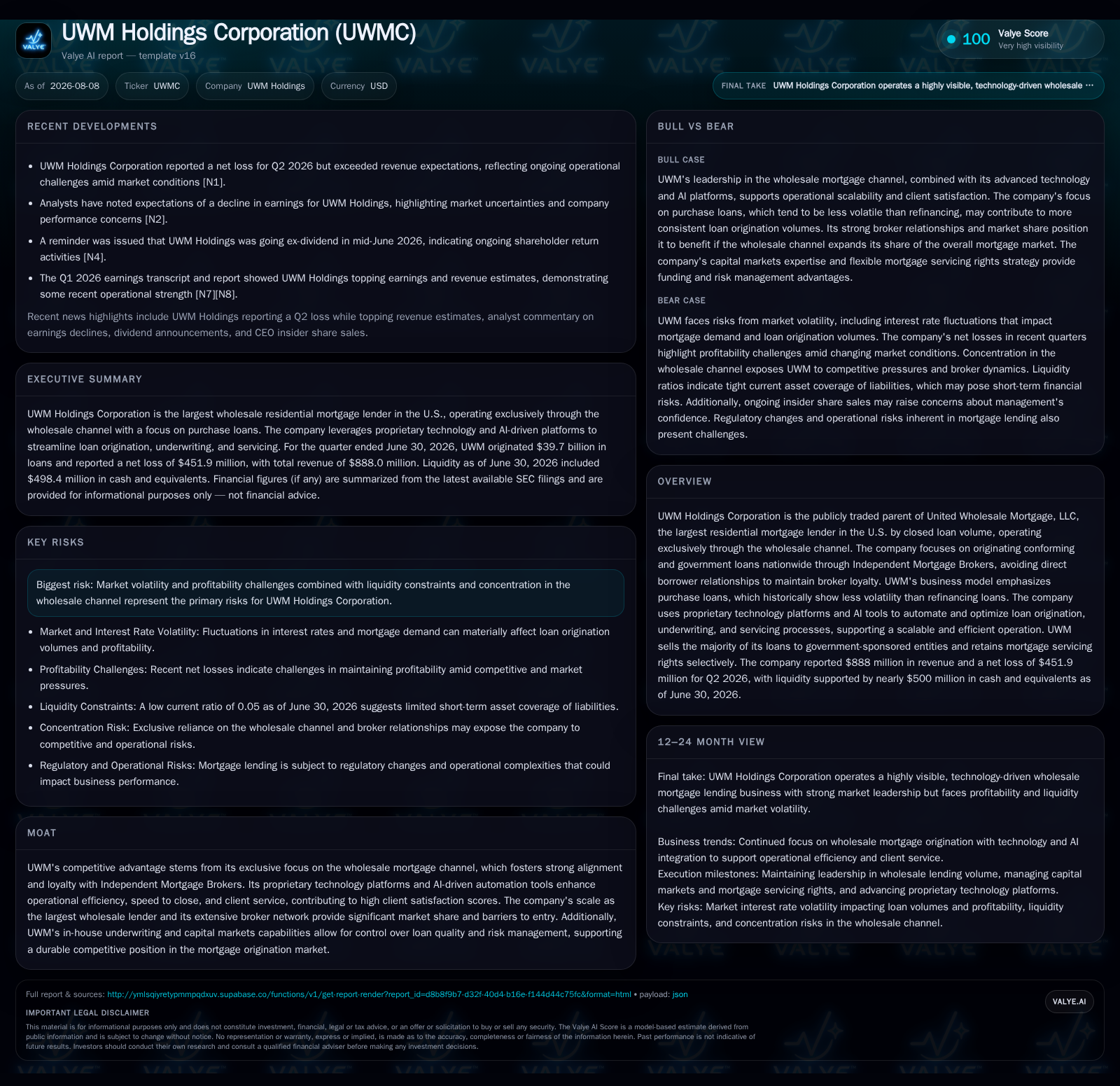
UWM Holdings Corporation continues to lead as the largest U.S. residential mortgage lender by closed loan volume, operating exclusively through its wholesale channel of independent mortgage brokers. The latest quarterly filing highlights an 18% rise in operating expenses driven chiefly by expanded broker incentives and training investments, pressuring margins despite stable origination scale. UWM's technology-enabled wholesale model supports loyal broker relationships, while its dynamic mortgage servicing rights (MSR) portfolio strategy showcases nimble capital management amid fluctuating interest rate conditions. The firm maintains compliance with debt covenants and preserves liquidity with $498 million cash against $3 billion total debt, highlighting both resilience and cost pressures in a challenging macro environment.
Q2 Cost Escalation Highlights Broker Channel Spend Elevation
The most immediate development in UWM Holdings’ latest quarterly report is a significant increase in operating expenses totaling $817.9 million for the six months ended June 30, 2026 — an 18% rise or $125 million increase compared to the same period in 2025 [S2]. This jump is attributed mainly to expanded costs in broker incentives, training programs, and sponsorship fees. Given UWM's exclusive reliance on independent mortgage brokers for origination volume, this escalation reflects intensifying efforts to sustain broker loyalty during a competitive landscape that likely sees elevated broker compensation demands. Depreciation and amortization also increased marginally due to leasehold improvements but are secondary factors [S2].
These elevated spend levels put pressure on operating margins despite stable top-line leadership as the largest wholesale mortgage lender by closed loan volume [S2], [S1]. The direct correlation of higher broker incentives with margin compression underscores the criticality of broker relationships in the wholesale business model — brokers effectively serve as UWM’s salesforce without direct borrower interaction.
Wholesale Mortgage Origination Model Fuels Scale but Margins Pressured
UWM operates a distinct model exclusively serving the wholesale channel through independent mortgage brokers nationwide [S1]. This channel differentiation avoids conflicts arising from direct borrower relationships prominent at retail lenders like Rocket Companies or LoanDepot. The company’s focus on conforming and government-backed loans (FHA, VA, USDA), which account for over 90% of loans sold to government-sponsored entities (GSEs) or pooled into secondary markets [S1], provides both scale and product stability.
A key advantage reported is UWM’s emphasis on purchase loans rather than refinancing [S1]. Purchase loan volumes generally exhibit less cyclical volatility relative to refinance volumes sensitive to interest rate movements. Hence, consistent purchase orientation supports steadier closed loan volume metrics which are central KPIs for revenue generation via origination fees [S1], [S2].
However, the margin profile faces headwinds from rising operating costs as noted above, along with persistent macroeconomic uncertainties impacting housing demand dynamics. Compared with retail lenders who engage directly with borrowers and often maintain more diversified product mixes (including non-QM or jumbo products), UWM's wholesale focus yields scale benefits but potentially limits margin expansion opportunities under cost pressures.
Operational Efficiency Backed by Technology Enhances Broker Relationships
Integral to sustaining its market leadership is UWM’s continuous investment in proprietary technology platforms that automate mortgage origination workflows including underwriting and servicing tasks [S1]. While precise proprietary details remain confidential, disclosures identify significant use of AI tools designed to increase processing speed and client satisfaction by enabling multiple teams simultaneous access to loan data and automated deficiency alerts.
This technological foundation reinforces broker loyalty by equipping Independent Mortgage Brokers with efficient tools that expedite closings and reduce friction compared to competitors reliant on third-party platforms [S1]. The interplay between tech-enabled efficiency gains and broker relationship management forms a durable competitive moat against peers who may lack similar vertically integrated systems.
Secondary Market Sales and Dynamic MSR Portfolio Management
After origination and closing — funded largely through warehouse facilities covering approximately 97-98% of principal balances — loans are pooled for sale or securitization primarily into agency-backed MBS programs governed by Fannie Mae, Freddie Mac, or Ginnie Mae [S1], [S2]. At sale points, UWM typically retains mortgage servicing rights (MSRs) associated with these loans.
Q2 filings reveal UWM holds a sizable conventional MSR facility with Citibank offering up to $2 billion of uncommitted borrowing capacity; as of June 30, 2026, all of this combined funding capacity was allocated to the Conventional MSR Facility [S2]. Additionally, a separately managed Ginnie Mae MSR facility provided $1.075 billion borrowing capacity with full utilization at quarter-end [S10]. This layering illustrates a keen management approach balancing retention of recurring servicing fee income against capital constraints.
Importantly, UWM maintains an opportunistic stance on MSR sales — retaining most production-related MSRs but selectively selling bulk portfolios when market conditions warrant liquidating legacy positions or optimizing capital usage [S1], [S2]. Elevated interest rates dampen refinancing demand materially more than purchase volumes; since UWM skews heavily toward purchases but still participates in refinancing originations (~10%), total volumes can swing significantly dependent on prevailing rates [S1], [N1]. Fluctuations also affect MSR portfolio valuations and corresponding servicing fee income.
Credit risk considerations include potential loan repurchase obligations if underwriting standards are not met post-sale; these contingencies add complexity to liquidity planning [S1]. Warehouse facility utilization is another critical watchpoint — as these short-term funding sources underpin initial loan funding stages prior to sale into secondary markets. The filing reports full allocation of approximately $2 billion combined Conventional MSR facility capacity as of Q2-end reflecting potentially elevated capital usage amid market headwinds [S2], [S10].
Additionally, recent equity raises including a securities purchase agreement with Oaktree Capital Management finalized August 5 indicate proactive capital replenishment strategies supporting balance sheet resiliency despite earnings pressures [S3].
Growth Potential Tied to Broker Network Expansion And Purchase Dominance
Looking forward growth drivers center on expanding penetration within the independent mortgage broker community nationwide leveraging UWM’s specialized platform offerings and value proposition absent retail conflict of interest [N2], [S1]. The wholesale channel itself continues expanding its share versus retail alternatives amid evolving consumer preferences for broker-mediated advice.
Concurrently demographic trends favor heightened homeownership levels over time supporting sustained purchase loan demand despite cyclical housing affordability challenges caused by rising rates or high prices. Regulatory environments permitting broader access to conforming government-backed products bolster pipeline stability further.
Product innovation around non-QM offerings or expanded government program participation remain potential levers although current emphasis appears anchored firmly in conforming/govt alignments ensuring robust secondary market access with minimal credit risk premium adjustments.
Financial Position Discussion: Capital Structure Stability Amid Net Losses
As of Q2-end June 30, 2026, UWM reported cash and equivalents of approximately $498 million against total reported debt near $3 billion translating into net debt around $2.5 billion [F1], [S2]. The predominant debt instruments include senior unsecured notes issued in September 2025 totaling $1 billion carrying a stated coupon of 6.25%, with semiannual interest payments commencing March 2026 [S2].
Warehouse facilities represent critical secured short-term borrowings used for loan funding; their covenants mandate maintenance of minimum tangible net worth levels as well as liquidity thresholds which have been met consistently including throughout Q2 2026 reports [S10], [S13].
Despite facing net losses recently attributed principally to elevated operating expenses including rising broker costs along with industry-wide margin compression challenges reported elsewhere in the sector ([N3]), UWM sustains adequate liquidity buffer allowing continued funding operations and strategic investments supported partially through recent equity raises documented in August events filings [S3].
Looking Ahead: Loan Volume Trends And Funding Milestones To Monitor
Key upcoming indicators for monitoring UWM's trajectory will revolve around quarterly closed loan volume trends especially within purchase segments alongside refinance participation shifts influenced primarily by evolving mortgage rate regimes [S2], [N1]. Tracking progression or moderation in broker incentive expense growth will be crucial as investors assess sustainability of current pricings strategies underpinning channel loyalty.
Additionally significant will be management discourse around ongoing MSR portfolio disposition plans given their impact on recurring fee streams versus capital deployment tradeoffs [S2], complemented by updates on warehouse facility utilizations reflecting underlying lending capacity constraints or expansions [S10].
Regulatory developments affecting conforming loan limits or government program eligibility could also tilt growth prospects subtly while technology platform enhancements might unlock further efficiency advantages translating into margin recoveries over extended periods [S1]
In sum, operational execution balancing cost control against sustaining or growing origination scale within its focused wholesale niche emerges as the principal near-term challenge shaping UWM’s performance landscape going forward.
Disclaimer: This analysis is based solely on publicly available information from SEC filings dated through August 7, 2026 and news reports cited herein. It does not constitute investment advice or research views but aims to provide detailed business model understanding and industry context regarding UWM Holdings Corporation.
Disclaimer: This is research-only, informational analysis and not investment advice. It may include AI-generated interpretation and general industry context. Always verify important details using primary sources.

Comments