
ServisFirst Bancshares Focuses on Relationship-Driven Commercial Banking with Decentralized Lending
Latest quarterly disclosures reinforce ServisFirst’s concentrated regional strategy, credit risk management, and operational controls in the Southeast U.S.
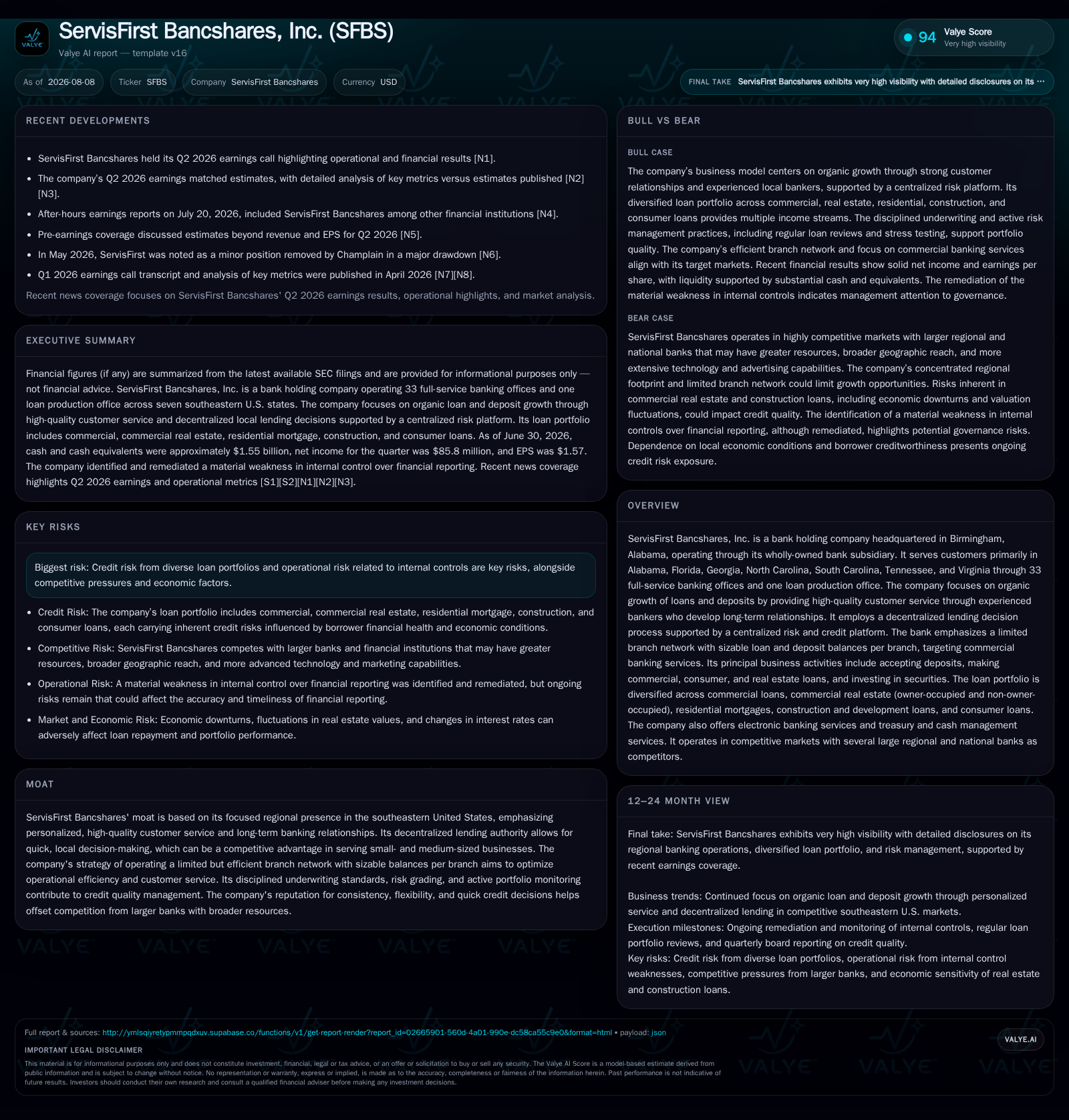
ServisFirst Bancshares, Inc. operates as a Southeastern regional bank focusing on organic loan and deposit growth through personalized service and decentralized lending decisions supported by centralized risk oversight. Its limited but efficient branch network maximizes loan and deposit balances per location, targeting commercial borrowers primarily in Alabama and neighboring states. The latest 10-Q reveals progress in remediation of a material weakness in internal financial controls with no material restatements needed, underscoring risks in operational governance. The bank’s concentration in commercial real estate loans and strong capital adequacy remain focal points amid competitive pressures from larger regional peers and fintechs.
Recent Operating Update
ServisFirst Bancshares' latest Q2 2026 filing [S2] reveals two critical updates shaping near-term operational contours. First, the company identified a material weakness in its internal control over financial reporting earlier but has implemented remediation measures considered effective as of this quarter. Notably, no prior financial statement restatements were required; however, continued control vigilance is essential given the inherent risks of timely error detection failures. Second, an updated investor presentation filed contemporaneously [S3] reflects current quarter financial information for investor engagement. These disclosures foreground the company’s ongoing focus on strengthening governance amid steady execution of its core banking activities.
Business Model Analysis
ServisFirst Bancshares operates primarily through its wholly owned bank subsidiary from Birmingham, Alabama. It maintains 33 full-service banking offices plus a loan production office spread across Alabama, Florida, Georgia, North Carolina, South Carolina, Tennessee, and Virginia [S1]. Unlike broad-scale retail banks that emphasize extensive branch networks targeting mass consumer deposits, ServisFirst deliberately pursues a strategy centered on operating a limited branch footprint with each branch maintaining sizable aggregate balances of loans and deposits. This model prioritizes operational efficiency and fosters deep client relationships essential to commercial banking.
The bank’s revenue generation hinges predominantly on net interest income derived from its commercial loan portfolio offset by interest expense on deposits. Additional income streams comprise fees from treasury services and electronic banking offerings including online/mobile platforms with remote deposit capture [S1]. The lending side is highly focused: small- to medium-sized business clients with annual revenues typically between $2 million to $250 million form the principal borrower segments. Commercial lending products offered include seasonal loans, bridge loans, term loans for expansion or asset acquisition, alongside commercial lines of credit tailored to client cash flow profiles [S19].
Decentralized lending authority is a centerpiece of ServisFirst’s competitive advantage. Individual lenders have delegated approval power based on their experience levels; exceeding those limits triggers escalation to regional CEOs or senior management for review [S1]. This contrasts with centralized underwriting approaches common at large institutions that can cause decision latency especially for smaller borrowers. Centralized back-office platforms uniformly standardize credit risk grading and portfolio monitoring activities supporting proactive asset quality oversight.
The company also extends into consumer loans and real estate lending; however, these are secondary to its primary commercial banking focus. Notably, several subsidiaries are structured as REITs for tax purposes managing residential mortgage participations reflecting a diversification within the broader loan portfolio [S1].
Industry Structure and Competitive Position
Operating as a Southeast-focused regional bank situates ServisFirst in direct competition with established players like Regions Financial Corporation and Truist Financial Corporation that possess scale advantages ([S19]). These peers enjoy expansive geographic coverage and robust technological capabilities but may lack the localized decision-making agility ServisFirst emphasizes.
Competitive factors within these markets hinge heavily on pricing dynamics for loans/deposits as well as service quality attributes including quick credit approvals and personalized relationship banking [S19]. ServisFirst leverages its decentralized authority model alongside experienced bankers embedded within communities to differentiate itself amid competition from both larger banks and alternative credit providers including fintech platforms.
Its chosen strategy of limited branches housing sizable balances aligns resources against meaningful customer engagements rather than thinly spreading assets/resources across many low-balance locations — a tradeoff enhancing cost efficiency yet perhaps limiting convenience for broader retail consumers [S1]. The reliance on organic growth mitigates risks associated with large acquisitions but accentuates sensitivity to local economic conditions impacting its Southeast footprint.
Growth Drivers
Key drivers for ServisFirst include continued economic expansion within its served markets fueling demand for new commercial lending solutions especially among small- to mid-sized enterprises undergoing growth or capital investments [S19]. The combination of high-touch service models supported by technology-enabled electronic banking services offers avenues to grow both deposit bases and treasury-related fee income collections.
Interest rate environments conducive to expanding net interest margins (NIM) underpin revenue potential given the large commercial loan portfolio exposure [S1]. The bank’s disciplined underwriting standards mitigate loss risk allowing potential scaling while maintaining asset quality metrics such as non-performing loan ratios near industry lows.
Operational improvements targeting acceleration in loan approval turnaround times through expanded decentralized decision authority could further enhance customer satisfaction fostering relationship retention/expansion.
Additionally, prudent branch network optimization balances access with cost containment supporting profitable organic deposit gathering critical for funding loan growth without reliance on expensive wholesale funding sources [S1].
Risks and Watchpoints
Credit risk concentration remains material given that over 50% of ServisFirst’s loan portfolio comprises owner-occupied ($2.74 billion) and non-owner-occupied ($4.60 billion) commercial real estate segments as of December 31, 2025 with associated substandard loans totaling approximately $109.8 million combined [S16][S26]. Fluctuations in real estate values or downturns impacting tenants or owners could pressure asset quality thus requiring vigilant monitoring through frequent board reporting protocols.
The previously identified material weakness in internal controls over financial reporting underscores operational risk exposure potentially affecting the accuracy/timeliness of disclosed results if not fully eradicated long-term [S2]. Though remediation has been reported effective this quarter, ongoing diligence remains imperative.
Competition from larger regional banks equipped with broader product sets or fintech disruptors offering niche digital lending/deposit alternatives could erode market share or compress margins necessitating continued innovation investment.
Economic cyclicality within Southeastern markets including susceptibility to natural disasters (hurricanes/tornados) pose systemic risks impacting borrower performance profiles [S23]. Garnering clarity on these KPIs will signal whether ServisFirst can sustainably scale while managing operational complexities inherent to regional banking.
Financial Profile Discussion
Operational expenses are controlled within an efficient branch model focusing resources where balances drive profitability versus higher overhead multi-location models typical at larger competitors. This conservative financial footing supports dividend policies governed by Alabama law limiting payments relative to earnings plus retained earnings preserving capital adequacy [S20].
Disclaimer: This is research-only, informational analysis and not investment advice. It may include AI-generated interpretation and general industry context. Always verify important details using primary sources.

Comments