
Teads Holding Co. Revises Strategy to Counter Digital Ad Market Shifts
Teads leverages AI-driven omnichannel platform and strategic restructuring to address industry headwinds and position for profitable growth.
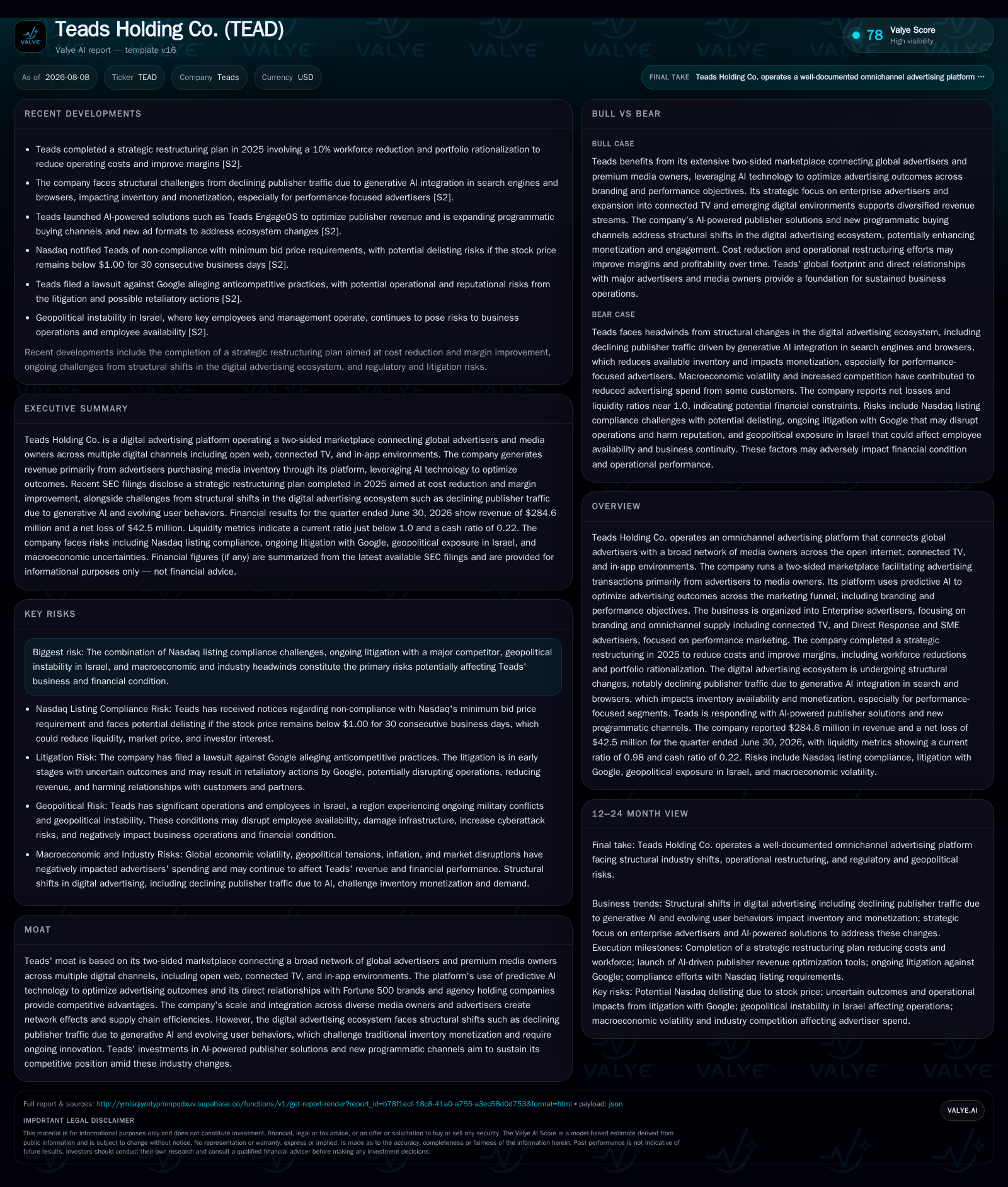
In Q2 2026, Teads completed a strategic restructuring aimed at reducing costs by approximately 10% in global workforce and rationalizing its portfolio to focus on supply quality amid disruptions from generative AI-induced declines in publisher traffic. Its two-sided marketplace connects global advertisers, including Fortune 500s, with premium media owners across open web, CTV, and apps, monetizing through programmatic advertising with outcome-based pricing optimized by an AI prediction engine. While structural challenges like declining paid page views reduce inventory and revenue pressure persists, Teads’ integration of connected TV inventory and investments in AI offer growth avenues. Nasdaq listing compliance concerns and litigation risks further shape its operating environment. The company ends Q2 2026 with solid liquidity but significant net debt, underscoring the importance of cash flow improvements as it implements its turnaround.
Quarterly Operating Update: Restructuring Progress Amid Revenue Pressure
Teads Holding Co.’s latest quarterly filing reveals substantial completion of a strategic restructuring announced in late 2025 aimed at reducing operating costs, improving margins, and enabling profitable growth amid a challenging digital advertising environment [S2]. This initiative involved roughly a 10% reduction in the global workforce alongside deliberate portfolio rationalization efforts focusing on supply quality enhancement. Specifically, underperforming advertising inventory was "cleaned up" to prioritize premium channels that support higher yield monetization.
The company continues serving thousands of unique active advertisers across its owned and operated platforms as well as through programmatic partnerships—a critical metric for platform engagement that drives revenue [S2]. Despite these efforts, Teads faces material headwinds tied to declining publisher traffic induced by generative AI technologies intercepting users’ traditional journeys to publisher sites. For its premium publishers segment, paid page views have declined approximately 10-15%, directly shrinking available advertising impressions for monetization [S1]. This fundamental reduction in inventory volume pressures top-line growth and complicates supply-demand balancing.
Confirming milestones indicating recovery would include stabilization or reversal in impressions served alongside increased retention rates among media partners—both vital signs of improving platform health.
Dynamic Two-Sided Marketplace: Monetizing Advertisers and Premium Media
Teads operates a two-sided marketplace connecting global advertisers—including Fortune 500 brands, agency holding companies, and small-medium enterprises—with premium media owners delivering digital ad inventory spanning open web, connected TV (CTV), and mobile app environments [S1], [S2]. The company’s revenue model is primarily driven by advertisers purchasing advertising inventory programmatically using various pricing structures such as cost per impression (CPM), cost per click (CPC), video completion rates based pricing, and other outcome-based formats designed to align spending to measurable marketing results.
This marketplace structure creates network effects: advertiser demand sustains partner media monetization while supply quality affects yield optimization. Average revenue per advertiser depends on campaign mix—Enterprise segment customers typically seek branding solutions leveraging omnichannel supply including CTV; Direct Response/SME segments emphasize performance marketing outcomes.
Retention rate of media partners is critical since publisher relationships govern access to high-quality inventory that commands premium prices. Underperforming or low-quality inventory rationalization tightens supply but supports sustainable revenue over time by prioritizing consistent monetization channels.
Platform Strength: AI Prediction Engine Driving Outcome-Based Advertising
Central to Teads’ competitive positioning is its AI prediction engine—a machine learning driven algorithmic platform optimizing ad delivery across the full marketing funnel from brand awareness through performance conversion objectives [S1], [S2]. By dynamically predicting engagement likelihoods such as completed video views or post-click actions, Teads can allocate impressions more efficiently and enhance return on ad spend (ROAS) for advertisers.
This predictive technology underpins improved CPMs or CPC yields by focusing advertiser budgets on inventory segments with higher probability of success, supporting margin expansion potential as higher value engagements translate into increased price realization without proportional increases in traffic acquisition costs.
Extensive adoption of this AI-driven targeting solution across customer segments reinforces platform stickiness. Future upgrade cycles or product enhancements anchored on this capability will be key leading indicators for sustained margin improvement.
Industry Forces: Generative AI Impact and Connected TV Growth Potential
The digital advertising ecosystem is under structural transformation influenced by several forces documented in Teads’ filings. One prominent trend is generative AI’s disruption of user journey behavior whereby searchers obtain direct answers or AI-generated summaries instead of clicking through to publisher websites. This shift erodes publisher traffic volume by an estimated 10-15% for Teads’ premium content partners worldwide—materially decreasing available display inventory quantity with direct implications for revenue [S1]
Conversely, connected TV (CTV) represents a growing segment within digital advertising characterized by expanding streaming platform penetration. Teads integrates CTV inventory into its omnichannel offering thus partially offsetting open web declines through diversification into video-rich formats with generally higher CPMs due to engaged audiences and limited supply elasticity.
Optimally blending these distinct channels via cross-device attribution models will be crucial for long-term resilience as advertisers increasingly seek scalable omnichannel brand experiences rather than siloed buys.
Growth Drivers & Constraints: Balancing Supply Quality with Scale Challenges
Key growth levers arise from increasing penetration among enterprise clients adopting comprehensive omnichannel campaign solutions incorporating CTV alongside web and app placements. Expanding advertiser base combined with rising average spend per client could bolster aggregate revenue despite unit-level headwinds.
However, several constraints temper outlooks—advertising budgets remain sensitive to macroeconomic volatility impacting discretionary spend levels. Additionally, seasonal fluctuations persist with Q4 holiday periods exhibiting heightened activity relative to lower volumes early each year.
Critically, traffic acquisition costs (TAC)—payments owed to media partners for impressions delivered—require vigilant management to protect gross margins since TAC typically tracks closely with revenue but can vary due to contractual terms or revenue mix shifts [S1]. Portfolio rationalization efforts aim both to elevate quality supply share thus stabilizing yield metrics while potentially limiting absolute scale.
Watchpoints: Nasdaq Compliance, Litigation Risk, and Reacquisition Plans
Post-Q2 filing disclosures highlight ongoing challenges outside core operations influencing enterprise risk profile. After regaining compliance with Nasdaq’s minimum bid price rule in June 2026 following prior notification periods, Teads stock closed below $1.00 per share for an extended period starting late June—which may trigger renewed compliance scrutiny if sustained beyond regulatory thresholds [S1]. This situation could affect stock liquidity and raise capital market access concerns.
Separately, the Company initiated litigation against Google LLC alleging anticompetitive conduct following recent judicial rulings—a material legal matter potentially impacting financial condition depending on outcome or settlement progress [S3].
Capital allocation flexibility also faces near-term tests given considerable indebtedness; management continues exploring debt repurchases or exchanges as part of broader financial strategy refinement [S2]
Indicators suggesting easing risk would include upward stock price momentum sustained beyond compliance deadlines or resolution phases advancing favorably in litigation contexts.
Financial Profile Discussion: Liquidity, Debt Reduction Efforts, and Cash Flow
As of June 30, 2026, Teads reported cash and cash equivalents totaling approximately $88 million alongside short-term investments amounting to $3 million. Available borrowing capacity under its revolving credit facility stood at $40 million subject to covenant conditions ensuring controlled leverage utilization [S2], [F1].
Total debt remained sizable at roughly $628 million principally represented by senior secured notes due in 2030 carrying fixed interest obligations requiring semiannual servicing estimated at nearly $63 million annually [F1]. Net debt after accounting for cash approximates $540 million reflecting significant leverage levels post-acquisition financing structures.
Operating activities consumed about $25.7 million in cash during H1 2026—a negative free cash flow signal attributed partly to restructuring costs along with depressed advertising spend cyclicality impacting collections timing [S2]. Financing activities used $11.1 million during the same period implying deleveraging initiatives are underway yet constrained by prevailing earnings erosion.[F1]
Overall liquidity appears sufficient for near-term obligations but highlights imperative execution risks tied to restoring positive operating cash generation aligned with margin improvements fostered through strategic restructuring measures.
This analysis synthesizes recent SEC filings incorporating operational developments alongside established digital advertising sector dynamics relevant to Teads Holding Co. Please note this report does not constitute investment advice or a research view regarding securities mentioned herein.
Disclaimer: This is research-only, informational analysis and not investment advice. It may include AI-generated interpretation and general industry context. Always verify important details using primary sources.

Comments