
i3 Verticals Executes Sharpened Focus on Public Sector SaaS With Payment Integration
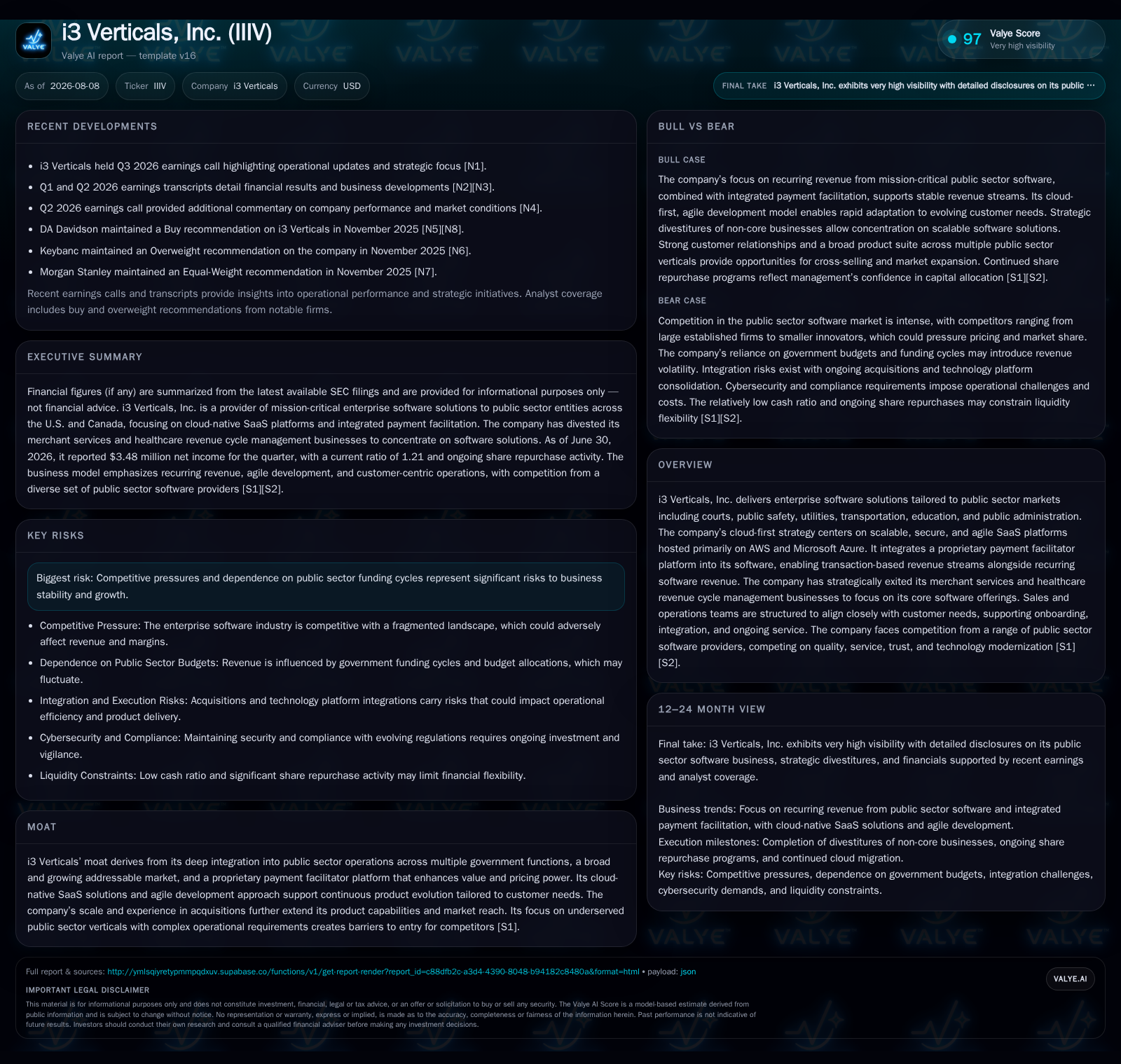
i3 Verticals solidifies its strategy by exiting legacy businesses to concentrate on integrated, cloud-native SaaS solutions for diverse public sector verticals, leveraging embedded payment facilitation to enhance revenue quality and growth potential.
In its latest quarter, i3 Verticals completed extensive share repurchases and confirmed the strategic shift away from merchant services and healthcare revenue cycle management segments. The company increasingly focuses on delivering cloud-hosted SaaS platforms tailored to complex public sector operations with embedded proprietary payment facilitation technology. This integrated approach diversifies revenue streams through recurring subscription fees and transaction-based payments, enhancing pricing power and stickiness in a fragmented market marked by long sales cycles and demanding compliance requirements. Key risks remain tied to public sector budget cycles and cybersecurity exposure due to payment processing responsibilities, but growth catalysts include increased digitization mandates and rising transaction volumes in government agencies.
Q3 Execution Anchors Strategic SaaS Focus Beyond Legacy Businesses
i3 Verticals' latest quarterly filing dated August 7, 2026, marks a pivotal step affirming its strategic pivot away from legacy merchant services and healthcare revenue cycle management businesses that were divested in 2024 and mid-2025 respectively [S1]. This divestiture has narrowed the company's operational focus exclusively to its core competency: providing cloud-native enterprise software solutions tailored for public sector verticals. In Q3 2026 alone, i3 Verticals executed over $48 million in share repurchases under two Board-approved programs initiated in early and mid-2026 that expended the prior program's capacity entirely [S2]. Such aggressive capital return amidst platform-focused reinvestment signals management's conviction in the sustainability of their SaaS growth trajectory.
The absence of older business lines now cleans the margin profile of legacy payment processing volatility and allows sharper measurement of SaaS unit economics. Operational commentary indicates stable performance metrics aligned with high retention typical of mission-critical government software workflows [N1]. This quarter’s updates do not indicate material shifts in risk disclosures but maintain emphasis on cybersecurity vigilance and integration complexity inherent in serving fragmented public agencies [S1],[S2].
Product Strategy: Embedded Payments Amplify Public Sector SaaS Offering
i3 Verticals' business model rests on delivering comprehensive cloud-hosted SaaS platforms covering critical functions across courts, public safety, transportation licensing, utilities management, education administration including school nutrition programs [S1]. What distinguishes it structurally is the proprietary payment facilitator platform tightly integrated into these solutions. This design enables i3 Verticals to capture recurring software subscription fees alongside transaction-based payment processing revenue within the same ecosystem.
Embedded payments bolster customer retention as switching costs rise with deeper financial flows running through the platform. Integrated payments also improve pricing power because i3 provides end-to-end compliance, security controls compliant with major card network rules (Visa, Mastercard etc.), and reduces third-party dependencies that often fragment government service delivery [S1]. While pure-play public sector SaaS competitors like Tyler Technologies or NIC Inc. offer comparable government technology platforms with payments components, i3’s broad portfolio across multiple verticals enhances cross-selling potential.
This dual revenue stream contributes to margin resilience: software subscription revenue tends toward high gross margins typical of cloud models while transaction fees add supplementary income tied to volume processed — a lever that can accelerate with service expansion or regulatory-driven digitization requirements.
Fragmented Public Sector Software Market Shapes Competitive Dynamics
The public sector software industry is characterized by fragmentation both vertically—spanning courts to transportation departments—and geographically across thousands of state/local agencies. Long sales cycles reflect the cautious procurement climate dominated by budget approvals and regulatory scrutiny [S1]. Against this backdrop, i3’s wide spread(client footprint) across all 50 states and Canada with thousands of installations gives a scale advantage that improves client trustworthiness critical for sensitive government workflows
Its dependence on evergreen AWS and Microsoft Azure infrastructure partners supports platform scalability, uptime reliability (essential for compliance), and geographic data residency which are competitive gates especially given stringent public data privacy laws across jurisdictions.
By contrast with fragmented competitors who might specialize narrowly by vertical or region, i3’s multi-vertical product breadth combined with integrated payments creates significant technical complexity that serves as a barrier to entry. New entrants would face steep challenges replicating deep operational integrations simultaneously across specialized workflows such as motor vehicle licensing software plus school lunch program management.
Growth Catalysts: Digitization, Regulatory Drivers, Cross-Selling Initiatives
The structural tailwinds behind i3 Verticals’ growth are anchored in accelerating digitization mandates within the traditionally underserved public sector. As many agencies transition from paper or siloed legacy IT systems toward fully electronic case management or compliance tracking environments, demand for scalable cloud-native platforms grows.
Regulatory requirements around electronic recordkeeping in courts or transit departments also drive uptake; these create compelled spend scenarios wherein agencies must modernize digitally or risk non-compliance. Payments integration is another key vector fueled by growing constituent preference for online government fee payments rather than cash or mail-in checks – i3’s embedded payment facilitator uniquely benefits here through capturing both sides of these financial flows.
Internally, i3 emphasizes improving customer onboarding time as an operational growth lever. Faster onboarding shortens sales cycle friction inherent in public agencies; combined with effective net revenue retention strategies protects against churn risks typical when agencies resist frequent vendor churn given testing/certification burdens [N1],[S1]. Cross-selling new modules or adding adjacent jurisdictions smoothly onto existing platforms further catalyzes ARR expansion.
Risks: Budget Cycles, Cybersecurity Exposure, Customer Concentration
Despite promising growth drivers, risks inherent in this space persist. Public sector customers depend heavily on annual or biennial budget cycles that can delay purchasing decisions sharply impacting near-term revenue visibility. While governmental contracts tend toward longer terms providing some stability compared to commercial SaaS clients prone to faster churn, stop-gap funding constraints remain a watchpoint.
Cybersecurity represents a major systemic risk given i3’s status as a registered payment facilitator holding sensitive cardholder data alongside personal identifiers such as social security numbers or driver license info. The company bears ultimate liability if third-party partner failures lead to data breaches violating stringent network rules or legal obligations [S1]. Historical litigation references related to cybersecurity incidents underscore ongoing vulnerability despite layered defenses – new AI-enabled cyber threats may increase exposure unpredictably.
Certain verticals or regional concentrations could magnify client-side disruption risk if budget cuts disproportionately impact those segments. Technology obsolescence also necessitates continual investment keeping platforms agile against emergent regulatory or interoperability demands.
Key Milestones Ahead: Retention Metrics and Platform Adoption Trajectory
Close monitoring of Annual Recurring Revenue (ARR) growth pace will be critical to validate sustained organic base expansion beyond acquisitive sources since divestitures refocused product scope [N1]. Net Revenue Retention Rate remains a vital KPI revealing customer upsell success plus churn containment indicating solution stickiness amid complex public agency environments.
Tracking Transaction Volume Processed through the embedded payment facilitator offers direct insight into platform monetization depth; rising volume mixes translate into enhanced transaction fee revenues complementing subscription income.
Reducing Customer Onboarding Time further would signal operational efficiencies translating into faster sales velocity—a meaningful competitive edge given long average sales cycles documented in enterprise SaaS for government sectors.
Management commentary in recent earnings calls underscores commitment to refining these KPIs sequentially post-divestiture as a signpost for execution quality going forward [N1],[S2].
Financial Profile Discussion: Share Repurchases Signal Confidence Amid Solid Liquidity
i3 Verticals’ balance sheet exhibits robust liquidity supported by $2.65 million cash equivalents at June 30, 2026 alongside no reported debt implying a clean capital structure conducive to reinvestment flexibility [F1],[S2].
Disclaimer: This is research-only, informational analysis and not investment advice. It may include AI-generated interpretation and general industry context. Always verify important details using primary sources.

Comments