
Hamilton Insurance Group Reinforces Specialty Position Amid Shifting Market Dynamics
Hamilton Insurance leverages diversified underwriting platforms and strong liquidity to navigate evolving specialty insurance and reinsurance markets.
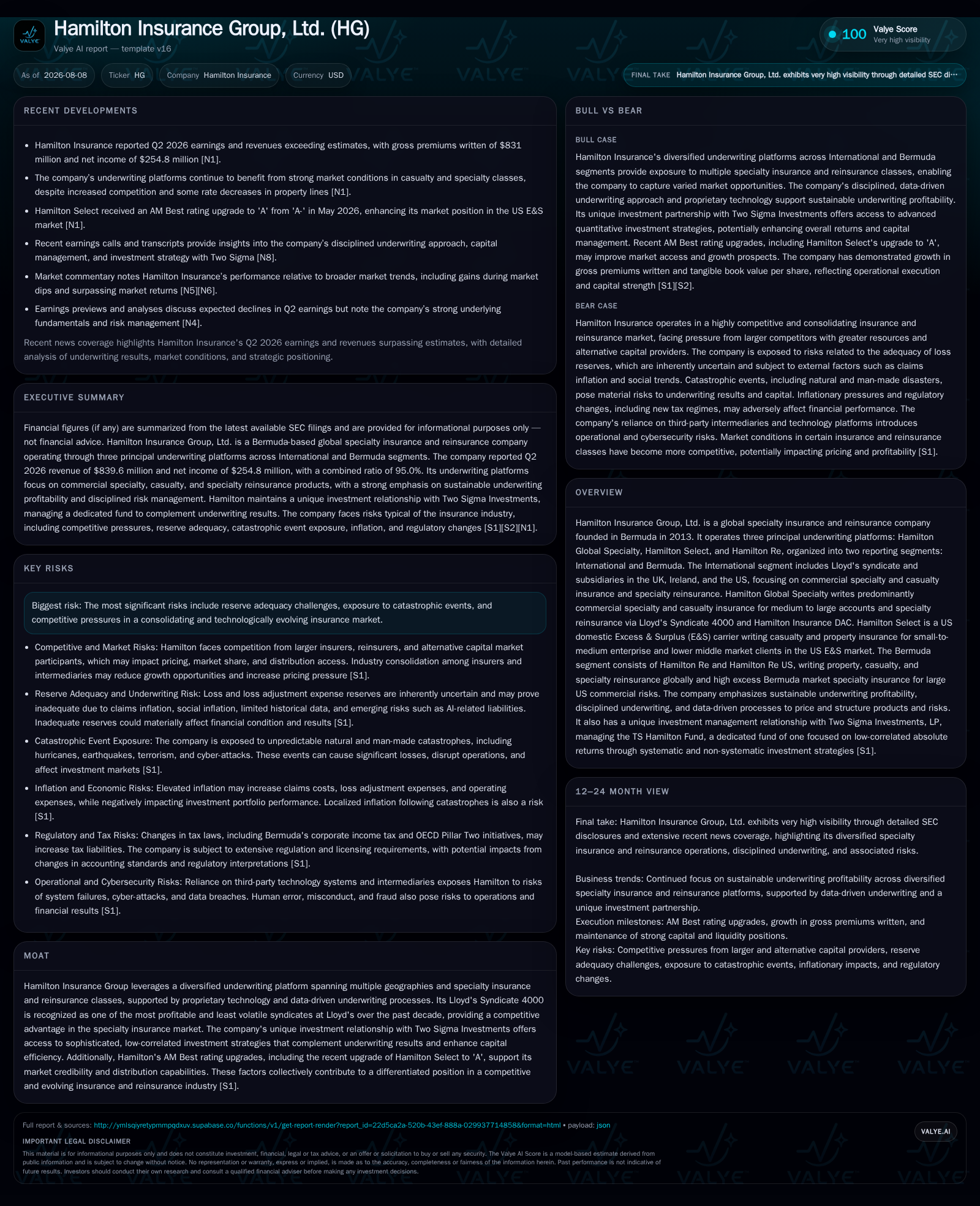
In its latest 10-Q filing, Hamilton Insurance Group highlights an evolving supply/demand dynamic in key reinsurance and specialty classes driving more competitive market conditions but maintaining risk-adequate pricing across its portfolio. The company’s diversified platforms—spanning Lloyd's Syndicate 4000, U.S. Excess & Surplus (E&S) operations, and Bermuda-based reinsurance—are supported by proprietary technology and a strategic investment partnership with Two Sigma, contributing to disciplined underwriting and capital efficiency. Recent AM Best rating upgrades bolster Hamilton’s credibility in attracting business amid competitive pressures. Key risks include reserve adequacy challenges and catastrophe exposure, while growth drivers center on rate environment improvements and expanded U.S. E&S presence.
Market Dynamics Shift: Insights From the Latest Quarterly Filing
Hamilton Insurance Group’s August 2026 10-Q filing underscores a notable shift in the reinsurance and specialty insurance markets characterized by evolving supply/demand dynamics. Historically benefiting from a robust imbalance favoring insurers—with constrained capacity generating strong pricing—the firm now observes a more competitive trading environment particularly in property and some specialty lines [S2]. Despite this moderation, management affirms that pricing across written lines remains risk adequate or better at the portfolio level. This nuanced shift signals an early stage market normalization following recent years’ hardening cycles.
Liquidity analysis reveals considerable operational flexibility with substantial cash reserves ($717 million) complemented by high quality liquid investments readily accessible within one to three business days barring restricted amounts linked to non-admitted regulations or letter of credit facilities [S2][F1]. This financial strength serves as a critical enabler for selectively pursuing growth during fluctuating class-specific conditions. Additionally, recent AM Best ratings upgrades—including Hamilton Select’s elevation to an “A” grade—enhance credibility among brokers and clients signaling broader market acceptance supporting future premium expansion [S2][S3].
Decoding Hamilton’s Multi-Platform Underwriting Model
Hamilton strategically operates three principal underwriting platforms organized under two reporting segments:
International Segment: Encompasses the Lloyd's Syndicate 4000 through which Hamilton Global Specialty focuses on commercial specialty and casualty lines targeted at medium-to-large accounts primarily from the U.S. Excess & Surplus (E&S) market. Syndicate 4000 has established a reputation as one of the most profitable yet least volatile syndicates at Lloyd's over the past decade—an indicator attributable to disciplined underwriting practices combined with broad market access via Lloyd's broker network [S1][S2]. This platform also includes Hamilton Insurance DAC based out of Dublin which writes specialty reinsurance.
Hamilton Select: A dedicated U.S.-based Excess & Surplus (E&S) insurer focused on casualty and property coverage tailored to small-to-mid-sized enterprises within difficult-to-place niches of the non-admitted market. This segment benefits from increased submission flow due to shifts from admitted markets alongside enhanced distribution stemming from AM Best rating improvements [S1].
Bermuda Segment: Houses Hamilton Re platforms comprising Hamilton Re and Hamilton Re US specializing in global property, casualty, and specialty reinsurance products plus high-excess Bermuda-market specialty insurance aimed at large-scale U.S. commercial risks. The Bermuda domicile facilitates favorable regulatory capital treatment aligning with the company's goal of enhancing capital efficiency while offering global reach [S1].
Technology underpins all platforms with proprietary data-driven underwriting approaches enabling improved risk selection accuracy and pricing discipline relative to traditional peers who may rely more on legacy processes. This technical sophistication is foundational for maintaining underwriting margins amid challenging supply/demand environments.
Competitive Positioning in Specialty Insurance and Reinsurance
Hamilton occupies a differentiated position among several peer categories:
Its Lloyd’s Syndicate 4000 stands out against peer syndicates through consistent low volatility metrics over extended periods—a key metric reflecting stable underwriting profit generation resistant to cyclical swings common at Lloyd’s broadly.
In the U.S. E&S market where numerous carriers target niche segments characterized by hard-to-place risks, Hamilton Select benefits from targeted underwriting expertise combined with recent AM Best upgrades that sharpen distribution appeal relative to competitors lacking such rating credentials.
The Bermuda-based reinsurance operations place Hamilton alongside global reinsurers such as Munich Re or Swiss Re concerning product offerings but differentiated by integration with alternative investment vehicles like Two Sigma-managed funds allowing enhanced financial flexibility uncommon in conventional reinsurers.
Additionally, the company confronts industry-wide headwinds including consolidation trends exerting pressure on mid-sized players plus emerging digital-focused entrants deploying advanced analytics which intensifies competition around risk-adjusted pricing thresholds.
Growth Drivers: Leveraging Technology, Capital Partnerships, and Market Tailwinds
Looking forward through the lens of identified growth catalysts:
Market Hardening Cycles: Although moderating compared to prior years' peaks, persistent rate increases particularly within casualty classes linked to social inflation uncertainties sustain opportunities for margin expansion via premium rate adequacy [S1][S2]
Expanding U.S. E&S Presence: Hamilton Select’s positioning within this growing non-admitted market segment is bolstered by AM Best “A” rating upgrade facilitating access to more complex risk submissions from brokers seeking rated carriers capable of robust claims performance [S1].
Technological Advancements: Proprietary data analytics accelerate risk selection refinement delivering superior combined ratios compared with peers relying on less sophisticated tools.
Two Sigma Investment Partnership: Provides differentiated access to alternative capital deployment strategies enhancing balance sheet efficiency and returns independent of traditional underwriting cycles—a strategic advantage magnifying overall shareholder value creation potential [S1].
Tracking gross premiums written (GPW) growth alongside incremental combined ratio improvements will serve as leading KPIs validating these growth theses.
Risks in Focus: Reserve Adequacy, Catastrophe Exposure, and Competitive Pressures
Hamilton acknowledges several material operational risks:
Reserve Adequacy: Long-tail casualty lines heighten uncertainty around ultimate loss liabilities necessitating vigilant actuarial review given potential adverse reserve developments impacting future earnings.
Catastrophe Risk Exposure: Natural disasters can drive sudden spikes in claims volatility straining combined ratios; although diversification across geographies partially mitigates concentrated catastrophe exposures.
Competitive Pressures: Market flattening coupled with technological disruption tightens pricing power requiring continuous enhancement of underwriting discipline.
Regulatory Complexity: Operating across multiple jurisdictions introduces compliance cost burdens plus restrictions on capital flows or dividend repatriations potentially limiting strategic agility.
Careful monitoring of reserve development patterns alongside detailed catastrophe loss analytics remains critical for early identification of adverse trends.
Monitoring Key Milestones: What to Watch in Upcoming Quarters
Key indicators will validate management’s thesis around risk adequacy and growth execution:
Pricing adequacy reflected via renewal rate changes especially in property/specialty reinsurance renewals will signal sustaining market discipline or indicate margin erosion potential.
Stability or improvement in combined loss/expense ratios over successive quarters will evidence effective operational control amid changing external conditions.
Reserve development measured quarterly will confirm actuarial assumptions remain sound or necessitate adjustments impacting profitability forecasts.
Progress on new business volumes within Hamilton Select post-AM Best upgrade will highlight success capturing incremental E&S market opportunities.
These metrics combined provide actionable benchmarks illuminating underlying business momentum.
Financial Profile Discussion: Liquidity Strength and Capital Management
As of June 30, 2026, Hamilton reported robust liquidity resources with cash and cash equivalents totaling approximately $717 million alongside manageable total debt near $150 million resulting in a net cash position exceeding $567 million [F1][S2]. This reflects prudent balance sheet management supporting operational needs without excessive leverage constraints.
Letter of credit facilities totaling roughly $1 billion provide additional collateral capacity essential for Lloyd's-related obligations and regulatory deposit requirements enabling scalable business growth without capital bottlenecks [S18][S21]
Overall cash flow generation from core operations remains solid supporting dividends and share repurchase programs that underpin shareholder return strategies while preserving capital buffers against unforeseen claim events or market disruptions [S21]. Recent AM Best upgrades further improve cost-of-capital profiles facilitating favorable financing terms enhancing long-term financial durability.
This analysis synthesizes publicly filed disclosures providing an impartial perspective on Hamilton Insurance Group’s evolving position within the specialty insurance and reinsurance industry landscape. It emphasizes operational dynamics shaping current performance without extrapolating beyond documented evidence or implying investment guidance.
Disclaimer: This is research-only, informational analysis and not investment advice. It may include AI-generated interpretation and general industry context. Always verify important details using primary sources.

Comments