
Trupanion Accelerates Transition Away from Third-Party Underwriting With Proprietary Technology
Q2 2026 results mark a strategic pivot as Trupanion phases out Pets Best underwriting and levers technology and veterinary partnerships to solidify its subscription insurance model.
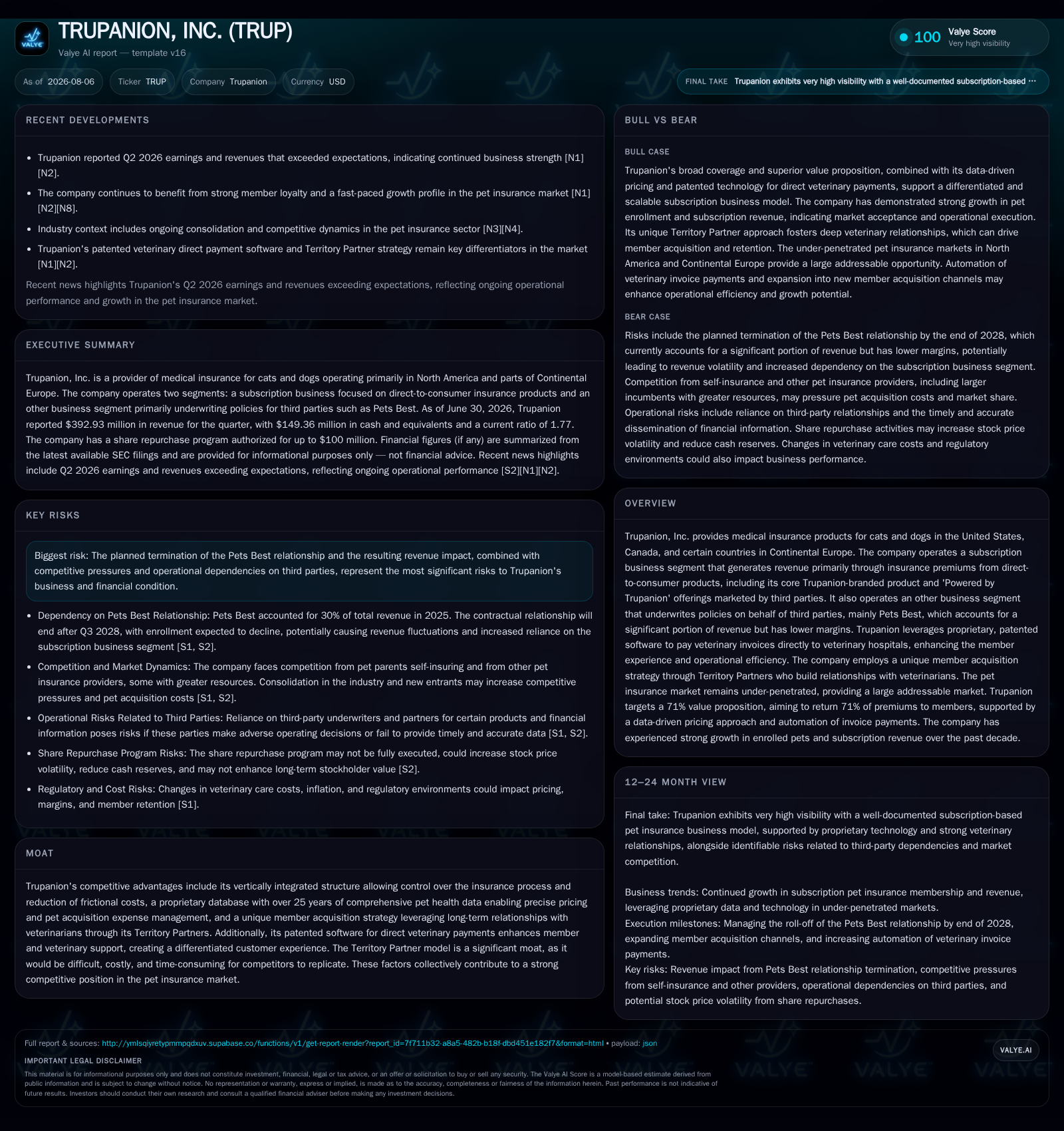
Trupanion’s latest quarterly filing reveals a deliberate shift away from its lower-margin third-party underwriting relationship with Pets Best, which constituted about 30% of revenue in 2025 but is set to end by Q3 2028. This transition intensifies focus on Trupanion’s direct-to-consumer subscription business, anchored by its patented veterinary invoice payment software and a unique Territory Partner acquisition model that strengthens ties with veterinarians. These elements underpin improved underwriting margins and member retention, offsetting near-term revenue concentration risks and positioning Trupanion to capitalize on expanding pet insurance demand. However, execution risks remain in managing the roll-off timeline and competitive pressures.
Q2 Shift: Ending MGA Dependence and Refocusing on Core Subscription Model
Trupanion’s Q2 2026 filings disclose a material acceleration in the planned termination of its contractual relationship with Pets Best, a managing general agent (MGA) responsible for about 30% of Trupanion’s total revenue in 2025 but carrying significantly lower margins compared to its direct subscription business [S2][S13]. The agreement stipulates cessation after Q3 2028, with an expected ongoing enrollment decline effectively rolling off this revenue stream. This phase-out reduces diversification but improves the overall margin quality as Trupanion increasingly concentrates on its direct-to-consumer and reinsured subscription products sold primarily through its own branded channels [S2]. However, the timing and magnitude of this roll-off is uncertain and could cause fluctuations or unexpected impacts in operating results [S2]. Administration during roll-off phases may also divert management focus from core subscription growth initiatives.
This shift marks a strategic inflection point as Trupanion moves from a mixed underwriting portfolio toward vertical integration where it controls underwriting risk directly or through selective reinsurance arrangements. This should enhance control over loss ratios and expense management in line with industry best practices seen among other vertically integrated insurers.
Leveraging Territory Partners for Scalable Member Acquisition
A cornerstone of Trupanion’s business model is its Territory Partner network—independent contractors tasked with building lasting relationships within the veterinary community to educate veterinarians on the value of high-quality pet medical insurance [S1][S7]. These partners act as trusted advisers within their regions, helping veterinarians recommend appropriate insurance coverage to pet owners at time of treatment.
This model creates substantial switching costs because pets insured under Trupanion's plans are typically not transferable due to exclusions for pre-existing conditions if switching providers occurs. The Territory Partner approach also generates qualified leads highly aligned with actual pet medical care needs. This contrasts favorably against marketing-heavy digital customer acquisition strategies common among peer direct-to-consumer insurers.
Additionally, this strategy drives KPI improvements such as new pet acquisition rate and policy retention rate by embedding insurance solutions into veterinary practices, effectively leveraging point-of-care moments.
Technology Edge: Patented Veterinary Invoice Payment Enhancing Claims Efficiency
Trupanion has developed patented proprietary software that directly integrates with veterinary practice management systems allowing for instant payment of approved invoices at the time of treatment [S1][S2]. This ability to pay veterinary hospitals within seconds reduces administrative claims handling costs, accelerates reimbursement timelines, and improves overall customer satisfaction.
This reduced friction supports better expense ratios by lowering claims processing overhead. It also enhances loss ratio performance indirectly by mitigating fraud or overbilling through improved invoice accuracy checks enabled by automated data validation tools embedded in the platform.
Few industry peers have matched this level of integration or immediacy in claim settlement, giving Trupanion a meaningful operational moat.
Data Analytics Driving Pricing Precision and Acquisition Cost Control
Trupanion benefits from one of the most comprehensive proprietary databases in pet health insurance with over 25 years of granular pet health outcome data [S1]. This extensive dataset underlies sophisticated actuarial modeling that allows precise pricing tailored for each pet’s characteristics such as breed, age, geography, deductible level, and coverage options.
Such precision enables the company to price policies more accurately than competitors relying on less detailed or newer data sources. This accuracy helps manage loss ratio volatility and protects underwriting margins despite rising veterinary medical costs—an enduring challenge across the industry.
Moreover, accurate pricing supports internal assumptions underlying new pet acquisition spending by forecasting lifetime customer value more reliably. This capability is crucial for sustaining economics when facing digital acquisition cost volatility prevalent across consumer insurance verticals.
Subscription Revenue Dynamics and Margin Profile Evolution
The bulk of Trupanion’s revenue arises from its subscription business segment delivering recurring premiums primarily through direct-to-consumer channels plus "Powered by Trupanion" third-party marketed products that retain high margins via full underwriting control or reinsurance arrangements [S1][S2]
The other business segment centers on MGA agreements like Pets Best that involve underwriting policies for unaffiliated third parties resulting in substantially lower margin contribution—reflecting commission-based income rather than premium retention [S1]
Post-Pets Best termination, Trupanion expects gross written premiums concentration toward subscription business will increase materially. Although this means short-term reduced diversification which could heighten risk exposure to core segments, it also indicates an opportunity for margin expansion as higher-margin premium dollars grow relatively faster.
The company targets paying approximately 71% of premiums collected back towards veterinary invoice payments (loss ratio), balancing competitive value propositions while preserving operational sustainability through disciplined expense ratio management [S20]. Tracking combined ratio trends post-rolloff will be important demand signals for investors.
Industry Context: Competitive Positioning Against Peers and MGAs
Within pet health insurance, there exists a spectrum from vertically integrated direct-to-consumer players like Trupanion (and Nationwide Pet Insurance) who own underwriting risk and control claims processing to third-party MGAs exemplified by Pets Best who act more as intermediaries between insurers and consumers [S1][S7].
However, evolutionary competitive pressures persist from new entrants leveraging gig-economy delivery models or alternative financing options targeting self-insuring customers. Regulatory complexity across American states plus foreign jurisdictions adds operational challenges compared to some consolidated peers operating only domestically.
Growth Drivers: Market Trends Supporting Demand Expansion
Secular tailwinds supporting expansion include steadily rising US & Canada pet ownership rates alongside increasing veterinarian medical costs driving demand for predictable budgeting via insurance products [S1]. Pet humanization trends have heightened consumer willingness to insure pets reflecting emotional bonds akin to family members.
Geographic expansions into Continental Europe—currently through third-party underwriters paying commissions—represent further growth avenues albeit currently smaller scale relative to North America [S1].
Increasing product breadth including employee benefit offerings and corporate partnerships also augments member growth opportunities aligned with diverse purchasing behaviors beyond traditional retail sales.
Engagement metrics like rising referral rates from existing members highlight organic growth potential fuelled by positive member experience enhancements such as rapid vet payments.
Risks and Watchpoints: Contract Roll-Off Impact and Competitive Pressures
Of key concern is managing the decline in revenue from Pets Best policies as contract expiration approaches [S2][S13]. The uncertainty around timing or rate of roll-off could create revenue volatility affecting near-term financial performance
Management attention split between administering this wind-down and advancing core subscription sales could constrain execution capacity accelerating pricing or acquisition missteps.
Competitive risks intensify from consolidated incumbents with greater resources seeking efficiencies mimicking Trupanion’s vertical integration model plus disruptive entrants offering partial pet financing alternatives that erode category growth potential.
Rising claims inflation due to escalating vet care prices presents persistent underwriting profit challenges requiring vigilant data-driven pricing adjustments grounded in comprehensive analytics infrastructure [S1]
Regulatory compliance across multi-jurisdictional footprints adds complexity especially amidst evolving insurance laws affecting product design or permitted distribution channels.[S1]
Financial Profile Discussion: Strong Liquidity Enables Strategic Flexibility
Trupanion remains well-capitalized entering H2 2026 with $149 million cash & equivalents against $29.6 million total debt per latest balance sheet dated June 30, 2026—implying net cash position supports liquidity buffer amid transition efforts [F1]. Current assets exceed current liabilities yielding a current ratio near 1.77 indicating solid short-term financial health supporting ongoing operations without liquidity stress [F1].
In June 2026, the Board authorized an open-ended $100 million share repurchase program enabled by this liquidity profile highlighting confidence in capital deployment flexibility alongside growth investment priorities [S3][S12][S14]
Strong capital structure mitigates refinancing risks despite floating rate debt exposure amid rising interest rates noted since late 2025 credit facility establishment [S23][S24]
Disclaimer: This analysis is based solely on publicly available regulatory filings as cited ([F1], ) along with known industry context without any non-public insight or valuation guidance. It does not constitute investment advice but aims to provide a detailed operational perspective within the pet health insurance sector.
Disclaimer: This is research-only, informational analysis and not investment advice. It may include AI-generated interpretation and general industry context. Always verify important details using primary sources.

Comments