
Cass Information Systems Navigates Payment Processing and Banking Integration Amid Interest Rate Shifts
Q2 2026 updates underscore Cass's reliance on net interest income growth supported by integrated payment services and bank operations.
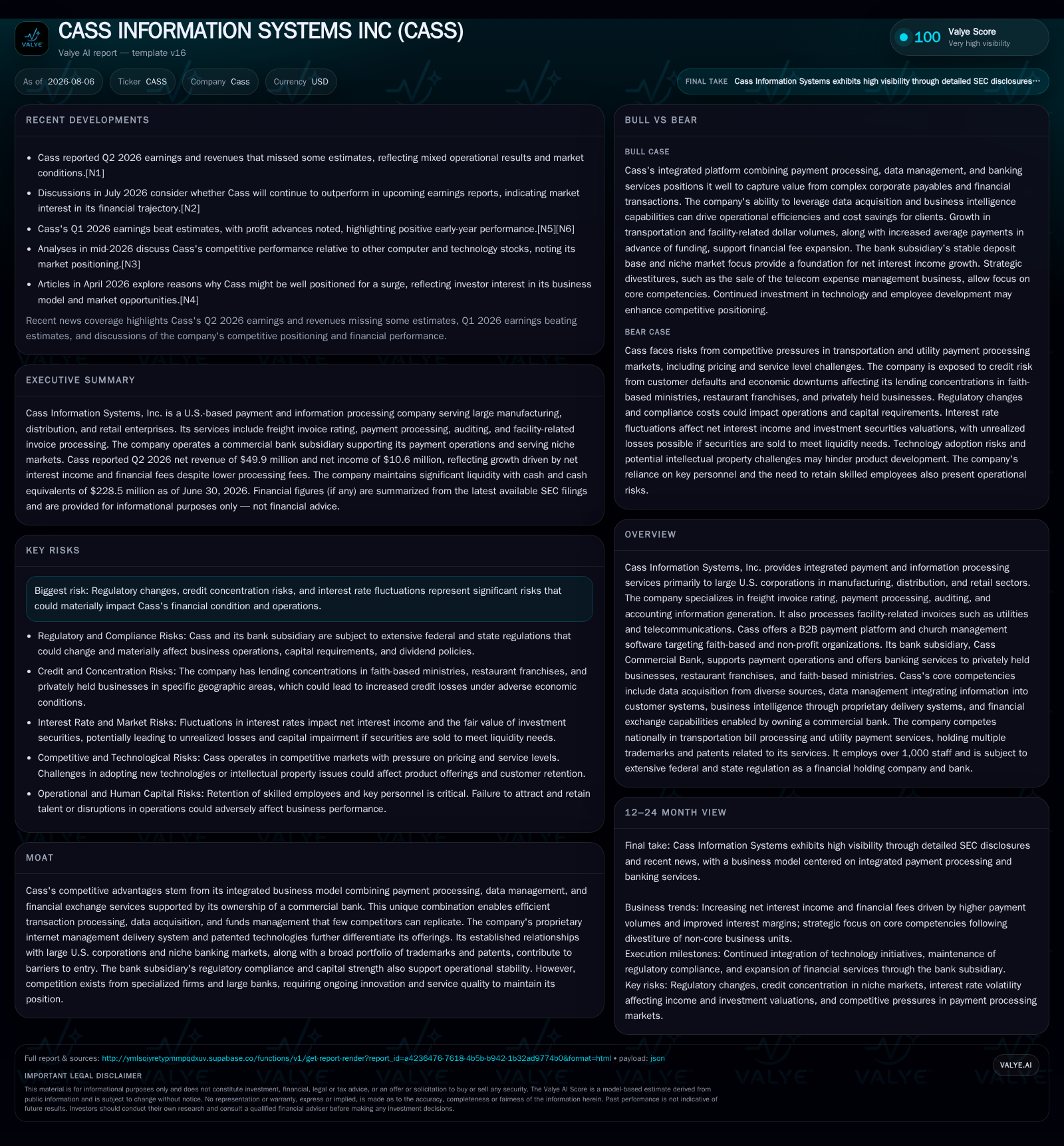
Cass Information Systems reported a mixed Q2 2026 performance characterized by improving net interest margins and modest growth in dollar volumes processed, offset by slight declines in transaction volumes. The company’s hybrid business model, uniquely combining B2B payment processing, invoice auditing, and commercial banking, remains a competitive niche that benefits from rising interest rates and transportation cost dynamics. Operational efficiency and client retention in freight and facility invoice services are pivotal for sustaining revenue streams. Going forward, risks include regulatory compliance, credit concentration, and macroeconomic fluctuations affecting transaction volumes.
Recent Operating Update
Cass Information Systems’ latest quarterly filing for Q2 2026 presents a nuanced operating picture driven largely by developments in its net interest income and payment processing volumes [S2]. The company’s net interest margin rose to 4.00% compared to 3.78% in the prior-year quarter, attributed mainly to a higher yield on earning assets (from 4.58% to 4.74%) combined with a reduction in the cost of interest-bearing liabilities (from 2.71% to 2.49%)
At the transactional level, transportation invoice dollar volume grew 7.4% year-over-year to approximately $10 billion while the corresponding transportation invoice count dipped slightly by 1.9%. Facility-related dollar volume also increased modestly by 2.6%, despite a 3% decline in related transaction volume [S2]. This divergence suggests that although fewer transactions occurred, pricing or billed amounts per transaction have increased — likely a function of rising freight contract rates and higher fuel surcharges recently noted by management [S2]. However, these trends also imply some underlying pressure on total transaction counts potentially due to economic uncertainty or market consolidation among carriers.
Business Model Analysis
Cass operates at the intersection of fintech-enabled payment processing and traditional commercial banking—offering an integrated suite focused on managing payables primarily for large U.S. manufacturers, distributors, and retailers. The core activities include freight invoice rating and auditing, accounts payable processing across transportation and facility-related spend categories (utilities, telecoms), coupled with data acquisition from multiple heterogeneous sources [S1].
Revenue is generated via three primary mechanisms: service fees charged per transaction or invoice audited; fee revenues linked to funds managed during payment cycles; and net interest income earned through investment of account balances between invoice receipt/payment timing facilitated by Cass Commercial Bank [S1][S2]. This triad creates a revenue model where both transactional volumes (number of invoices processed) and economic activity reflected as dollar volumes are critical KPIs impacting total revenue.
Cass’s proprietary technology platforms enable complex data capture using multiple input methods—including AI-assisted extraction—combined with advanced data management systems that integrate directly into clients’ financial accounting frameworks [S1]. This business intelligence capability provides operating efficiencies for clients by reducing internal accounting burdens while enabling robust exception reporting for operational control.
The offering extends beyond corporate clients into niche verticals like faith-based organizations through church management software and generosity giving platforms—leveraging cross-selling opportunities within its bank subsidiary’s target markets that also include privately held businesses and restaurant franchises [S1]. This diversification supports customer retention while penetrating more specialized segments less vulnerable to competition from pure fintech firms or traditional banks alone.
Industry Structure and Competitive Position
Within the broader payment processing ecosystem—where peers include specialized fintechs like Bottomline Technologies or broader payment processors such as FLEETCOR—Cass distinguishes itself via its hybrid model that tightly integrates payment execution with banking functions. Unlike pure-play payment processors reliant solely on service fees or transaction volume growth, Cass benefits from accompanying net interest income generated through prudent asset-liability management afforded by owning a commercial bank.
This ownership positions Cass uniquely at the interface of technology-driven financial workflow automation and regulated banking services—a combination that creates substantial barriers to entry given the capital requirements, regulatory oversight complexities (including Basel III standards), and specialized technology needed [S1]. The stability of deposit bases tied directly to customers utilizing CassPay solutions further enhances funding cost advantages relative to competitors lacking captive deposit franchises.
Nevertheless, competition is persistent across various fronts: national banks expanding fintech capabilities could compete on scale; fintech startups focusing on accounts payable automation challenge pricing power; specialized auditing firms compete on depth within specific spend categories; all while large technology companies may encroach via enterprise resource planning software integrations.
Growth Drivers
Key catalysts supporting Cass’s growth prospects revolve around sustained outsourcing trends whereby large corporations increasingly entrust third parties with critical back-office functions such as accounts payable processing. Inflationary pressures in transportation fuel costs coupled with contractual freight rate increases enhance overall dollar volumes processed—which directly drives fee revenue scales—although this effect is modulated by underlying transaction volume trends.
Technological innovation remains central; AI-enhanced data acquisition capabilities reduce client processing costs while enriching data analytics offerings through business intelligence dashboards—creating stickier integration within customer finance departments [S1]. Additionally, Cass leverages recent regulatory emphasis on transparency in payments to position its audit and exception reporting services as compliance enablers.
Niche expansions into faith-based organizations through dedicated church management software represent additional vertical-specific growth areas less susceptible to commoditization pressures [S1]. The bank subsidiary’s localized lending relationships within St. Louis area privately held businesses provide cross-sell opportunities for deeper product penetration.
Risks and Constraints
Several material risks loom over Cass’s operational trajectory. Regulatory changes affecting the bank subsidiary—ranging from capital adequacy rules under Basel III regimes to Community Reinvestment Act modernizations—increase compliance costs while potentially constraining dividend policies or capital deployment flexibility [S1][S13][S15].
Credit concentration poses non-trivial exposure risks given the dependency on a relatively narrow client base for loan portfolios tied into its banking operations; worsening credit quality amid macroeconomic downturns could impair earnings stability [S1].
Interest rate volatility cuts both ways: while rising rates currently boost net interest margins, rapid reversals or flattening yield curves could compress spreads or reduce loan demand. Economic slowdowns may depress invoice volumes as manufacturing output slows or logistics chains constrict—directly impacting service fees based on transaction volumes [S1].
Operational risks include cyber threats jeopardizing data integrity pivotal for invoice auditing processes alongside system reliability challenges inherent in fintech platforms where uptime correlates closely with customer satisfaction.
Finally, evolving competitive dynamics—with national banks enhancing fintech offerings or standalone SaaS platform providers targeting similar verticals—threaten market share without sustained investment in technology differentiation.
What To Watch Next
Key milestones will center around quarterly trends in transportation and facility-related transaction counts alongside corresponding dollar volume processed figures as leading indicators of organic demand strength or softness [S2]. Maintaining or expanding net interest margins amid evolving Fed policy actions will reveal Cass’s asset-liability management effectiveness.
Regulatory examination outcomes related to banking compliance—in particular Community Reinvestment Act ratings—will signal operational soundness of the bank subsidiary which underpins liquidity stability [S1][S13]. Additionally, monitoring disclosures on loan portfolio credit quality metrics would flag emerging risks tied to concentration.
New product deployments boosting integration capabilities or AI-powered data analytics enhancements could fortify competitive positioning if highlighted in earnings supplements or investor presentations accompanying future filings.
Financial Profile Discussion
The June 30, 2026 balance sheet evidences total liabilities of approximately $2.27 billion—a decline of $91.5 million versus December-end 2025 primarily due to decreases in accounts payable balances offset partially by higher short-term borrowings ($80 million outstanding) used principally for funding expanded payments activity reflecting increased dollar volumes processed [S2]. Total shareholders’ equity was reported at $244.7 million with a modest increase driven by net income generation partially offset by dividends ($8.2 million) and stock repurchases ($6 million) during the half-year ending June 2026 [S2].
Fee revenues tied directly to transactional processing declined sharply following divestiture of the telecom expense management business unit but remain supplemented by stable service fees from core transport/facility segments reflecting ongoing client usage patterns despite some volume headwinds [S1][S2]. Operating expenses showed significant reductions commensurate with downsizing non-core units creating leaner cost structures supportive of margin preservation.
Overall, Cass exhibits disciplined balance sheet management integrating liquidity provisioning tied directly into its payment platform flows—a structural advantage uncommon among standalone fintech providers lacking banking charters—and benefiting from intersecting revenue streams that blend transactional service fees with net interest spreads under benign credit quality conditions.
This report synthesizes publicly available SEC filings along with recent news releases covering Cass Information Systems’ fiscal updates without offering investment guidance or price forecasts. It is designed solely for analytic insight into company operations within its industry context.
Disclaimer: This is research-only, informational analysis and not investment advice. It may include AI-generated interpretation and general industry context. Always verify important details using primary sources.

Comments