
Northwest Bancshares Strengthens Loan Growth and Interest Rate Risk Management Amid Regional Banking Dynamics
Q2 2026 results reflect robust commercial loan expansion, prudent credit risk oversight, and stable capital adequacy driving operational resilience.
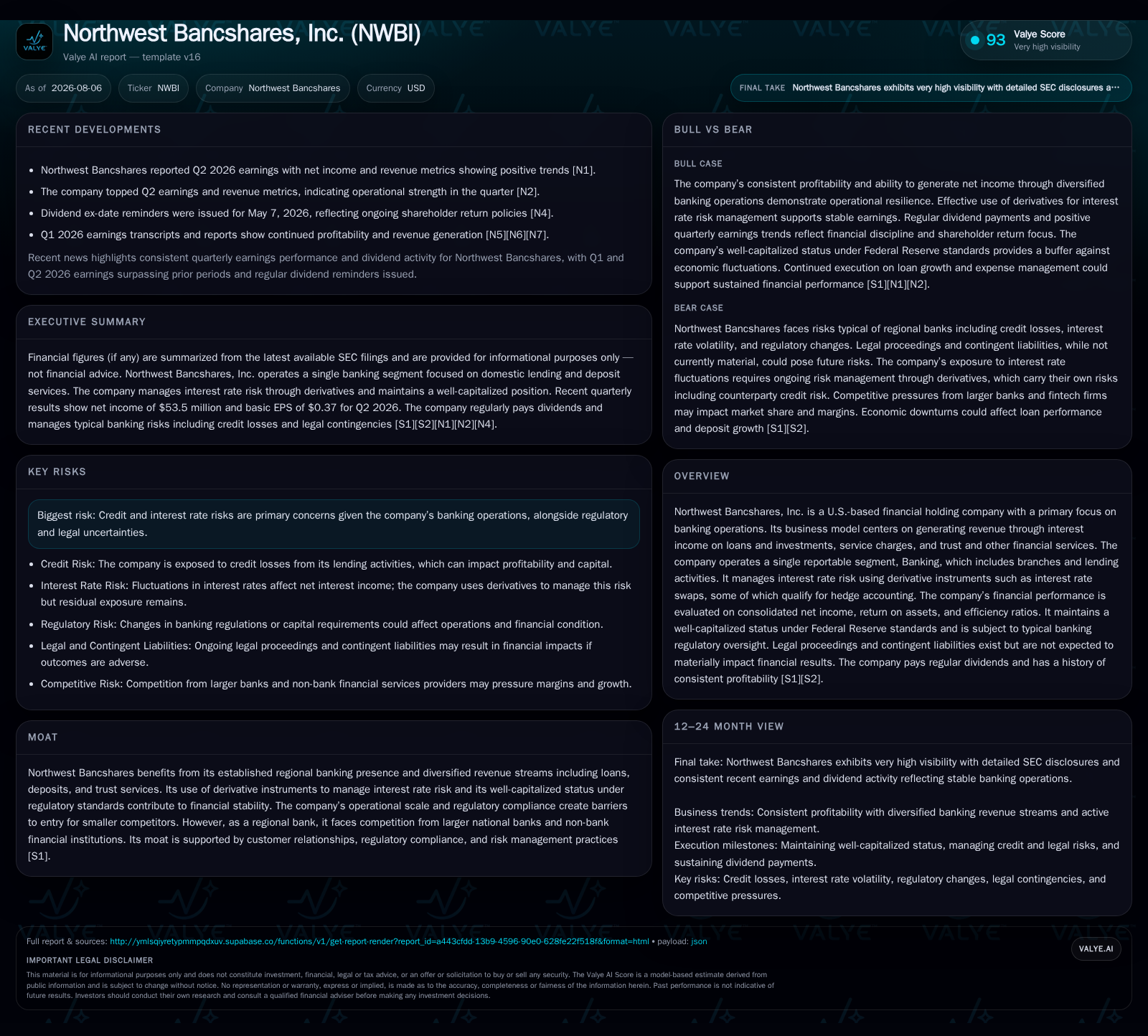
Northwest Bancshares, Inc. delivered a solid Q2 2026 operating update marked by expanding commercial lending activity and effective management of interest rate risk via derivatives. The company maintains a single banking segment concentrating on diversified loan portfolios, deposits, and fee-generating trust services. Despite increased concentrations in commercial real estate lending that attract regulatory scrutiny, Northwest holds well-capitalized status and demonstrates disciplined credit risk controls. Going forward, sustaining net interest margin amidst evolving deposit beta and provisioning trends remains critical as the regional banking industry navigates macroeconomic and regulatory complexities.
Latest Operating Update: Q2 2026 Highlights
Northwest Bancshares reported a steady progression in its core banking operations for the quarter ended June 30, 2026 [S2]. The company emphasized expanded commercial loan balances as a primary growth driver yet acknowledged the inherently higher credit risk this entails compared to residential lending. Regulatory filings note that large loan balances concentrated among fewer borrowers amplify potential loss severity in adverse scenarios [S1]. Concurrently, Northwest discloses continuing reliance on derivative instruments—particularly interest rate swaps—to manage rising interest rate risk inherited from its loan and investment portfolios [S1]. Some positions qualify for hedge accounting, which stabilizes earnings recognition over volatile rate cycles.
This quarterly disclosure complements an earlier July event release where the company reaffirmed its capital strength and operational discipline during a period of intense regional banking sector flux [S3][N1][N2]. Earnings topped analyst estimates due to disciplined margin management and controlled provision expenses despite competitive pressures.
Business Model Overview
Northwest Bancshares operates effectively as a traditional regional bank focused on generating net interest income from loans funded primarily by customer deposits [S1][S4]. Its single reportable segment consolidates branch and lending activities under one umbrella, simplifying performance monitoring based on consolidated net income metrics like return on assets (ROA)
Revenue streams include:
- Interest income driven by diversified loans—residential mortgages, commercial loans including real estate-related credits—which form the bulk of earning assets.
- Non-interest income, notably service charges on deposit accounts and trust-related financial services offering fee diversification beyond pure lending spreads.
- Investment securities gains/losses which fluctuate with market conditions but remain a smaller component.
Operating expenses such as interest expense on deposits/debt, credit loss provisions, and payroll expenses form the largest cost elements impacting efficiency ratios [S4]. These ratios serve as key indicators relative to peer regional/community banks on cost competitiveness
Importantly, the bank actively manages interest rate risk through derivative instruments like caps and swaps to protect margins. This tactical use of financial hedges reduces earnings variability in an environment marked by shifting Fed policy rates [S1].
Industry Structure & Competitive Positioning
Northwest Bancshares occupies a niche as a mid-sized regional bank serving domestic markets without geographic fragmentation [S4]. This positions it to leverage strong community relationships fostering customer loyalty—a competitive advantage against larger national banks with broader but less personalized footprints.
However, concentration in commercial real estate (CRE) loans poses both risks and competitive considerations. Regulatory guidance classifies banks with CRE exposure exceeding certain multiples of capital as subject to heightened supervisory scrutiny [S1]. At year-end 2025, Northwest's combined residential and commercial real estate loans stood at approximately 342% of total capital, indicating elevated concentration risk compared to typical thresholds [S1]. This scenario demands advanced risk management frameworks to maintain regulatory compliance while balancing growth ambitions.
The regional banking landscape also includes competition from fintech lenders capturing some consumer lending segments and credit unions vying for local deposits. In response, Northwest’s emphasis on expanding trust services and cross-selling financial products aims to deepen wallet share within its existing customer base [S1]. Effective deployment of technology will be vital going forward to streamline operations and enhance client experiences versus peers.
Growth Drivers
Key growth levers identifiable from current disclosures include:
- Loan Portfolio Expansion: Sustained increases particularly in commercial lending directly boost net interest income but require vigilant credit underwriting given borrower cash flow dependency [S1][S2].
- Deposit Base Stability: Core deposits underpin liquidity; evolving deposit beta—how quickly deposit pricing responds to market rates—influences funding cost volatility affecting margins.
- Trust & Financial Services Fees: Increasing fee income from these sources diversifies earnings away from cyclically sensitive net interest components enhancing profitability resilience [S4].
- Credit Quality Improvement: Reduced provision expense linked to stable or improving asset quality supports bottom-line growth.
- Interest Rate Environment: A favorable rate backdrop can widen net interest margins if managed effectively through hedges.
Monitoring these drivers through KPIs such as loan-to-deposit ratio trends, non-performing loan ratios, provision-to-average-loans ratio, efficiency ratio progress, ROA stability, and capital adequacy metrics will gauge execution success over coming quarters.
Risks & Growth Constraints
Several factors temper growth optimism:
- Credit Risk Concentration: Elevated CRE loan concentration above regulatory thresholds invites intensified oversight risking potential enforcement actions or mandated capital buffers that constrain growth capacity [S1]. Commercial loans secured by non-real estate collateral expose the bank to appraisals challenges and potentially longer foreclosure durations.
- Interest Rate Risk: Despite derivative usage, rapid or unpredictable Fed moves could impair margin predictability especially if deposit cost repricing accelerates (high deposit beta).
- Regulatory Compliance Costs: Maintaining well-capitalized status requires ongoing capital planning which may limit aggressive balance sheet expansion.
- Liquidity Risk: Deposit outflows driven by alternative investment attractiveness or sector-wide confidence shocks could stress funding models [S23].
- Operational Risks: Cybersecurity threats or system failures flagged pose potential earnings disruption risks [S1].
- Competitive Pressures: Larger regional/national banks with scale or fintech entrants present stiff challenges for new customer acquisition or product innovation.
Insights into these areas from successive quarters will inform performance durability assessments relative to peers like WSFS Financial or other mid-tier regional players noted for recent earnings surprises [N3].
Financial Profile Discussion
Regulatory capital levels meet "well-capitalized" criteria under Federal Reserve Regulation Y standards affirming strong buffer capacities against lending losses or market shocks [S1][S23]. Such capital adequacy enables ongoing dividends yet tempers highly aggressive balance sheet expansions amid rising CRE concentrations flagged by regulators.
Return on assets — a core metric used internally — reflects effective asset utilization given efficient expense control supported by moderate efficiency ratios compared to community bank peers [S4][N2]. Nonetheless, continued vigilance is needed on provisioning expense management given the larger commercial segment exposure.
Derivatives deployed mitigate interest rate swings that could otherwise erode net interest margin — central to earnings quality given competitive pressure on loan yields vs deposit costs across the regional banking peer group.
Conclusion
Northwest Bancshares demonstrates operationally sound execution in growing loans while offsetting interest rate risks via sophisticated hedging strategies. Its single-segment regional bank model relies heavily on diverse revenue channels encompassing loans funded through core deposits plus fee-driven trust services. Elevated CRE concentrations subject it to stringent regulatory oversight necessitating vigilant risk management frameworks. Maintaining capital adequacy alongside steady ROA supports confident continuation of dividend payments. Key performance indicators over upcoming quarters—loan mix changes, credit provisions, deposit behavior shifts, and hedge outcomes—will decisively influence sustainability of this financial stability narrative in an active competitive landscape.
Disclaimer: This is research-only, informational analysis and not investment advice. It may include AI-generated interpretation and general industry context. Always verify important details using primary sources.

Comments