
Public Storage Extends Market Reach with Strategic Acquisition and Operational Resilience
The closing of a major Canadian acquisition bolsters Public Storage’s portfolio while same-store NOI softness highlights near-term operational pressures.
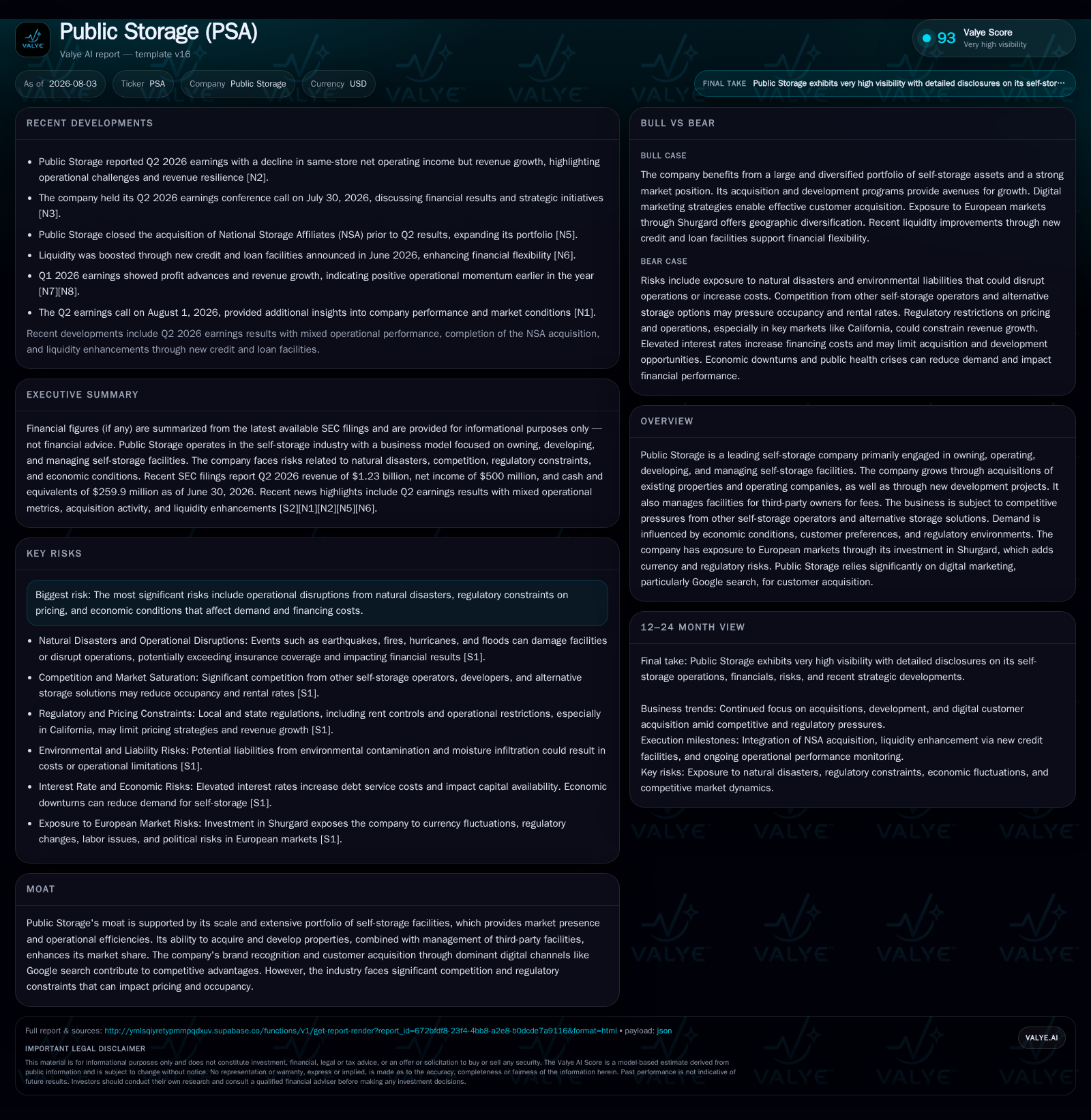
Public Storage completed the acquisition of PS Canada in Q2 2026, adding approximately $1.2 billion in assets primarily through equity issuance and cash, thereby expanding its scale and development pipeline. However, despite revenue growth driven by this acquisition and organic leasing operations, the company reported a decline in same-store net operating income (NOI), reflecting competitive pricing pressures and rising operating costs. Public Storage’s business model balances owned facility leasing revenue with growing third-party management fees, supported by digital marketing efficiency focused on Google search as a key customer acquisition channel. Capital structure remains robust with a net debt position near $10 billion as of June 2026, enabling continued acquisition and development investments amid macroeconomic and regulatory challenges.
Q2 2026 Acquisition Closure Refreshes Growth Pipeline Amid Operational Mixed Signals
Public Storage (PSA) formally closed its acquisition of PS Canada in the second quarter of 2026, paying approximately $1.2 billion consisting of nearly $889 million in PSA OP common units and $310 million cash consideration plus earn-out potential tied to net operating income targets [S2], [S3]. This transaction significantly enlarges Public Storage's asset base and acquisition pipeline while reflecting the company's ongoing strategy to grow through accretive self-storage property acquisitions within competitive markets. The equity issuance component aligns interests via PSA OP units convertible into common shares or cash at PSA’s discretion, providing flexibility in capital deployment while limiting immediate cash outflows.
However, despite the scale expansion brought by this deal, Public Storage's latest quarterly filing revealed operational headwinds as same-store net operating income (NOI) declined even though total revenues grew due to acquisition contributions [S2]. This divergence highlights margin pressure largely attributable to cost escalation factors like property tax increases—especially notable in states like California—and wage inflation, which together squeeze profitability on comparable existing facilities [S1]. Furthermore, external regulatory constraints have tightened rental rate adjustment levers in core U.S. markets. These dynamics introduce a nuanced near-term tradeoff between growing footprint and sustaining healthy operating margins.
A Multifaceted Business Model: Owned Leases Balanced by Third-Party Management Expansion
Public Storage’s revenue primarily stems from leasing self-storage units to both individual consumers and commercial tenants seeking flexible storage solutions. Rental income is recurring and underpinned by occupancy rates averaged across a vast facility network. Lease terms tend to be short-duration but with high renewal propensity due to switching costs for customers reorganizing space needs [S1]. Tenant insurance offerings add an ancillary revenue stream that also reinforces customer retention.
Complementing direct ownership operations is a growing third-party management fee business where PSA manages facilities owned by others in exchange for service fees. This model enhances PSA’s fee income diversification without incurring substantial capital expenditures associated with property ownership or development projects. Especially in tight financing markets or when capital allocations are stretched by acquisitions like PS Canada, third-party management provides steady fee revenue that supports earnings stability [S1], [S2].
Competitive Dynamics: Pricing Pressure Versus Digital Marketing Efficiency in Customer Acquisition
In an increasingly saturated self-storage sector characterized by several large REITs such as Extra Space Storage and CubeSmart, Public Storage competes intensely on pricing and occupancy. Regulatory frameworks in various states impose constraints on rental rate increases limiting top-line leverage potential at mature properties [S1]. Consequently, maintaining occupancy rates alongside gradual improvements in average rental rates per square foot becomes critical to sustaining same-store NOI growth.
Public Storage’s reliance on digital marketing—chiefly Google search engine marketing—forms a cornerstone of its customer acquisition strategy. Efficient targeting reduces customer acquisition costs relative to peers who invest more heavily across diversified offline channels. This digital advantage facilitates consistent tenant inflow despite competitive pressures from alternative storage solutions including portable storage services or emerging warehousing options tailored for e-commerce clients [N2], [S1]. Nonetheless, the cost efficiencies gained could be offset if competitors match digital sophistication or if changes in consumer search behavior dilute effectiveness.
Capital Structure Frame: Debt Levels Amid Financing Market Options and Dividend Policy Implications
As of June 30, 2026, Public Storage carried approximately $10.25 billion in total debt offset by about $260 million in cash equivalents resulting in net debt near $9.99 billion—a leverage position consistent with large-scale self-storage REIT peers managing extensive real estate portfolios [F1]. The company maintains access to revolving credit facilities priced at SOFR plus margins between roughly 0.625% and 1.55%, reflecting sound credit ratings that enable flexible capital deployment for acquisitions and developments without immediate refinancing strain [S6], [S7].
Furthermore, the issuance of preferred shares at yields surpassing 6.5% signals market sensitivity to interest rate environments but also broadens funding channels attractive to retail investors preferring stable income streams over common equity volatility [N10–N14]. This layered capital approach supports balanced dividend policies necessary to retain NAV valuations while funding growth.
Growth Catalysts: Geographic Expansion, Development Activity, And E-Commerce Related Demand Drivers
Demographic trends favoring greater residential mobility—particularly among urban millennials—and accelerating e-commerce adoption underpin structural growth opportunities for PSA's self-storage offerings. Increasing small business inventory demands elevate unit turnover rates and diversify end-user profiles beyond traditional personal storage tenants [S1].
Additionally, PSA continues advancing development projects in high-demand geographies complemented by strategic acquisitions like PS Canada that boost scale efficiently versus ground-up builds alone. International exposure through Shurgard adds incremental geographic diversity but brings currency risk and regulatory oversight considerations that may affect profit margins unevenly across borders [S1], [S2].
Regulatory and Environmental Risk Exposure Including Property Tax Trends in Key States
Risk factors remain salient as property tax assessments rise notably in states with dense facility concentrations such as California; such taxation escalations inflate operating expense ratios directly impacting net operating income resilience on existing assets [S1], [S2]. Wage inflation further tightens labor cost controls necessary for property maintenance operations.
Environmental risks including natural disasters historically expose PSA facilities to potential physical damage or business interruptions that may not always fall within insured limits given partial self-insurance strategies outlined by the company. Moreover, tenant insurance exposure introduces liability components consequential during disaster events which could affect occupancy sentiment or claims frequency negatively over time [S1]. Regulatory prohibitions temporarily limiting rent adjustments can also blunt responsiveness during inflationary cycles.
Headwinds and Watchpoints: Same-Store NOI Decline and Integration Hazards for Recent Acquisitions
The reported decline in same-store NOI despite revenue growth signals margin compression pressures possibly linked to cost inflation outpacing rental escalations on legacy assets post-acquisition integration hurdles. Such dynamics warrant close monitoring during upcoming quarters as realization of synergy benefits from PS Canada unfolds or if disruptions arise from operational system harmonization challenges across newly acquired properties [S2], [N6], [N7].
Investors should observe how occupancy sustains or improves following integration periods alongside control over operating expenses including maintenance efficiencies leveraged through portfolio scale effects.
Milestones to Monitor: Upcoming Earnings Guidance, Occupancy Rate Trajectories, Development Starts
Future catalysts include management updates on occupancy trends which serve as proxy indicators for sustained demand strength amid pricing headwinds reported thus far. Planned development project commencements or completions will bear on capacity-driven revenue expansions documented periodically while incremental third-party management contracts provide diversification signaling robust service demand beyond direct ownership segments.
Earnings guidance revisions will be closely examined for insights into corrective actions addressing margin contractions observed recently alongside clarity around timeline expectations for full assimilation of PS Canada assets into PSA’s operational fabric [N3], [N4], [S2].
Financial Profile Discussion
At quarter-end June 2026, Public Storage reported cash reserves approximating $260 million against total debt levels nearing $10.25 billion delivering net debt close to $9.99 billion—indicative of stable leverage aligned with industry norms among large-cap self-storage REITs focusing on balance sheet strength to support continuous asset additions via acquisitions or developments without undermining liquidity buffers or compliance with lending covenants outlined under revolving credit arrangements priced competitively relative to prevailing benchmark rates [F1], [S6], [S7]. This financial flexibility remains vital amid cyclical uncertainties affecting rental rate enhancements due to regulatory caps or inflation-driven expense upticks.
This analysis synthesizes recent quarterly disclosures emphasizing Public Storage's strategic portfolio expansion tempered by operational margin pressures reflective of broader self-storage market challenges including regulatory restrictions and rising input costs. The firm’s dual-pronged business model leveraging both owned leases and third-party management underpins revenue resilience though requires attentive integration execution post sizable acquisitions such as PS Canada. Monitoring key operational KPIs including occupancy trends alongside prudent capital structure management will be crucial near-term factors shaping sustainable growth trajectories within competitive digital marketing landscapes dominating customer acquisition efficacy.
This article does not constitute investment advice but provides an analytical perspective grounded strictly on publicly available filings, news reports, and sector knowledge.
Disclaimer: This is research-only, informational analysis and not investment advice. It may include AI-generated interpretation and general industry context. Always verify important details using primary sources.

Comments