
Crane NXT Leverages Global Manufacturing and IP to Drive Security and Payment Technology Growth
Crane NXT’s latest quarterly results reflect durable demand for its diversified industrial security and payment solutions amid geopolitical risks.
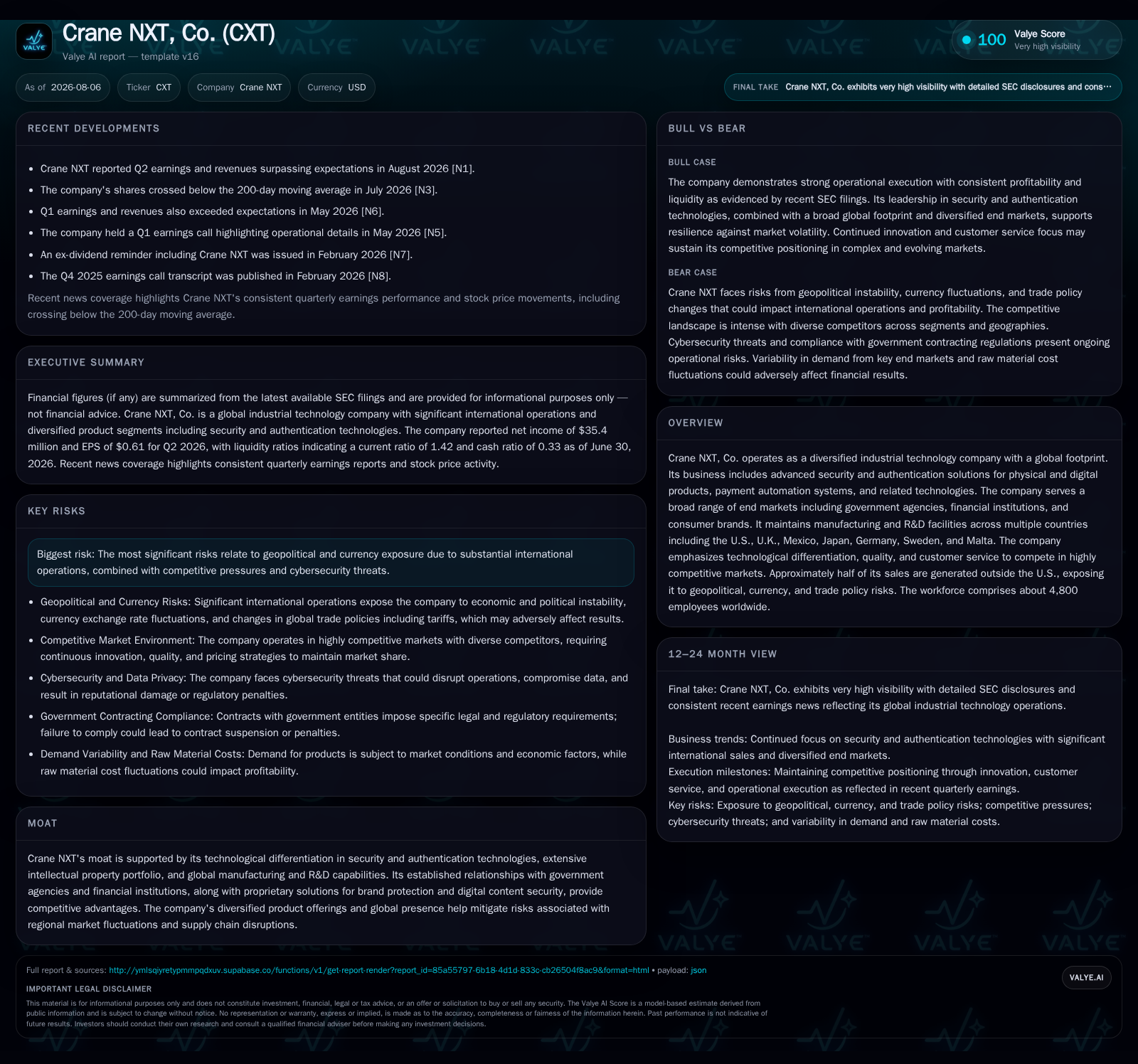
Crane NXT, Co. reported solid operating performance in Q2 2026, supported by resilient demand for its advanced security authentication and payment automation products globally. The company’s diversified business model, spanning proprietary micro-optics technology and electronic payment systems, is anchored by extensive R&D and manufacturing footprints across multiple countries. Despite exposure to trade policy uncertainties and currency fluctuations with international sales comprising half of revenue, Crane NXT sustains competitive differentiation through intellectual property and longstanding government and financial institution relationships. Key growth drivers include rising counterfeiting concerns and expanding adoption of digital payment technologies. Monitoring order backlogs, pricing trends, and supply chain resilience will be critical to assessing near-term momentum.
Recent Operating Update
Crane NXT, Co. announced results for the quarter ended June 30, 2026, which beat earnings and revenue expectations [S2], [S3], [N1]. This marks a continuation of stable customer demand in both the Security and Authentication Technologies (SAT) segment — formed through the acquisition including OpSec and De La Rue businesses — and the Crane Payment Innovations (CPI) segment focused on electronic payment hardware and software solutions. The company attributes its near-term performance to sustained adoption trends in digital payments alongside brand protection offerings that leverage proprietary micro-optics technology for physical-to-digital authentication [S3], [S1].
Operational resilience was supported despite ongoing global trade tensions affecting costs in key facilities like Mexico's Maquiladora plant. Management reiterated confidence in their ability to mitigate tariff impacts via price adjustments and productivity improvements without sacrificing volume or customer relationships. However, macroeconomic volatility remains a watchpoint given exposure to fluctuating demand across end markets such as government agencies and financial institutions that are sensitive to budget cycles [S1], [S12].
Business Model
Crane NXT operates as an industrial technology company specializing in advanced security hardware integrated with software ecosystems. The company’s core revenue streams are split between two segments: CPI delivers electronic equipment supporting automated cash handling, transaction verification, remote diagnostics, and productivity software primarily targeting retail operators and financial venues; SAT offers both physical product authentication solutions using patented micro-optics technologies as well as digital authentication platforms serving governments, brand owners, and financial institutions globally [S1],.
The business model combines direct sales of high-technology hardware with recurring service contracts for software updates, field service, and remote monitoring. This blend enhances revenue stability compared to pure hardware suppliers in adjacent industries. Contract structures often involve long-term agreements with government entities requiring compliance with complex procurement regulations — adding switching costs that support retention but also introduce regulatory risk.
Manufacturing footprint spans multiple continents including the U.S., U.K., Mexico under special trade programs, Japan, Germany, Sweden, and Malta. This global infrastructure is strategically positioned to optimize supply chain logistics while mitigating regional risks such as tariffs or currency fluctuations. Proprietary intellectual property in detection technologies ensures differentiation from lower-cost competitors that struggle to replicate cryptographic micro-optics or integrated sensing capabilities essential for combating counterfeiting or fraud, [S12].
Industry Structure and Competitive Position
The industrial technology sector specializing in security hardware straddles a competitive landscape where brand reputation hinges heavily on technological innovation. Peers typically emphasize portfolios of patented inventions combined with broad geographic manufacturing footprints to serve diverse institutional customers efficiently while managing geopolitical risks.
Crane NXT compares favorably with peers by integrating both physical authentication (e.g., banknote security features) with electronic payment automation — enabling cross-selling opportunities across government contracts and private sector clients like financial institutions. Its recent acquisitions underpin greater scale in SAT products relative to standalone competitors focusing only on either category.
However, companies across this industry face shared headwinds from global trade policies affecting component sourcing costs; cybersecurity threats necessitating continuous upgrades; rapidly evolving compliance requirements impacting contract terms; plus supply chain vulnerabilities showcased during recent global disruptions impacting lead times, [S1], [S12],.
Operational efficiency within manufacturing — including capacity utilization rates — materially affects gross margin profiles given fixed cost absorption dynamics in specialized hardware production lines.
Growth Drivers
Several structural tailwinds underpin Crane NXT's growth outlook:
- Digital Payment Automation: Increasing shift towards cashless transactions globally boosts demand for sophisticated CPI hardware/software platforms that enable faster processing while enhancing fraud detection.
- Counterfeiting & Brand Protection: Rising counterfeit incidents drive government agencies and consumer brands towards advanced physical authentication methods leveraging Crane's patented micro-optics technology.
- Regulatory Compliance: Governments worldwide mandate stronger security standards for currency printing and transactional integrity requiring continuous product innovation.
- Expansion of Service Attach Rates: Bundling hardware sales with service contracts extends customer lifetime value beyond point-of-sale equipment purchase.
- Geographic Revenue Diversification: Maintaining roughly half of revenues outside the U.S. spreads market opportunity but also introduces hedging complexity around currency fluctuations.
These drivers are reflected operationally through monitoring KPIs such as new product introductions signaling pipeline strength; order backlog metrics providing forward visibility; geographic revenue mix tracking exposure shifts; contract renewal rates evidencing penetration; plus steady R&D investment ratios sustaining competitive edge relative to peers whose technology lead can erode without reinvestment,.
Risks / Watchpoints / Growth Constraints
Key risks that could impede execution include:
- Geopolitical & Trade Policy Risks: With half revenues international, uncertainties surrounding tariffs especially impacting Mexican facilities’ cost advantages pose profitability pressures.
- Currency Exchange Rate Volatility: Fluctuations mostly related to JPY, GBP, EUR, SEK impact reported results when translating foreign income into USD reporting currency.
- Cybersecurity Threats: Potential breaches in information systems or product security could damage reputation or cause regulatory penalties given sensitivity of government contracts.
- Competitive Pricing Pressure: Intense competition could necessitate maintaining price levels unfavorable for margin expansion despite productivity initiatives.
- Supply Chain Disruptions: Component shortages or logistical delays remain systemic risks evident since recent global events impacting manufacturing schedules.
- Dependency on Institutional Customers: Government contracting cycles or budget constraints can produce lumpier order patterns requiring active management.
- Technological Obsolescence: Rapid innovation pace demands consistent R&D spending; failure could erode differentiation.
Monitoring how these risks manifest will require attention to order backlog cancellations/additions data; pricing trends reflecting pass-through success; any indications of IT-related incidents disclosed publicly; plus competitive intelligence around peer launches or contract awards highlighting shifting market share dynamics [S18],.
What to Watch Next
Investors should track several operational milestones over the coming quarters:
- Quarterly shipment volumes relative to prior periods demonstrating end-market health,
- Updates on new product rollouts expected from pipelines particularly within SAT segment leveraging OpSec/De La Rue integration,
- Order backlog trends signaling durability or softness arising from macroeconomic changes,
- Geographic revenue composition shifts illuminating emerging market traction or retrenchment,
- Pricing power metrics revealing tariff impact mitigation capability,
- Contract renewal rate announcements especially around major government deals,
- Supply chain lead time improvements post recent bottlenecks indicating operational recovery,
- R&D spend cadence indicating continued investment intensity necessary for competitive moat maintenance.
Upcoming quarterly filings beyond August 2026 will provide real-time confirmation or challenges to management’s strategy execution effectiveness.
Financial Profile Discussion
As of June 30, 2026, Crane NXT reported cash & equivalents of $231.4 million against total debt estimated at $1.26 billion resulting in net debt approximating $1.03 billion—a leverage level that suggests moderate but controlled indebtedness given its industrial capital intensity profile [F1]
In summary, Crane NXT’s disciplined financial management paired with its leveraged but manageable capital structure supports ongoing strategic investments critical for securing future growth drivers while navigating inherent global operational risks.
This analysis is intended solely for informational purposes based on publicly available data as of August 2026 without any investment research view.
Disclaimer: This is research-only, informational analysis and not investment advice. It may include AI-generated interpretation and general industry context. Always verify important details using primary sources.

Comments