
LiveWire Expands into Electric Off-Road Market Amid Ongoing Cash Burn and Strategic Partnership Reliance
LiveWire Group's recent acquisition of Dust Motorcycles broadens product scope while capital raising and operational cost control remain critical.
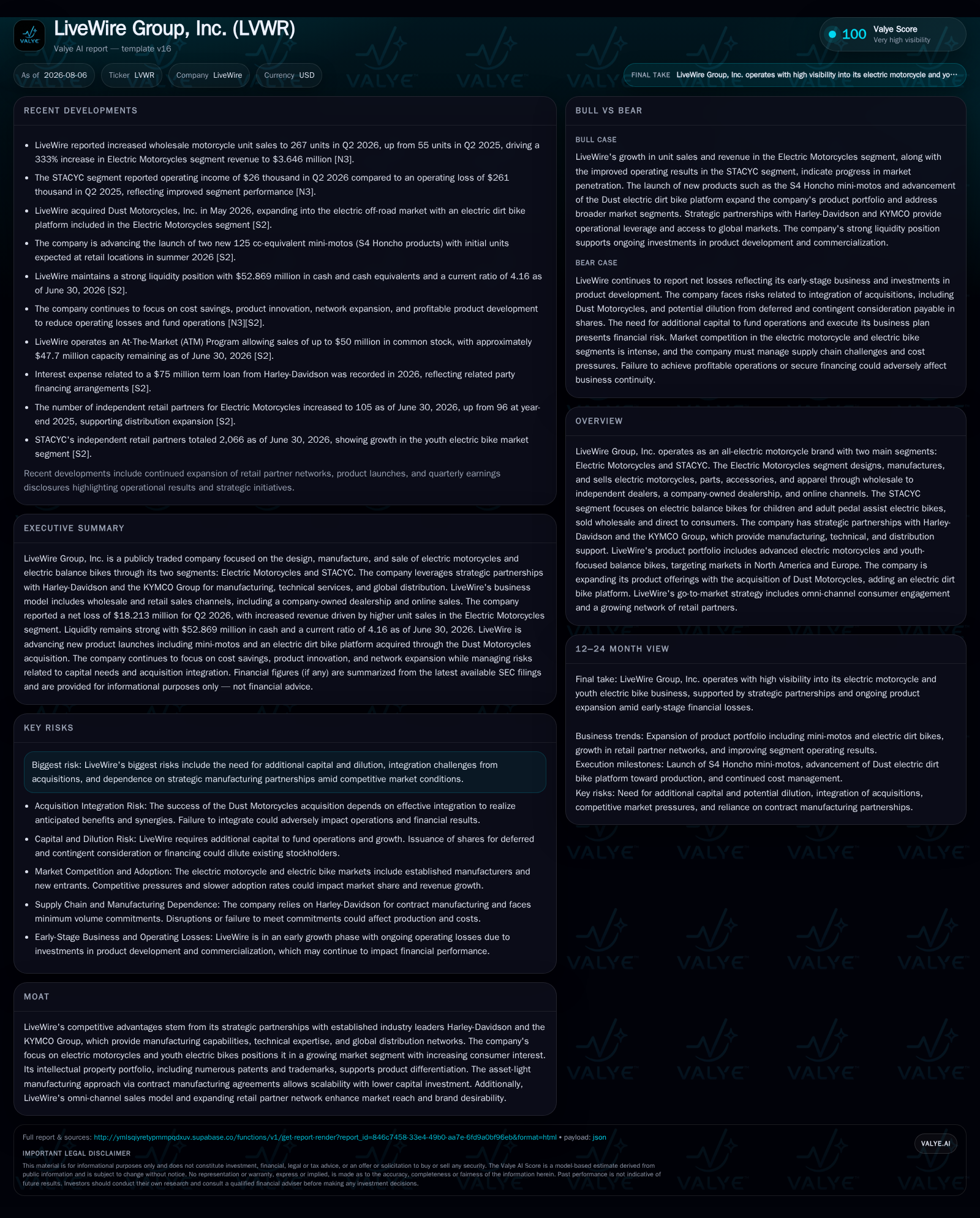
LiveWire Group, Inc., a pioneer in electric two-wheel vehicles, reported modest reductions in net losses in its latest quarter through focused product development and cost management. The May 2026 acquisition of Dust Motorcycles signals strategic expansion into electric off-road bikes, complementing its core electric motorcycles and youth electric balance bikes. Despite solid cash reserves supported by a $75 million term loan agreement with Harley-Davidson and an At-The-Market equity program, the company continues to confront liquidity risks inherent in early-stage EV manufacturers. LiveWire’s partnership model leveraging Harley-Davidson and KYMCO’s manufacturing and distribution capabilities underpins scalability but entails dependence risks.
Recent Operating Update
In its latest quarterly filing dated August 5, 2026, LiveWire Group, Inc. reported continued modest improvement in net losses during ongoing investments in technology and product development [S2]. Net loss for Q2 2026 was $18.2 million compared to $18.8 million for Q2 2025, demonstrating operational discipline despite early-stage scaling challenges. Operating losses from the Electric Motorcycles segment remained roughly flat at approximately $18 million for the quarter but improved on a six-month basis due to cost-efficiency gains. The STACYC segment posted a marginal operating profit of $26 thousand for Q2 2026 compared to a loss previously [S2].
A key development is the May 18, 2026 acquisition of Dust Motorcycles assets, marking LiveWire’s entry into the electric off-road motorcycle space through an electric dirt bike platform now included under the Electric Motorcycles segment [S2]. While Dust contributed no revenue yet post-acquisition, this move diversifies LiveWire's portfolio into a high-growth niche complementary to its road-focused motorcycles and youth bikes.
The company continues to navigate liquidity cautiously amidst these strategic investments. Cash and equivalents stood at $52.9 million as of June 30, 2026 against total debt of approximately $76.8 million resulting in net debt of around $23.9 million [F1]. A recently amended $75 million delayed draw term loan facility with Harley-Davidson allows draws through December 15, 2025 with maturity extended to December 15, 2027 [S2]. The term loan also includes covenants restricting certain financial activities.
Management emphasizes flexible spending controls alongside active exploration for additional capital sources including the At-The-Market (ATM) equity program allowing up to $50 million issuance capacity [S2],[S10]. As of mid-2026 substantial ATM capacity remains unused.
Additionally, the company publicly disclosed July 23 notice from NYSE regarding stock price non-compliance with listing standards pointing to market challenges reflected in share price depreciation [S3],[N3],[N1].
Business Model Analysis
LiveWire’s business model centers on designing electric two-wheel vehicles covered under two discrete segments: adult Electric Motorcycles and STACYC youth/electric pedal-assist bikes [S1],[S2]. Electric motorcycles are sold wholesale to independent retailers (dealer network), direct retail via a company-owned dealership location, and online platforms — an omni-channel approach that balances broad market coverage with controlled consumer touchpoints.
The STACYC segment targets children primarily through electric balance bikes and strategically entered pedal-assist adult e-bikes launched in March 2025 [S1],[S2]. STACYC products are likewise distributed wholesale to dealers/distributors plus direct consumer sales online.
Revenue generation is driven by unit sales volume across each segment complemented by aftermarket parts/accessories sales (batteries, upgrades), branded apparel licensing adds ancillary income streams enhancing brand loyalty.
Critical operational leverage stems from strategic manufacturing partnerships — most notably with Harley-Davidson (H-D) who supplies contract manufacturing capabilities under agreements including minimum purchase commitments and inventory reimbursement clauses [S1],[S4],[S5]. KYMCO Group partnership further enhances technology sharing and distribution network access internationally.
This outsourcing manufacturing model reduces capital intensity compared to owning production facilities outright while enabling scalability aligned with demand fluctuations without bearing heavy fixed asset burdens.
Partnerships also inform product quality standards given H-D’s well-regarded engineering reputations which supports positioning LiveWire as a premium all-electric motorcycle brand alongside peers such as Zero Motorcycles.
Industry Structure and Competitive Position
The electric two-wheel vehicle manufacturing industry comprises niche manufacturers like LiveWire focusing on electric motorcycles alongside broader players in electric bicycles (including balance bikes) targeting urban mobility solutions.
Competition includes incumbent ICE motorcycle manufacturers entering EV markets (e.g., Harley-Davidson itself with its internal LiveWire origin), pure EV startups like Zero Motorcycles providing differentiated performance offerings, as well as electric scooter/bike companies like Segway-Ninebot competing primarily on cost-sensitive mass adoption models.
LiveWire occupies a hybrid position emphasizing higher-performance adult electric motorcycles while also developing youth-focused products under STACYC branding. This distinct dual-segment focus differentiates it somewhat from peers commonly specializing solely on either adult or youth markets.
Its reliance on contract manufacturing via prominent partners confers potential speed-to-market advantages but also dependence risks if partners face capacity constraints or strategic divergences.
The market remains fragmented globally but poised for structural demand growth driven by emissions regulations favoring zero-emission vehicles and urban micro-mobility trends supporting smaller electric vehicles’ adoption.
Growth Drivers
Demand drivers include increasing consumer preferences for sustainable transportation alternatives facilitating accelerated adoption of zero-emission motorcycles and e-bikes domestically and internationally.
Government incentives at federal/state levels in key markets reduce purchase costs boosting penetration rates particularly among environmentally conscious buyers catering well to LiveWire’s premium brand positioning.
Technological advancements improving battery energy density support longer range vehicles enhancing utility justifying premium pricing power maintained by brands investing heavily in R&D such as LiveWire focusing on new powertrain innovations [S2]
Diversification into adjacent segments like Dust’s off-road e-dirt bikes expands addressable market size potentially enhancing dealer network utilization while capturing emerging leisure/off-road trends amid younger consumer cohorts [S2]
Expansion of omni-channel sales channels allows greater direct consumer data capture improving marketing effectiveness while fortified dealer relationships incentivize broader retail footprint thus supporting scaling unit volumes [S1]
Risks and Constraints
Significant risks remain inherent including persistent negative cash flows requiring continuous capital influxes which lead to dilution concerns raised by deferred/contingent stock issuances tied to acquisitions such as Dust Motors [S11],[S12].
Dependency on strategic partners exposes LiveWire to supply chain disruption or contractual risks should disagreements arise affecting timely manufacturing or inventory management crucial for customer fulfillment consistency.[S4]
Pricing pressures could emerge as competition from cheaper entry-level EVs intensifies forcing margin compression challenging profitability attainment timeline.
Integration challenges related to recent acquisitions could slow return on investment if synergies do not materialize or if integration costs exceed expectations.[S11]
Stock price volatility noted by NYSE listing concerns may impair ability to raise capital efficiently impacting medium-term liquidity plans [S3]
Customer adoption pace of premium-priced electric motorcycles is still evolving potentially slowing revenue ramp relative to forecasts dependent on infrastructure availability such as charging stations.
What to Watch Next
Key milestones include progress toward commercial production of new Dust-derived off-road product lines evidencing expansion execution [S2]. Monitoring changes in net loss trajectory, operating margins per segment will signal improvements in operational leverage.
Capital raising activity including ATM program utilization or new financing arrangements should be tracked closely given ongoing cash burn requirements [S10]
Dealer network size growth metrics alongside online direct-to-consumer sales proportion shifts will highlight success of channel strategies balancing brand control versus market reach.
Competitive responses from legacy motorcycle manufacturers further entering the EV space or emerging startup launches will affect pricing dynamics creating headwinds or opportunities depending on differentiation outcomes.
Regulatory shifts influencing subsidies or emission standards may materially alter addressable markets expanding or contracting potential volumes especially at regional geographies where LiveWire operates.
Financial Profile Discussion
As of June 30, 2026, LiveWire held cash and equivalents totaling roughly $52.9 million against total debt approximating $76.8 million resulting in net debt near $23.9 million with a strong current ratio above 4 indicating good short-term liquidity cushioning [F1]. This buffer affords operating flexibility although continued unprofitable operations necessitate proactive capital management.
The amended term loan agreement with Harley-Davidson provides committed funding access up to $75 million drawn through December 15, 2025 with maturity extended to December 15, 2027 supporting runway extension [S2]
LiveWire’s balanced focus on reducing cash burn via cost reduction initiatives coupled with prioritizing profitable product development aims at eventually bridging toward operating profitability though no positive free cash flow is expected within the next year based on current disclosures [S2]
Equity issuance capability under an active ATM program up to $50 million aggregate provides incremental financing optionality subject to favorable market conditions though dilution effects may weigh on shareholder equity value over time[S5],[S10].
Continued monitoring of warrant liabilities is pertinent given their contingent impact on capitalization structure depending on stock price performance relative to exercise thresholds [S11]
Disclaimer: This analysis is based solely on publicly available filings up to August 2026. It does not constitute investment advice or endorsement of any securities mentioned herein.
Disclaimer: This is research-only, informational analysis and not investment advice. It may include AI-generated interpretation and general industry context. Always verify important details using primary sources.

Comments