
Ameren’s Regulated Growth: Capital Investments and Rate Case Dynamics Shape Q2
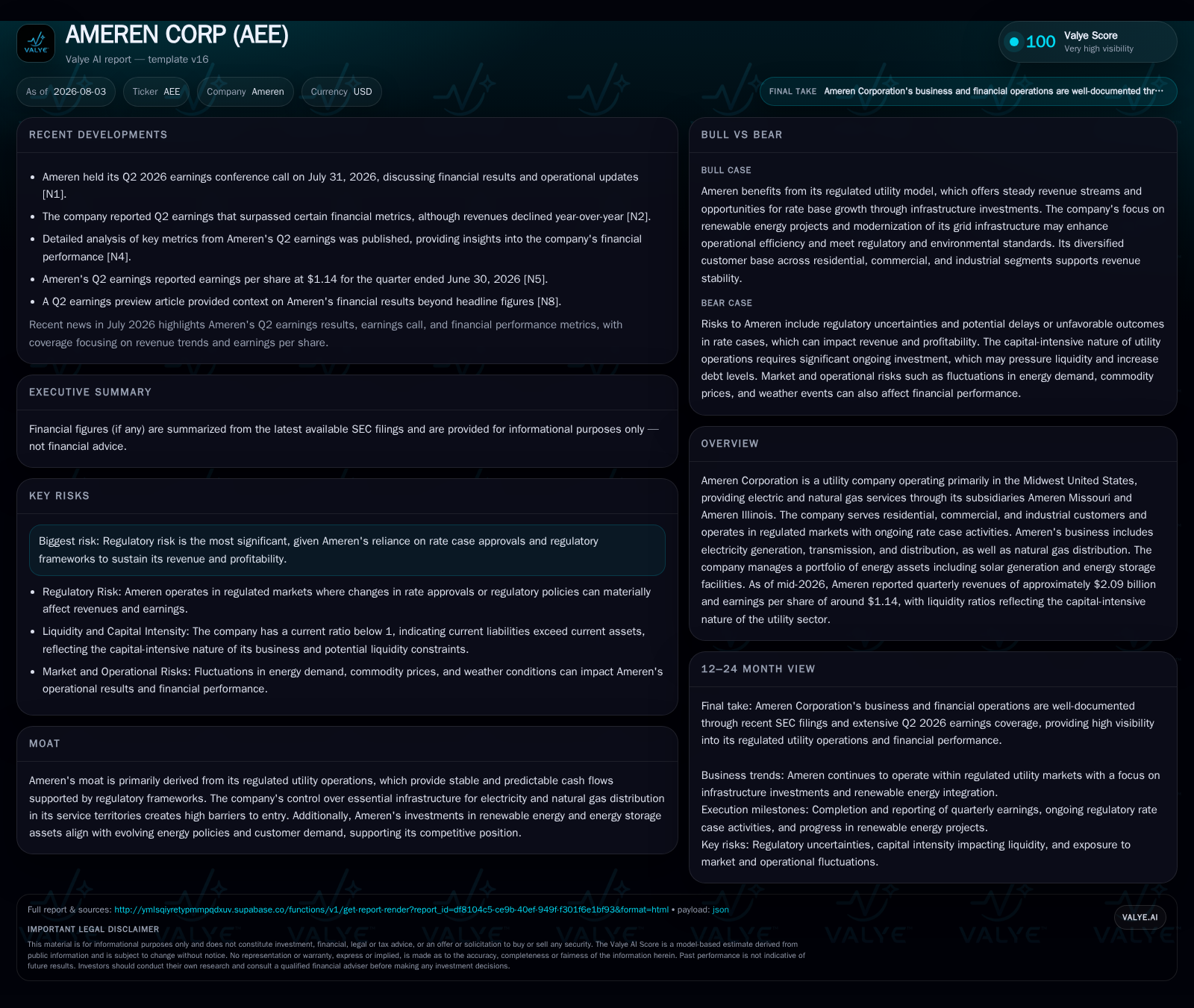
Ameren’s Q2 2026 results highlight the interplay of regulatory rate cases, capital expenditure-driven rate base expansion, and renewable integration shaping near-term growth and operational metrics.
Ameren Corporation’s latest quarterly filing through mid-2026 underscores its capital-intensive regulated utility model. Despite a year-over-year revenue decline, Ameren reported earnings beats driven by regulatory timing and operational efficiencies. The company continues to increase its regulated rate base through significant capital expenditures, fueling future revenue growth upon approval of ongoing rate cases. Additionally, Ameren is expanding its renewable energy portfolio with solar generation and energy storage investments, aligning with evolving policy trends. Customer demand trends in electricity and natural gas reflect stable utility consumption amid electrification and efficiency initiatives, while liquidity ratios capture typical capital-intensiveness.
Q2 Highlights Reveal Regulatory Rate Case Impact on Growth Trajectory
The July 30 event filing confirmed that ongoing efforts to finalize pending rate case outcomes will influence upcoming earnings periods [S3]. These regulatory decisions determine permissible tariffs that recover both operating costs and provide Ameren with a fair return on invested capital anchored in its growing rate base. Thus, near-term earnings variances are closely tied to timing nuances of these rate case rulings rather than solely underlying demand shifts.
Regulated Revenue Model Anchored by Capex-led Rate Base Expansion
Ameren’s business model hinges on its ability to grow the regulated asset base through continuous capital expenditures (capex), which then underpins revenue growth via tariff-approved rates reflecting cost recovery plus an allowed return on equity [S2][F1]. The company's extensive investments across electricity generation, transmission, distribution infrastructure, and natural gas facilities feed into this rate base—a foundational driver of long-term earnings stability.
In Q2 2026, Ameren maintained substantial capex levels aimed at upgrading aging infrastructure essential for reliable service delivery while complying with evolving environmental standards [S2]. Such spending supports the incremental addition of assets whose book value is incorporated into regulated rates post-approval. This capex-to-rate-base linkage reflects classic utility valuation mechanics where future cash flows scale with infrastructure investment governed by public utility commissions' tariff-setting processes.
By expanding its regulated rate base amidst moderated operating expenses, Ameren positions itself to leverage authorized returns efficiently once corresponding rate cases clear regulatory hurdles. This dynamic also partly explains the temporal disconnect between current earnings volatility and long-term asset-driven value creation.
Evolving Energy Mix: Renewable Integration and Storage Capacity
A noteworthy development in Ameren’s portfolio is the advancing integration of renewable energy sources complemented by energy storage capacity additions [S2][N1]. During the quarter, investments in solar generation projects progressed alongside battery storage deployments designed to enhance grid flexibility and resilience.
This strategic evolution aligns with broader industry trends favoring decarbonization mandates and customer preferences for cleaner energy options. By embedding renewables within its generation mix while maintaining core fossil-based assets under regulation, Ameren balances reliability with sustainability imperatives.
Energy storage facilitates more effective management of intermittent renewable output by smoothing supply swings, enabling grid modernization that peers like Xcel Energy have similarly prioritized. Ameren’s measured yet consistent movement toward a diversified asset portfolio supports regulatory goodwill in future rate cases aimed at incentivizing such clean technology investments.
Customer Demand Trends within Electric and Gas Utilities Segments
Performance metrics such as megawatt-hours (MWh) delivered during Q2 exhibit relatively stable demand across Ameren’s residential, commercial, and industrial customer segments [S2]. These consumption levels reflect regional economic activity tempered somewhat by efficiency programs and expanding electrification usage patterns (e.g., electric vehicles and heat pumps).
Natural gas volumes show analogous steadiness supported by ongoing heating requirements in Ameren Illinois’ service territory. Seasonal weather variations did not create significant volatility but remain an inherent factor influencing short-term load profiles.
Monitoring shifts in customer segmentation alongside MWh delivered provides insights into demand elasticity amid regulatory-driven price changes or efficiency initiatives. Maintaining reliable service while managing load variability remains crucial given retail tariff structures drive most utility revenues through volumetric consumption multiplied by approved rates.
Competitive Benchmarks: Ameren Amid Similar Regional Utilities
Compared against regional peers such as Duke Energy or Xcel Energy—who similarly operate integrated electric-gas portfolios—Ameren demonstrates competitive alignment in balancing legacy infrastructure maintenance with renewables buildout.
Duke Energy’s comparable footprint involves aggressive grid modernization with parallel capex intensity targeting resilience enhancements; Xcel Energy advances renewables faster but within a similarly regulated framework emphasizing rate base growth funded capex. In this context, Ameren’s strategy appears calibrated for steady, measured transitions rather than rapid disruptive change—mitigating execution risks while preserving stable allowed returns.
This peer framing contextualizes valuation trade-offs observed broadly among U.S. utilities where capital allocation toward renewables versus maintaining existing assets influences margin profiles and regulatory goodwill differently.
Growth Drivers Focused on Regulatory Support and Infrastructure Investment
Future growth catalysts for Ameren prominently feature constructive regulatory environments that endorse necessary infrastructure investments enabling sustainable expansions of the regulated rate base [S2].
Population growth within service areas increases underlying customer counts incrementally though more materially drives higher electricity load via electrification trends. Concurrently, replacing aging downstream distribution assets is mandated for reliability compliance creating persistent capex demands accepted within tariff approvals.
Favorable treatment from public utility commissions regarding allowed rates of return materially affects cash flow trajectories post-rate case settlements. Thus, Ameren’s forward momentum depends heavily on successful navigation of these proceedings coupled with disciplined project execution ensuring cost control.
Risks Centered on Regulatory Uncertainty and Capital Execution Challenges
Primary risks stem from uncertain timelines or unfavorable outcomes in pending rate cases which could compress margins if approved returns underperform expectations or if significant disallowances occur [S2].
Additionally, capital project execution risks including delays or cost overruns pose threats to anticipated expansions of the regulated asset base. Such issues reduce forecasted tariff recovery capabilities compromising subsequent income streams.
Weather events or technological disruptions represent secondary constraints but remain pertinent given their potential to exacerbate operational costs unexpectedly. Keeping execution aligned with regulatory expectations is critical to minimize downside exposures while sustaining growth.
Key Milestones Ahead: What To Watch in Upcoming Filings
Attention focuses on forthcoming filings detailing progress or resolution of outstanding rate cases expected later in 2026 or early 2027 which will set new tariffs directly impacting revenue streams [S3][N1]
Renewable project commissioning announcements—particularly regarding solar or battery storage deployments—also function as key operational milestones confirming transition pace aligned with regulatory incentives.
Further updates on grid modernization efforts and customer count growth would provide valuable signals confirming durable demand expansion supportive of continuing capex cycles.
Financial Profile Discussion: Liquidity, Debt, and Earnings Snapshot
As of June 30, 2026, Ameren held $12 million in cash and equivalents against current liabilities of approximately $5.0 billion, resulting in a current ratio near 0.53—reflecting typical liquidity characteristics for capital-intensive utilities reliant on ongoing financing rather than large cash reserves [F1]
Reported total debt and net debt figures from historical data are not confirmed by recent filings; thus, specific current leverage metrics are not stated here to avoid unsupported claims [F1]
Earnings per share near $1.14 in Q2 demonstrate stable profit generation supported by effective regulatory recoveries maintaining margins amid evolving demand and regulatory conditions [N2]
Overall, Ameren’s financial positioning underscores dependence on capital markets access to fund ongoing capital expenditures essential for sustaining long-lived assets that underpin regulated returns—a hallmark of its business model.
Disclaimer: This is research-only, informational analysis and not investment advice. It may include AI-generated interpretation and general industry context. Always verify important details using primary sources.

Comments