
Richardson Electronics Revives Growth Amid Specialized Engineering and Aftermarket Strength
Richardson Electronics demonstrates resilient operating performance supported by its diversified segments and integrated service capabilities despite tariff-induced cost pressures.
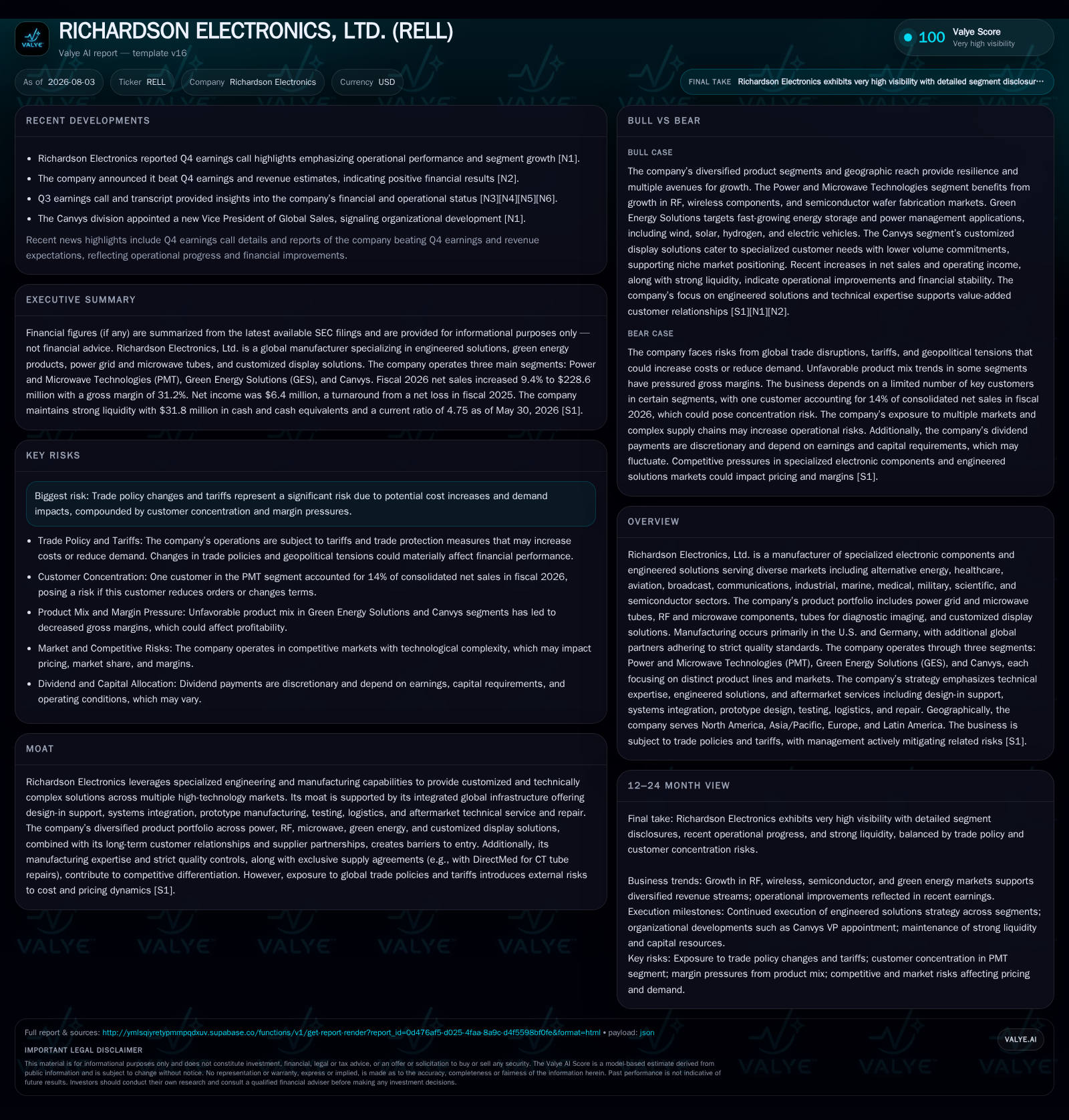
In the latest quarter, Richardson Electronics reported stable operating income and sustained backlog levels amid ongoing trade tariff headwinds. The company’s tripartite business model—Power and Microwave Technologies (PMT), Green Energy Solutions (GES), and Canvys—offers diversification across high-technology markets that mitigates cyclicality and customer concentration risks. Its emphasis on engineering expertise, design-in support, and proprietary aftermarket services, including exclusive CT tube repairs, underpin durable customer relationships and margin resilience. Key risks remain exposure to trade policies, supply chain disruptions, and concentrated OEM demand profiles.
Latest Quarterly Operating Momentum Evidences Modular Strength during Tariff Pressures
Richardson Electronics’ latest quarterly filing for the period ended February 28, 2026 details operational continuity despite external cost headwinds from global trade tariffs. This resurgence is notable as many electronic component manufacturers face margin compression due to tariffs increasing input costs without commensurate pricing power.
Importantly, order intake patterns underpinning backlog stability align with a roughly balanced book-to-bill environment reported in recent communications. Such steadiness suggests customers maintain confidence in Richardson's specialized engineered solutions during macroeconomic uncertainty [N1]. Maintaining high backlog levels serves as a forward visibility metric critical in industrial hardware sectors where long lead times and customization dictate revenue timing.
"Crafting a Durable Moat": How Segmented Product Diversification Sustains Revenue Stability
Richardson structures its operations into three principal segments—Power and Microwave Technologies (PMT), Green Energy Solutions (GES), and Canvys—that together deliver broad exposure across multiple high-technology verticals: healthcare imaging equipment, semiconductor manufacturing systems, alternative energy infrastructure, and customized industrial display platforms [S1].
The PMT segment combines legacy power grid tubes and microwave tube manufacturing with cutting-edge RF wireless technologies serving aerospace, defense, communications, medical diagnostic imaging, and scientific applications. This segment’s diverse end-uses help dampen cyclicality that often afflicts single-market suppliers.
Green Energy Solutions capitalizes on the expansion of renewable energy assets like wind turbines, solar arrays, hydrogen fuel systems, and EV battery management through engineered subsystems emphasizing power conversion components. This aligns strategically with secular growth trends driving electrification.
Canvys provides customizable displays tailored for professional enterprise clients requiring specialized computing form factors in sectors such as medical diagnostics and industrial automation. Lower volume commitments relative to mass-market panel providers create defensible niche positioning requiring deep engineering support.
This product mix diversification reduces demand concentration risk typical of OEM supply chains while fostering organic cross-segment synergies that improve revenue stability metrics such as book-to-bill ratio and order backlog consistency.
"Engineering Advantage": Integrated Design Support and Aftermarket Services Cement Customer Ties
A core competitive advantage is Richardson’s integrated business model combining design-in support—from prototype manufacturing through testing—to rigorous aftermarket services anchored by a suite of repair capabilities for complex components like CT X-ray tubes under exclusive supply agreements with DirectMed Imaging [S1], [S3]. These aftermarket services generate recurring revenue streams with higher gross margins than initial product sales while extending customer life cycle engagement.
Design wins facilitated by embedded engineering teams allow Richardson to embed their solutions early into OEM production cycles securing longer tenure partnerships—a critical differentiator versus commodity suppliers whose relationships are primarily transactional. This integration also enables better inventory management aligned with production schedules enhancing working capital turnover.
Such end-to-end involvement from system conception through post-sale service boosts switching costs for customers reliant on high-quality technical support backed by global logistics networks ensuring uptime—critical for mission-critical industrial and healthcare applications.
"Global Manufacturing Footprint Anchors Quality Control but Faces Trade Tariff Headwinds"
More than 55% of Richardson’s manufacturing footprint resides in the United States (LaFox, Illinois; Marlborough, Massachusetts) and Donaueschingen, Germany; complementing global contract manufacturing partners who adhere strictly to company quality standards according to its supplier code of conduct [S1]. These geographically diversified operations provide proximity advantages to Western OEM customers facilitating tight quality control standards essential in medical-grade components or high-reliability aerospace parts.
However, this geographic dispersion exposes Richardson to ongoing trade tensions imposing tariffs on certain imported materials or finished goods potentially increasing input costs unpredictably. The company actively collaborates with suppliers and customers to ameliorate these impacts via price adjustments or sourcing alternatives but notes that failure to fully pass through incremental costs could adversely affect margins or reduce demand elasticity [S19]. Supply chain management remains a critical lever given semiconductor shortages’ echoed risks in electronic component industries generally.
"Contextualizing Risks": Customer Concentration and Supply Chain Exposures in Focus
One salient risk is customer concentration within specialized markets like healthcare imaging where large OEM accounts can represent outsized revenue contributions. While Richardson has partly mitigated this via segment diversification into green energy solutions and industrial displays reducing volatility linked to any single vertical’s capital expenditure cycle, sustained dependency on a limited pool of major customers requires ongoing strategic focus.[S1], [S2]
Additionally, supply chain disruptions exacerbated by geopolitical tensions or raw material scarcity could further constrain capacity utilization or delay product delivery—metrics tightly linked to effective order backlog management. The company's public disclosures highlight awareness of these vulnerabilities amid fluctuating trade policies particularly affecting its power grid tubes and microwave tube supply lines subject to import tariffs levied recently.[S2], [S19]
Growth Opportunities in Semiconductor Equipment, Green Energy, and Diagnostic Imaging
Richardson is positioned to capitalize on several secular growth vectors recognized industry-wide. Accelerating semiconductor fabrication capacity expansions globally increase demand for precision RF components integral to advanced manufacturing tools—a market where PMT’s engineered subsystems are relevant [N3]
Simultaneously, GES benefits from surging investments in durable green energy infrastructure targeting decarbonization goals including wind turbines utilizing specialized power conversion tubes and emerging hydrogen fuel cell technologies requiring robust electrical management solutions.[S1]
Healthcare advances particularly in high-resolution diagnostic imaging sustain steady replacement cycles for components like CT X-ray tubes repaired exclusively by Richardson via DirectMed partnership providing a steady aftermarket revenue source.[N3], [S1]
Capturing further design wins across these verticals will be central to sustaining booked orders translating into revenue growth beyond modest historical rates.
What To Watch: Backlog Trajectories, Margin Trends, and Order Inflows in Upcoming Quarters
Investors monitoring Richardson should focus on quarterly updates detailing order backlog evolution relative to shipments signaling demand firmness or easing [S3]. Variations in the book-to-bill ratio will indicate whether new bookings continue to outpace deliveries supporting growth assumptions.
Gross margin trends warrant close observation given ongoing tariff cost pressures; margin expansion or stable rates would imply success passing through pricing or operational efficiencies maintaining cost discipline [N1]
Additional indicators include updates on aftermarket service contract renewals and potential cadence changes in design win announcements reflecting competitive dynamics especially vis-à-vis peers like II-VI Incorporated or MKS Instruments known for similar specialty electronic components.[N2]
Financial Profile Discussion: Liquidity Cushion Supports Operational Flexibility Amid Market Uncertainties
As of May 30, 2026, Richardson Electronics held $31.8 million in cash and equivalents with current assets of $172.7 million and current liabilities of $36.4 million, resulting in a strong current ratio of approximately 4.75—reflecting solid short-term liquidity cushioning operational demands amid volatile input costs [F1]
Working capital management appears prudent balancing inventory reductions with receivable increases concurrent with sales growth [F1]
This sound financial footing enhances the company's ability to navigate tariff-related volatility while investing selectively in the engineering capabilities sustaining its differentiated product portfolio.
Disclaimer: This analysis reflects information available as of August 2026 from public SEC filings and market disclosures without expressing any investment research view or future guidance projection.
Disclaimer: This is research-only, informational analysis and not investment advice. It may include AI-generated interpretation and general industry context. Always verify important details using primary sources.

Comments