
Anika Therapeutics Advances Manufacturing Capacity Amid Customer Concentration Risks
Q2 2026 results highlight Anika's reliance on J&J MedTech and efforts to expand production capability for HA-based orthopedic products.
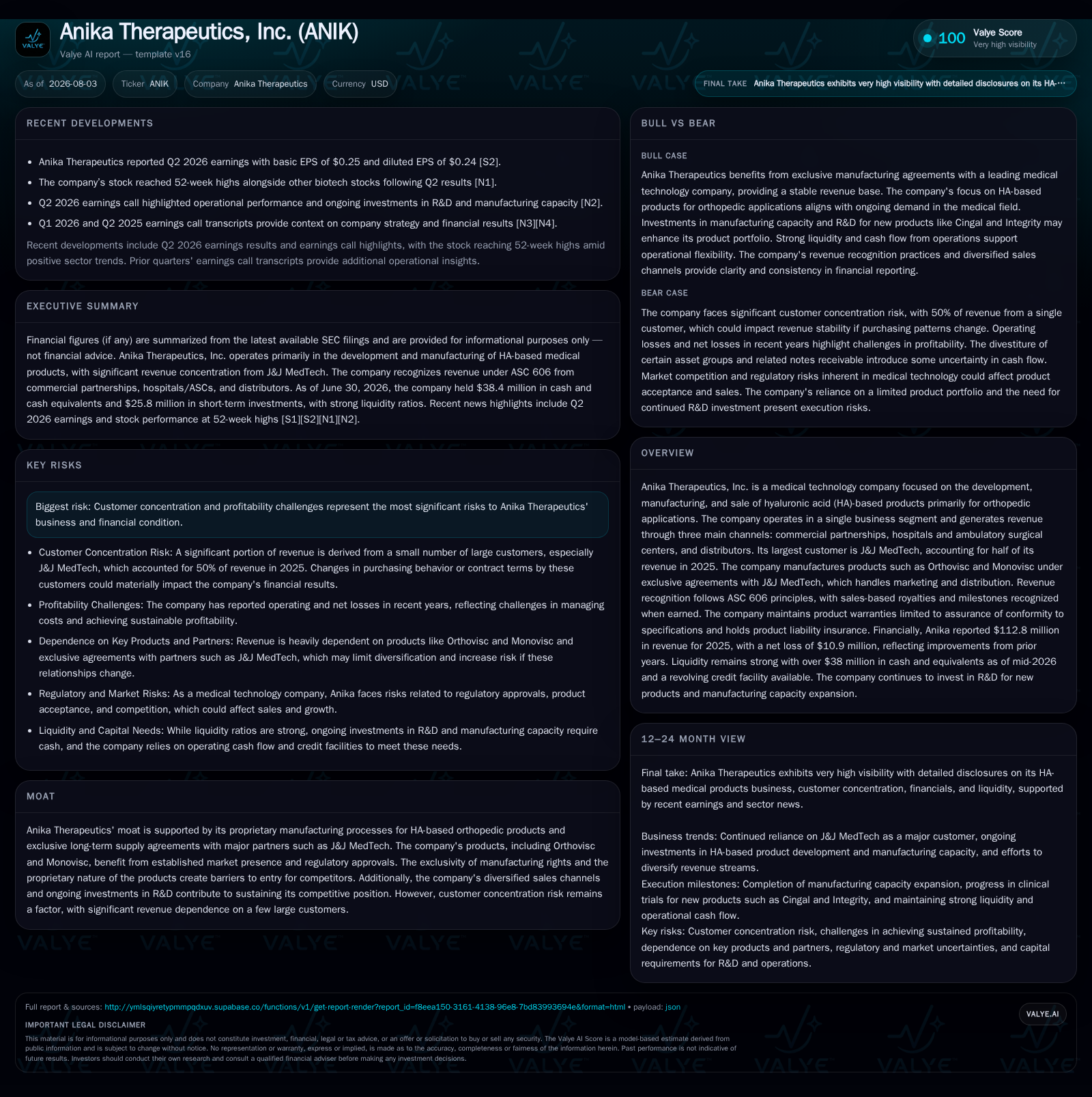
Anika Therapeutics reported continued revenue concentration with J&J MedTech accounting for half of its 2025 sales, underscoring persistent customer dependency risks. The company operates primarily as an exclusive manufacturer of hyaluronic acid (HA)-based orthopedic products like Orthovisc and Monovisc, partnering with large OEMs who handle marketing and distribution. Recent quarterly disclosures reveal ongoing investment in manufacturing capacity expansion at its Bedford facility to meet rising demand for osteoarthritis treatments. While product royalties and direct product sales form the revenue base, Anika's strategic challenge remains diversifying its customer base and navigating competitive pricing pressures within a complex regulatory environment.
Recent Operating Update
Anika Therapeutics' Q2 2026 disclosure reaffirmed critical dependencies and operational priorities shaping near-term performance [S2][S3]. Foremost is the enduring customer concentration risk with J&J MedTech representing 50% of total revenue in 2025, down slightly from 57% the previous year [S1][S5]. This dependency reinforces how much Anika’s top-line is linked to the purchasing decisions of a single major OEM partner who markets and distributes key proprietary HA-based viscosupplement products such as Orthovisc and Monovisc. These long-term exclusive manufacturing contracts provide stable volume but constrain diversification [S5].
Financially, the company reported widening operating losses in 2025 ($11.1 million operating loss) due partly to elevated R&D investments ($25.8 million spent) demonstrating a strategic focus on pipeline development despite profitability pressure [S1][S13]. Capital expenditures rose modestly in support of Bedford manufacturing capacity expansion, aiming to scale production capabilities for growing orthopedics demand [S1][S17]. With strong liquidity evidenced by $38.4 million in cash and a healthy current ratio near 4.5x at mid-2026 [F1], Anika maintains financial flexibility for operational investment.
Business Model Specifics
Anika Therapeutics operates as a specialized manufacturer within the orthopedic medical device ecosystem focused almost exclusively on hyaluronic acid (HA)-based orthopedic products used predominantly in viscosupplementation—a non-surgical treatment approach for osteoarthritis pain relief [S1][S5]. The company earns revenue through three primary channels: commercial partnerships (notably J&J MedTech), direct sales to hospitals and ambulatory surgical centers (ASCs), and independent distributors. The commercial partnership model involves Anika producing products exclusively sold to the partner who controls downstream marketing, pricing, and distribution [S5][S10]. This model limits Anika’s control over final price realization but reduces selling expense responsibility.
Revenue mechanics follow ASC 606 rules with product revenues recognized at shipment when control transfers to customers; royalties and milestone payments are recognized based on reported net sales by partners or achievement of developmental triggers [S9][S10]. Product warranties are limited strictly to assuring compliance with specifications rather than performance guarantees, supported by company-held product liability insurance which together mitigate manufacturing defect risks [S10]. This approach suits medical device manufacturing where regulatory oversight dictates quality standards.
Industry Structure and Competitive Position
The orthopedic medical device industry is characterized by complex regulatory requirements for FDA approval or equivalency abroad alongside entrenched dynamics between manufacturers, OEM partners, healthcare providers, and distributors [F1]. Within this ecosystem, Anika occupies a critical upstream position as a proprietary HA producer supplying premium viscosupplement products. Its moat derives from patented manufacturing technologies for Orthovisc/Monovisc combined with exclusive supply agreements that significantly raise barriers for OEM competitors or new entrants attempting supply substitution.
Peer companies like DePuy Synthes (a Johnson & Johnson business unit) illustrate the scale possible when combining manufacturing prowess with comprehensive distribution networks. Zimmer Biomet and Stryker Corporation similarly dominate joint preservation implant markets offering integrated orthopedics solutions beyond HA therapies. Meanwhile, products such as Hyalgan or Synvisc stand as key comparables within HA viscosupplementation though often distributed under different commercial models emphasizing retail pharmacy or clinician administration.
Competitive pressures include alternative pain management therapies—including corticosteroid injections or emerging biologic treatments—and the gradual shift toward minimally invasive joint restoration devices versus injection-based treatments. Regulatory changes impacting reimbursement or product approvals could disproportionately affect smaller specialized manufacturers like Anika.
Growth Drivers
Several structural demographics underpin sustained growth prospects for Anika’s core HA-based orthopedic products:
- The aging global population drives increasing prevalence of osteoarthritis—the primary indication for viscosupplementation treatments—which fuels stable clinical demand.
- Rising adoption rates of joint preservation therapies over surgical replacements support expanding outpatient intervention volumes including ASC penetration where Anika sells directly.
- Advancements in HA formulations enhancing durability or ease of administration may allow incremental pricing power or expanded patient eligibility supporting revenue growth.
- Geographic expansion through enhanced commercial partnerships beyond North America could unlock incremental revenue channels.
- Continued R&D efforts targeting new HA applications or regenerative medicine adjuncts may broaden Anika’s pipeline beyond current offerings.
Operationally, scaling manufacturing capacity at Bedford not only alleviates past constraints but positions Anika to meet anticipated shipment volume increases aligned with these secular trends [S1][S17]
Risks and Watchpoints
Despite promising tailwinds, significant risks persist:
- Customer concentration remains the foremost risk; losing or materially reducing orders from J&J MedTech would cause immediate revenue disruption given half of total sales tie back.
- Limited direct market control due to reliance on partners constrains pricing flexibility amidst healthcare cost pressures.
- Manufacturing scale-up carries execution risk; inefficiencies or capacity shortfalls could delay supply fulfillment damaging partner relationships.
- Regulatory uncertainty either delaying approvals or changing reimbursement policies could unpredictably impact product marketability.
- Competitive threats from novel OA treatments including biologics or devices may erode viscosupplement market share over time.
- Legal exposures remain inherent with product liability despite insurance coverage; any material claim could inflict reputational harm.
Monitoring indicators such as order backlog growth at Bedford facilities, renewal terms negotiated with J&J MedTech, evolving payer reimbursement statuses for HA injections, and competitor product launches will be essential [N2]
What To Watch Next
Key milestones include quarterly shipment volumes reported via partner disclosures confirming scaling success; announcements regarding expanded commercial partnerships or geographic reach; progress reports on pipeline candidates entering clinical trials; regulatory approvals accelerating new product introductions; updates on cost structures linked to factory expansions; and financial results evidencing trajectory toward improved profitability via R&D leverage.
Explicit guidance remains unavailable however relative improvements in gross margins or reductions in operating losses alongside steady royalty inflows will be proxies for execution quality [N2]
Financial Profile Discussion
As of June 30, 2026, Anika held $38.4 million in cash equivalents against current liabilities approximating $22.1 million yielding a robust current ratio around 4.48x which signals solid near-term liquidity.[F1] Total debt data is less current but historically minimal relative to cash resources suggesting leverage is low.[F1] The company maintains an undrawn revolving credit facility providing up to $75 million lending capacity subject to covenants.[S4][S6]
Operating cash flow has improved historically reflecting narrower net losses ($11 million operating loss most recently), supported by disciplined SG&A reduction coupled with meaningful R&D spending designed to enhance future growth avenues.[S17] Capital expenditure increases reflect strategic investment rather than maintenance which bodes well if matched by corresponding topline gains.[S17]
Continued monitoring of cash burn rates against op cash flows will be important given ongoing loss positions while evaluating returns on increased capex allocating toward manufacturing improvements [F1][S1]
This analysis synthesizes public filings up through mid-2026 without forward-looking projections or research views. It leverages detailed SEC disclosures combined with orthopedic industry dynamics to provide an informed perspective on Anika Therapeutics’ standing within its niche medical technology segment amid evolving operational challenges and opportunities.
Disclaimer: This is research-only, informational analysis and not investment advice. It may include AI-generated interpretation and general industry context. Always verify important details using primary sources.

Comments