
Southern First Bancshares' ClientFIRST Model Drives Deposit Stability and Efficient Regional Growth
Southern First Bancshares leverages a relationship-driven banking model and targeted branch operations in select Southeastern metro markets to sustain deposit strength, disciplined loan growth, and cost efficiencies.
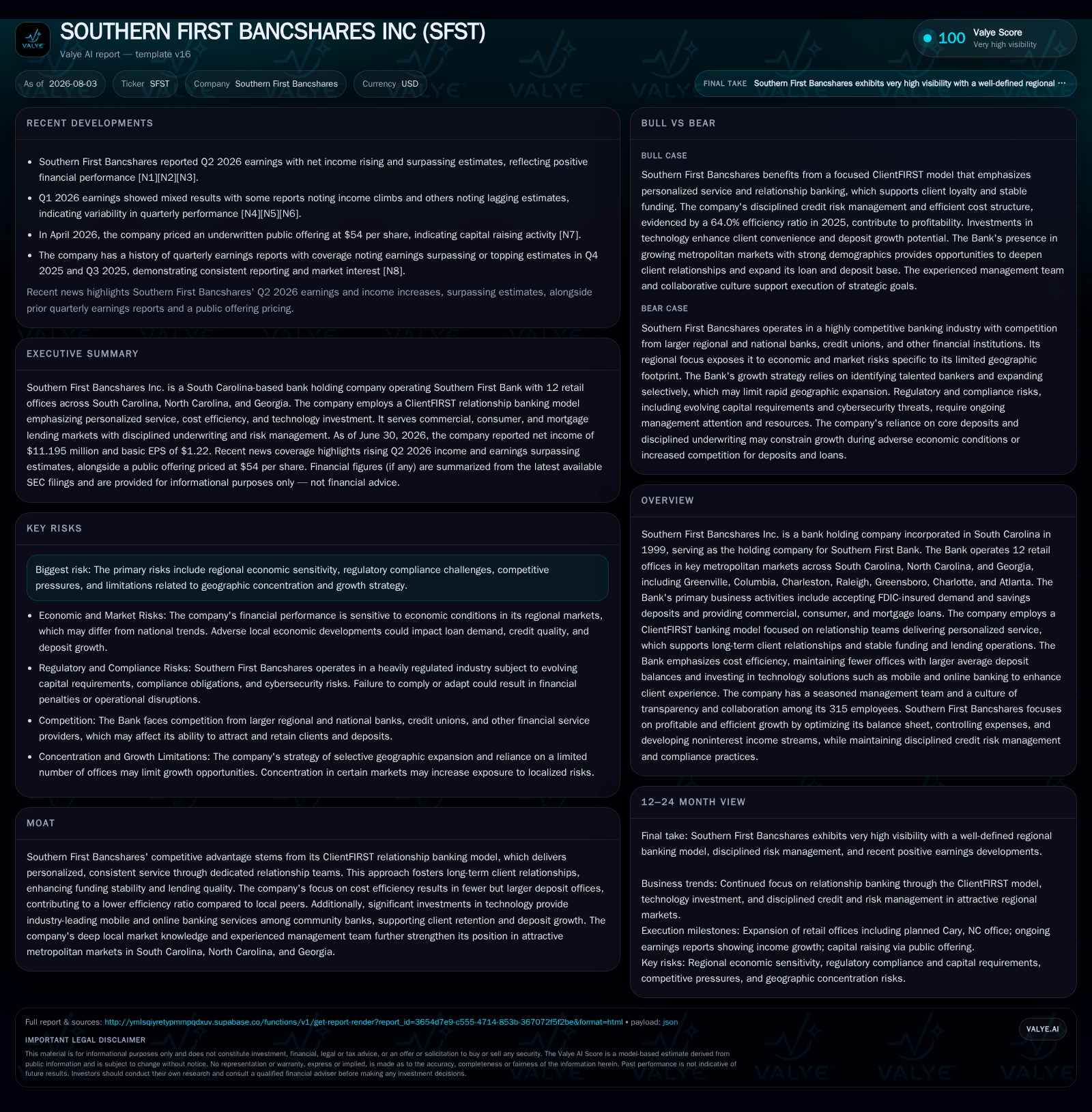
Southern First Bancshares Inc. operates as a regional bank holding company focused on personalized relationship banking through its ClientFIRST model across key markets in South Carolina, North Carolina, and Georgia. Its strategy emphasizes fewer but larger branches combined with technology investments that support deposit gathering and commercial lending. Recent quarterly disclosures highlight stable funding sources, consistent loan portfolio expansion, and ongoing investment in digital banking capabilities. While regional economic sensitivity and concentration in commercial real estate lending remain risk factors, the company's adherence to strong credit standards and efficient cost management underpin its competitive position among community banks in the Southeast.
Recent Operating Update
Southern First Bancshares’ latest quarterly filing dated August 3, 2026 [S2] reinforces the stability of its ClientFIRST relationship banking model as the foundation for operational performance. Deposits continued to show resilience driven by personalized client engagement across its twelve branches spanning South Carolina, North Carolina, and Georgia metropolitan markets. The company’s earnings press releases around mid-2026 confirm that net interest income remains robust with continued loan portfolio growth and healthy deposit inflows despite regional economic headwinds [S3][N1]. This quarter reaffirms Southern First’s focus on maintaining higher average deposit balances per branch compared to typical community banks.
Business Model Analysis
As a bank holding company for Southern First Bank, Southern First Bancshares earns revenue predominantly through net interest income generated by leveraging FDIC-insured demand, savings deposits, and certificates of deposit into commercial, consumer, and mortgage loans [S1]. The business model centers on the ClientFIRST philosophy — relationship teams provide personalized service that deepens client engagement and leads to higher funding stability. This approach contrasts with transactional models more common at larger regional or national banks.
The strategy of operating a reduced number of branches with larger average deposits ($263.7 million per office) enables economies of scale in branch management while keeping operating expenses contained. This leads to efficiency ratios that compare favorably with more dispersed community banks [S1]. Complementing this footprint is a material investment in digital platforms—mobile banking accounts for about 15% of deposit acquisition with remote deposit capture contributing an additional 43%, indicating high adoption of technology-enhanced banking services [S14].
Revenue mix benefits from a well-diversified loan portfolio comprising primarily real estate-secured loans (~83%), including construction loans that are carefully underwritten with caps on loan-to-value ratios and cash flow coverage requirements [S16]. The average loan size ($382,000) suggests a middle ground between smaller community lender volumes and larger regional bank exposures. Non-interest income accrues from ancillary services such as transaction fees and cash management solutions.
Industry Structure and Competitive Position
Southern First operates within the regional banking segment serving mid-size Southeastern metropolitan areas. Its geographic footprint includes attractive yet economically differentiated markets like Greenville-South Carolina’s fast-growing metro area; North Carolina’s Triad (Greensboro) and Research Triangle (Raleigh/Charlotte); and Atlanta-Georgia’s major financial hub. Such location choices offer demographic growth potential but impose concentration risk absent diversification beyond the region [S1].
Peers would generally be comparable community banks or regional institutions focused on similar metro corridors but typically manage broader branch networks or larger asset bases (e.g., Synovus Financial or Regions Financial as benchmarks). Southern First’s competitive moat is anchored in its ClientFIRST approach—a service-intensive model embraced by a loyal client base wary of commoditized national bank offerings—and its above-average deposit balances per branch that point to deeper wallet share within its existing markets.
Technology investments further distinguish it from traditional community banks which may lag in digital capabilities. Maintaining such digital channels is becoming critical for client acquisition and retention especially among younger demographics who prioritize mobile convenience over branch proximity [S14]
Growth Drivers
Several key levers support Southern First’s expansion trajectory. Foremost is deepening penetration within existing markets through cross-selling opportunities enabled by relationship teams whose personalized attention bolsters fee income streams from products like cash management or wire transfer services.
Branch network adjustments also offer growth pathways: the recent addition of the Dream Mortgage Center in Columbia (2023) targets specialized homebuyer education alongside mortgage lending expansion while a new retail office planned in Cary, NC for late 2026 signals cautious geographic scaling based on talent availability rather than broad market conquest ambitions [S1][S3]
Regional economic growth trends in these metros underpin loan demand from commercial clients engaged in real estate development or business expansions as well as consumer credit needs. Digital channel adoption supports core deposit increases at lower funding cost than wholesale certificates of deposit previously relied upon [S5][S14], effectively improving net interest margin potential.
Lastly, disciplined underwriting standards focused on collateral-backed commercial real estate loans maintain credit quality that supports consistent loan growth without excessive risk-taking—a critical factor as regulatory scrutiny intensifies around CRE exposure levels nationally post-pandemic [S16][S19].
Risks and Watchpoints
Southern First faces notable challenges principally related to geographic concentration risks manifesting through economic cycles affecting Southeastern metros where it operates. A downturn impacting any of its core regions could elevate credit losses disproportionately versus more diversified peers [S1].
Credit risk is accentuated by the sizable share of commercial real estate lending (~31% of commercial loans), requiring stringent monitoring amid shifting CRE valuations or tighter supervisory limits being signaled by FDIC and Federal Reserve regulators targeting institutions with elevated CRE concentrations [S16][S19].
A changing regulatory environment demands ongoing compliance investments. Future promulgations could increase capital or liquidity expectations necessitating balance sheet adjustments or shifts in product strategy [S12][S25]
Competition from both larger regional banks offering wider product arrays and fintech entrants innovating customer experiences pressures Southern First to sustain its investment pace in technology platforms without eroding profitability margins [S14]. Additionally, cybersecurity threats remain an operational risk given increasing reliance on digital interfaces.
Operationally, balancing growth ambitions against prudent cost control is essential given the smaller branch count relative to peers; failure to maintain efficiency advantages could impair returns over time.
What To Watch Next
Key milestones include progress against opening the planned Cary, North Carolina retail branch later this year along with updates on integration success at the Dream Mortgage Center designed to expand mortgage lending specialty offerings [S1][S3]. Monitoring sequential trends in deposit balances per branch will signal whether customer loyalty continues translating into stable low-cost funding.
Loan portfolio metrics such as non-performing asset ratios or changes to credit loss provisions will be early indicators of credit quality resilience against macroeconomic stresses particularly within commercial real estate segments.
Efficiency ratio trends remain central; any deviation upward might reflect increased expenses related to technology upgrades or regulatory compliance burdens. Conversely, sustained or improved ratios could affirm operating leverage benefits from branch productivity gains.
Finally, investor communications following quarterly earnings releases will be critical for incremental color on competitive positioning versus other regional/community banks adapting to accelerating digital transformation dynamics.
Financial Profile Discussion
The balance sheet mix prioritizes core deposits accessible via retail branches supplemented by commercially sourced certificates of deposit totaling over $550 million at prior year-end figures aimed at optimizing funding costs amid rising interest rate environments [S5][S14]
Liquidity management includes prudent use of secondary funding lines from federal Home Loan Bank advances or correspondent bank facilities where needed; contingencies are closely monitored under heightened regulatory scrutiny post-2023 sector episode events [S6]
Overall financial discipline supports favorable return metrics benchmarked implicitly against mid-sized Southeast regional banks without specific peer margin data disclosed publicly.
Disclaimer: This is research-only, informational analysis and not investment advice. It may include AI-generated interpretation and general industry context. Always verify important details using primary sources.

Comments