
Regency Centers Strengthens Retail Portfolio with Solid Leasing Momentum and Active Capital Management
Retail REIT Regency Centers reports resilient same property NOI growth and leasing spreads, supported by grocery-anchored shopping centers amid macroeconomic uncertainties.
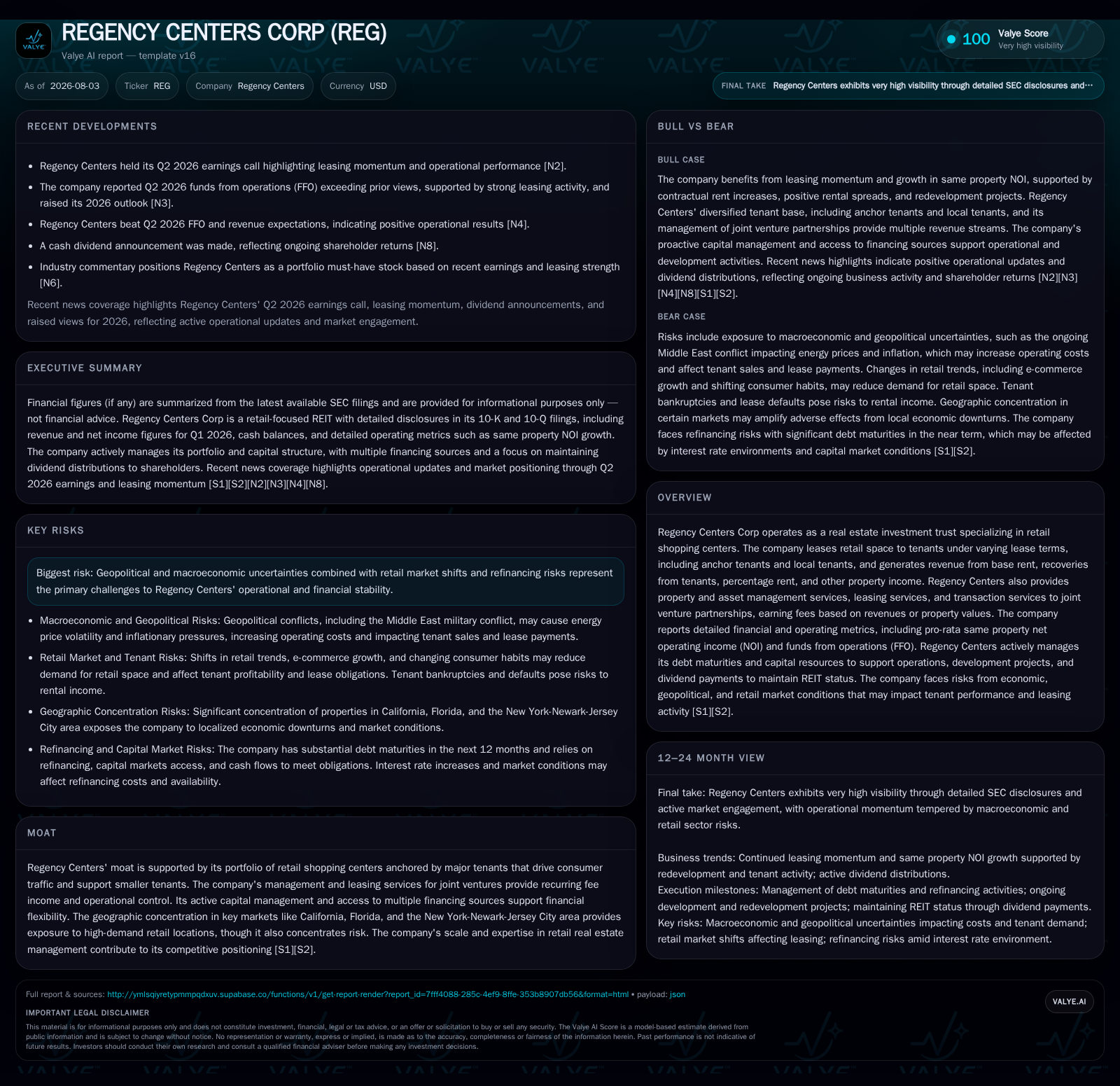
In its latest quarterly filing, Regency Centers Corp demonstrated continued growth in base rent and tenant recoveries driven by positive leasing spreads and occupancy gains. The company's predominantly grocery-anchored retail portfolio, concentrated in high-demand suburban trade areas, underpins stable net operating income (NOI) expansion and funds from operations (FFO) growth. While geopolitical conflicts and inflationary pressures challenge operating costs and tenant demand, Regency’s active capital management and redevelopment initiatives sustain financial flexibility and dividend coverage. Peer retail REITs show similar trends, emphasizing the importance of anchor tenants and portfolio quality in this volatile environment.
Recent Operating Update: Solid Q2 Performance Anchored in Leasing Strength
Regency Centers Corp's latest quarterly report dated August 3, 2026, reveals a robust increase in lease income by approximately $100 million year-over-year [S1][S2]. This primarily stems from a $62.9 million rise in base rent attributable to same-property performance — itself driven by higher occupancy levels, contractual rent escalations within existing leases, and favorable rental spreads on new or renewal leases. Additionally, recently completed redevelopment projects contributed around $14 million toward this growth, confirming the company’s capacity to add value through property enhancements. New acquisitions and development completions also bolstered base rent by over $21 million combined
Tenant recoveries — representing reimbursements for operating expenses such as maintenance, insurance, taxes — grew by over $31 million, largely reflecting increased property occupancy and higher recovery rates aligned with rising costs [S1]. The company’s ability to pass through these expenses to tenants is critical to margin stability amid inflationary pressures affecting operational outlays
Other income streams like percentage rent and termination fees showed modest improvements, indicating some upside from tenant sales linkages without material volatility [S1]. Notably, straight-line rent recognition increased by $4.2 million due to the timing effects of lease commencements and escalations, often signaling positive lease profile improvements when assessed alongside cash rents collected
Operating expenses rose roughly $30 million year-over-year driven by depreciation associated with newly acquired or developed assets and higher property operating costs consistent with expanded portfolio scale [S1]. Despite this climb in expenses, net operating income (NOI) growth remains healthy due to strong revenue enhancements
Business Model: Grocery-Anchored Retail REIT with Integrated Asset Management
Regency Centers operates as a self-managed real estate investment trust specializing in retail shopping centers primarily located in suburban trade areas characterized by strong demographic fundamentals. Its portfolio encompasses approximately 481 properties totaling around 58.4 million square feet of gross leasable area (GLA), with a pro-rata share of about 50.5 million square feet inclusive of partial interests through partnerships [S1]
The company's core monetization derives from leasing retail space under varying contracts that include fixed base rents typically supplemented by tenant recoveries for operating expenses and percentage rents tied to tenant sales performance. The presence of leading grocery store anchors is pivotal; these tenants generate consistent consumer traffic that supports smaller local service providers within the center. This anchoring effect reduces vacancy risk and stabilizes cash flows.
Regency also earns recurring management fees through provision of property management, asset management, leasing services, and transaction facilitation to joint ventures where it holds interests or manages assets on behalf of partners. These fee revenues contribute to diversified income streams beyond straightforward rental payments.
Capital deployment targets include acquisition of operating properties likely to generate immediate returns, alongside development or redevelopment projects designed to refresh assets’ appeal — enhancing lease-up potential at higher rents [S1][S2]. Efficient expense pass-through mechanisms via tenant recoveries help preserve net margins even when inflation impacts underlying costs
Industry Structure and Competitive Positioning
Within the retail REIT sector focusing on shopping centers anchored heavily by necessity-based grocers, Regency Centers ranks among the larger players with considerable scale advantages among about half a billion square feet in predominantly U.S. suburban markets. Its geographic concentration in key metropolitan areas such as California, Florida, and the New York/Newark/Jersey City corridor leverages regions with population density and economic activity supporting consumer demand.
Peers such as Kimco Realty Corporation similarly manage nationwide portfolios with grocery-anchored centers but may have different concentrations or strategic orientations regarding service retail vs experiential tenants. Federal Realty Investment Trust emphasizes more urban retail formats but competes through quality assets tied to essential retailers. Compared to these peers, Regency’s emphasis on neighborhood/community centers aligns well with consumer needs for convenience shopping — a segment less disrupted by e-commerce compared to general mall-based retail.
Key competitive advantages include tenancy mix focused on essential service providers shielding against volatile discretionary spending downturns; active management that improves lease terms via renewal negotiations capturing rental step-ups; recurring management fee structures providing stable non-rental revenue; along with disciplined capital allocation supporting attractive returns on redevelopment investments that refresh property life cycles [S1][S2]
Growth Drivers: Leasing Momentum Amid Strategic Capital Initiatives
Regency's growth narrative rests heavily on several pillars:
Leasing Activity: Positive leasing spreads highlight effective retention strategies where renewing tenants sign leases at higher rents reflecting market demand shifts or inflation adjustments. The anchoring grocery stores sustain foot traffic which benefits adjacent retailers.
Portfolio Quality Enhancement: Redevelopment projects completed or underway contribute to incremental NOI gains via upgraded amenities attracting higher-quality tenants or capturing unmet market demand.
Strategic Acquisitions: Incremental acquisitions expand revenue bases immediately; consolidation of prior partial holdings into full ownership also consolidates cash flow benefits.
Favorable Demographics: Suburban trade areas with growing populations underpin long-term demand for convenience-oriented shopping centers where Regency operates.
Recurring Fee Income: Management fees earned from joint venture partnerships smooth revenue variability relative to leasing cycles.
The company’s focus on high-performing neighborhoods insulated somewhat from e-commerce disruptions aligns well with retail sector trends emphasizing experiential visits coupled with essential goods consumption.
Risks / Watchpoints / Growth Constraints
Despite operational strengths, Regency faces notable risks:
Macroeconomic & Geopolitical Pressures: The ongoing Middle East conflict involving U.S., Israel, Iran expands risk exposure through energy price volatility raising inflationary pressures impacting construction materials costs as well as tenants’ operating margins potentially curtailing expansion appetite or causing defaults [S2][S3].
Retail Sector Dynamics: Shift toward e-commerce persists as a latent threat reducing brick-and-mortar footprint needs except for necessity-oriented categories which moderation protects so far.
Geographic Concentration: While focused markets offer scale benefits they also concentrate risk should economic conditions deteriorate locally or regulations change adversely impacting operations.
Asset Obsolescence: Properties requiring redevelopment must balance CapEx investment commitment timing against potential rental yield uplift; misjudgments could impair return thresholds.
Monitoring occupancy rates closely alongside rent collection effectiveness provides early indications of tenant financial health during economic uncertainty.
What To Watch Next
Investor interest should track:
- Quarterly updates on same property NOI growth rates relative to peer benchmarks showing Regency's competitive leasing effectiveness.
- Leasing spread data on both renewals and new leases measuring pricing power sustainability amid inflationary backdrop.
- Trends in percentage rent contributing incremental upside linked directly to tenant sales strength.
- Pace and outcomes of active redevelopment projects providing earnings catalysts.
- Debt maturity schedules disclosed in subsequent filings indicating refinancing risk mitigation strategies.
- Guidance updates on dividend payout levels especially regarding FFO coverage ratios under fluctuating macro conditions.
- Potential shifts in tenant mix toward more experiential or service-oriented offerings responding to evolving consumer behaviors.
Financial Profile Discussion
The company's funds from operations (FFO), a critical industry metric reflecting recurring earnings power excluding non-cash charges like depreciation inherent in real estate accounting standards, showed favorable beats above consensus estimates during Q2 releases — driven largely by leasing momentum noted earlier [N2][N6]. Dividend payout policies remain calibrated to distribute taxable income while balancing reinvestment needs. Investors should assess leverage ratios relative to EBITDA alongside interest coverage trends going forward to gauge financial resilience given external uncertainties.
Conclusion: Sustained Operational Execution Amid External Challenges
Regency Centers continues reinforcing its position as a leading retail REIT anchored by grocery-secured suburban shopping centers generating increasingly steady cash flows supported by leasing strength across its portfolio. Active portfolio enhancements through redevelopment combined with management fee diversification provide additional layers of stability even as macroeconomic headwinds from geopolitical tensions introduce cost pressures potentially challenging tenants' capacity to absorb higher rents or expenses. Capital discipline reflected in balanced debt positioning underscores prudent financial stewardship aligning with dividend sustainability objectives crucial under REIT rules. Tracking key indicators such as occupancy trends, rental rate escalations, FFO performance versus peer outcomes will inform judgment on its ongoing competitive execution within the retail real estate investment landscape.
This analysis is based purely on disclosed SEC filings [S1][S2][S3], recent market news summaries [N1][N2][N6], and current financial data snapshots [F1] without any investment advice offered.
Disclaimer: This is research-only, informational analysis and not investment advice. It may include AI-generated interpretation and general industry context. Always verify important details using primary sources.

Comments