
AbbVie Expands Pipeline and Faces Earnings Pressure Amid High Acquired IPR&D Spending
Q2 2026 results highlight strong collaboration revenues but elevated acquisition expenses weigh on near-term earnings.
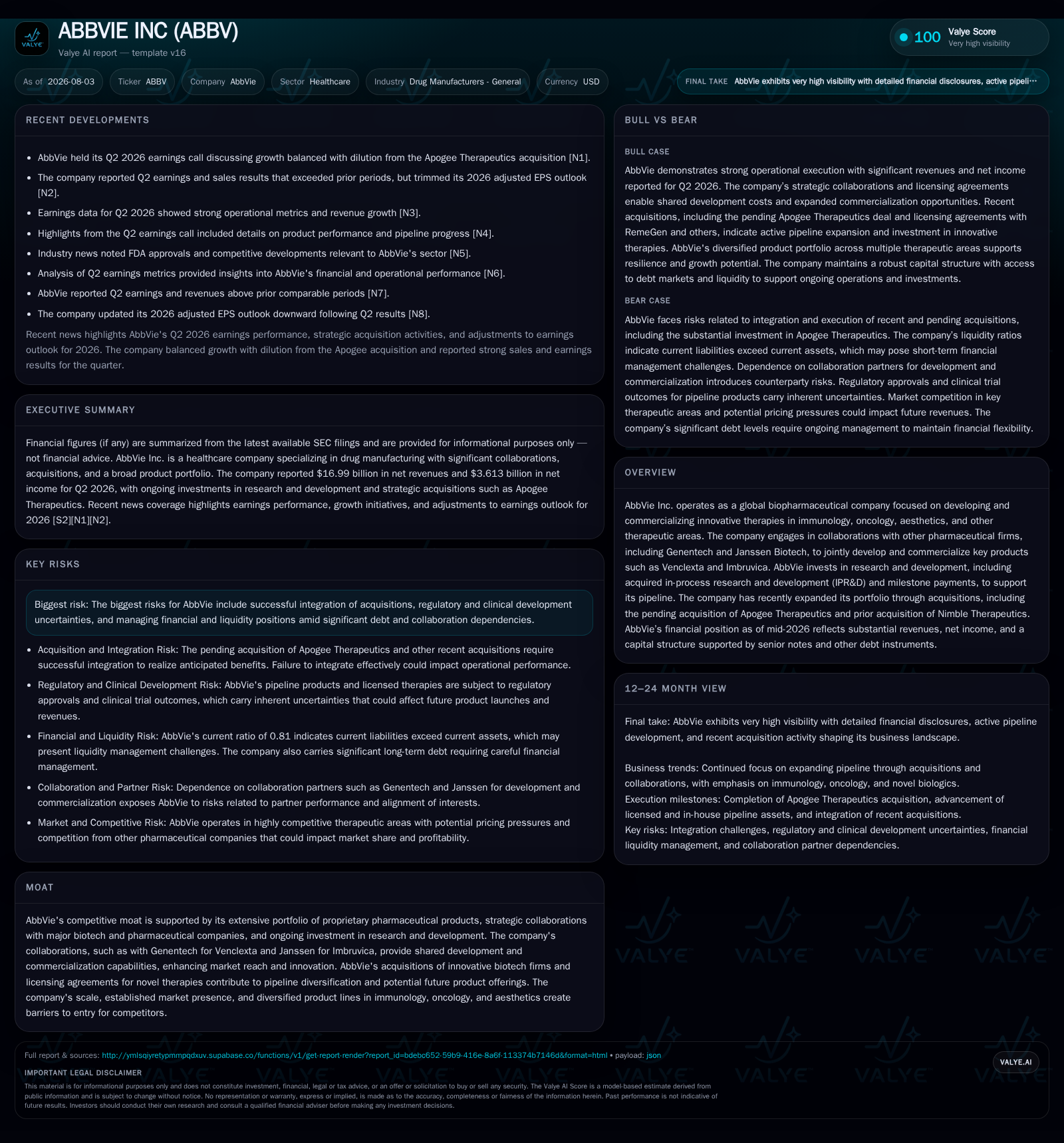
AbbVie’s latest quarterly filing reveals robust product commercialization supported by collaboration agreements, particularly with Genentech on Venclexta. The firm is actively shaping its pipeline through acquisitions such as Nimble Therapeutics and the pending $10.9 billion Apogee Therapeutics deal, focused on specialty biologics for inflammatory conditions. Though revenues remain solid, increased acquired in-process R&D (IPR&D) charges and milestone payments are pressuring adjusted earnings per share guidance in 2026. Continued integration success of recent biotech acquisitions and efficient pipeline advancement are critical to sustaining growth along the biopharma value chain.
Recent Operating Update
AbbVie's Q2 2026 filing underscores the company's strategic reliance on collaborations and acquisitions as drivers of its pipeline and revenue growth. Its profit-sharing agreement with Genentech over Venclexta in the United States means that AbbVie bears 50% of pre-tax profits and losses domestically while paying royalties on international sales [S2]. This collaboration exemplifies AbbVie's push into oncology through co-commercialization models that broaden market outreach while sharing risk.
However, there has been a notable increase in acquired in-process research and development (IPR&D) expenses and milestone payments reported for Q2, totaling $291 million [S19]. These amounts reflect upfront charges from licensing agreements or asset acquisitions intended to replenish the pipeline but come at an immediate cost detracting from adjusted earnings per share (EPS). Indeed, AbbVie trimmed its full-year 2026 EPS guidance citing these elevated acquisition costs [N2], signaling operational leverage constraints despite growing top-line momentum.
The pending acquisition of Apogee Therapeutics represents a major capital allocation move aimed at strengthening AbbVie's presence in immunology sub-segments like atopic dermatitis and asthma [S19]. The $10.9 billion cash offer, expected to close in Q3 2026 upon regulatory clearance, adds clinical-stage biologic candidates with differentiated mechanisms around inflammatory pathways. Alongside this, the completed Nimble Therapeutics purchase provides novel oral peptide therapeutics emphasizing IL23 receptor inhibition for psoriasis—a crowded but high-value indication [S19], [S8].
Business Model Analysis
AbbVie operates predominantly as a global biopharmaceutical company engaged mid-to-late in the pharmaceutical value chain where product lifecycle management, clinical development investments, manufacturing scale, regulatory compliance, and commercialization capabilities drive business outcomes. The company derives revenues primarily from the sale of proprietary drugs across immunology (e.g., RINVOQ), oncology (e.g., Venclexta), aesthetics (Botox Cosmetic), and other specialty therapeutic areas [S1].
Revenue streams are nuanced: direct product sales form the bulk of top-line inflows; however, AbbVie supplements this with milestone payments received via licensing deals—such as those with RemeGen for ABBV-1480 PD-1/VEGF bispecific antibody—and royalties paid or collected depending on geographic rights [S8], [S20]. Collaboration agreements impose revenue-sharing or cost-sharing structures which affect margin profiles differently than standalone commercialization.
The company invests heavily in R&D both organically and through acquisitions. Acquired IPR&D charges represent the capitalized value expensed immediately upon obtaining rights to promising investigational drugs prior to regulatory approval. This causes short-term dilution but reflects attempts to offset patent cliffs threatening legacy product lifecycles. The sizable spend related to Apogee and RemeGen collaborations illustrate AbbVie's strategy to diversify pipeline offerings beyond established franchises.
Commercial distribution leverages both direct sales forces in core markets like the U.S., Europe, and key emerging regions plus partnerships to optimize market penetration. With numerous global regulatory approvals enabling broad market access for flagship drugs like SKYRIZI in immunology and MAVYRET in antivirals [S23], AbbVie commands durable customer relationships primarily among healthcare providers, hospitals, specialty pharmacies, and payors ensuring steady demand.
Industry Structure & Competitive Position
Within the biopharmaceutical arena, AbbVie occupies a leadership niche typified by large integrated pharmaceutical companies combining scale manufacturing capacity with robust R&D pipelines focused on specialty medicines. Peers such as Bristol Myers Squibb, Johnson & Johnson Pharmaceutical, and Regeneron Pharmaceuticals provide context on competitive dynamics involving innovation productivity, collaboration footprints, geographic diversity, and financial health.
AbbVie's collaborative arrangements with entities like Genentech (a Roche subsidiary) enable sharing complex clinical development risks while leveraging complementary commercial reach—critical competitive moats amid increasing pressure from biosimilars and generics eroding revenues from older molecules [S2]. The company's broad portfolio spanning oncology’s targeted therapies alongside leading immunology biologics affords diversified sources of revenue less vulnerable to abrupt patent expirations or reimbursement shifts.
Product lifecycle management becomes essential as mature products face biosimilar entrants; here AbbVie's ongoing injections into innovation via bolt-on acquisitions like Nimble Therapeutics provide new indications or administration routes boosting adoption curves post-launch. Regulatory expertise across multiple jurisdictions also lets AbbVie efficiently navigate approvals accelerating time-to-market advantages—key KPIs compared favorably against smaller specialty biotech firms reliant on single assets.
Growth Drivers
Key growth drivers include successful clinical trial outcomes advancing candidates closer to regulatory approval—enhanced by substantial R&D intensity reflected in milestone activity—and expansion into new therapeutic areas such as advanced solid tumors with bispecific antibodies licensed from RemeGen [S8]. Geographic diversification fosters resilience by tapping emerging markets alongside established ones.
Acquisitions strategically target pipeline gaps or emerging scientific platforms; for instance, Apogee's focus on atopic dermatitis complements existing immunology assets addressing chronic inflammatory diseases—a large unmet medical need segment globally. The combination of organic innovation blended with licensing deals enables AbbVie to sustain a robust flow of clinical trial phase completions underpinning near-term product launches.
Enhanced commercialization capabilities also contribute through effective marketing of recently approved formulary additions like SKYRIZI and RINVOQ which penetrate growing patient populations demanding novel treatments with improved efficacy or safety profiles.
Risks & Watchpoints
Despite strengths, significant risks persist related to integrating acquisitions effectively without disrupting core operations or diluting financial returns excessively amid high capital spending on biotech deals [S19]. Clinical trial setbacks or failures can delay key launches causing pipeline holes difficult to fill swiftly given long drug development cycles inherent to pharma.
Pricing pressures from government payors or private insurers especially in major markets could limit gross margin expansion while potential patent challenges expose drugs to biosimilar competition sooner than anticipated. Regulatory uncertainties remain prominent as shifting standards or accelerated approval policies pose risks.
Financially, the sizeable net debt position estimated near $56 billion leverages investments but constrains flexibility if macroeconomic conditions tighten credit availability or elevate interest costs despite currently manageable liquidity evidenced by $6.57 billion cash plus equivalents [F1], [S2]. Observing how wisely AbbVie manages debt maturities amidst integration costs will be critical.
What To Watch Next
Upcoming milestones include closure timing of Apogee acquisition pending shareholder votes and regulator approvals expected within Q3 2026 [S19]. Market reaction will hinge partly on visible synergy capture initiatives accelerating pipeline progression. Monitoring adjustments to EPS guidance beyond H2 2026 once full integration effects materialize is essential for gauging operating leverage trajectory.
Regulatory clearance of lead pipeline candidates developed via acquisitions or collaborations marks critical inflection points; any positive clinical data releases would validate investment theses supporting blockbuster potential extending beyond current franchises.
Tracking renewal metrics from collaboration partners like Genentech along with royalty income trends can also signal stability within key revenue streams underlying long-term fundamentals.
Financial Profile Discussion
As of June 30, 2026, AbbVie held cash and equivalents totaling $6.57 billion against total debt approximating $62.5 billion resulting in net debt near $55.9 billion—a leverage level reflective of intensive acquisition activity alongside shareholder returns [F1], [S2]. Current assets of roughly $33.7 billion versus current liabilities about $41.6 billion yield a current ratio of approximately 0.81 indicating short-term liquidity coverage below parity but bolstered by revolving credit facilities available though unused at quarter end confirming adequate immediate liquidity buffers [F1], [S15].
Operating income remains robust due primarily to sustained product sales though caution is warranted given rising acquisition-related charges impacting margins as seen in Q2 earnings before interest and tax trends [S28]. Interest expense net increased modestly sequentially reflecting consistent cost levels tied to outstanding borrowings though manageable given cash flow generation capacity from operations exceeding $4 billion over six months [S2].
Overall capital structure choices illustrate balancing growth financing against prudent credit risk management within a highly capital-intensive pharmaceutical environment characterized by extended drug development timelines requiring upfront investment commitments.
This analysis synthesizes publicly available SEC disclosures up to August 3, 2026 without speculative forecasts or proprietary metrics beyond reported figures. It aims solely to contextualize AbbVie's evolving operating profile within its biopharmaceutical industry setting based on confirmed data points observed in filings and news documentation.
Disclaimer: This is research-only, informational analysis and not investment advice. It may include AI-generated interpretation and general industry context. Always verify important details using primary sources.

Comments