
Equity Residential’s Coastal-Focused Portfolio and Ongoing Merger Reshape Multifamily REIT Outlook
Equity Residential reported solid Q2 results supported by strong coastal market demand and proceeds toward its merger with AvalonBay Communities.
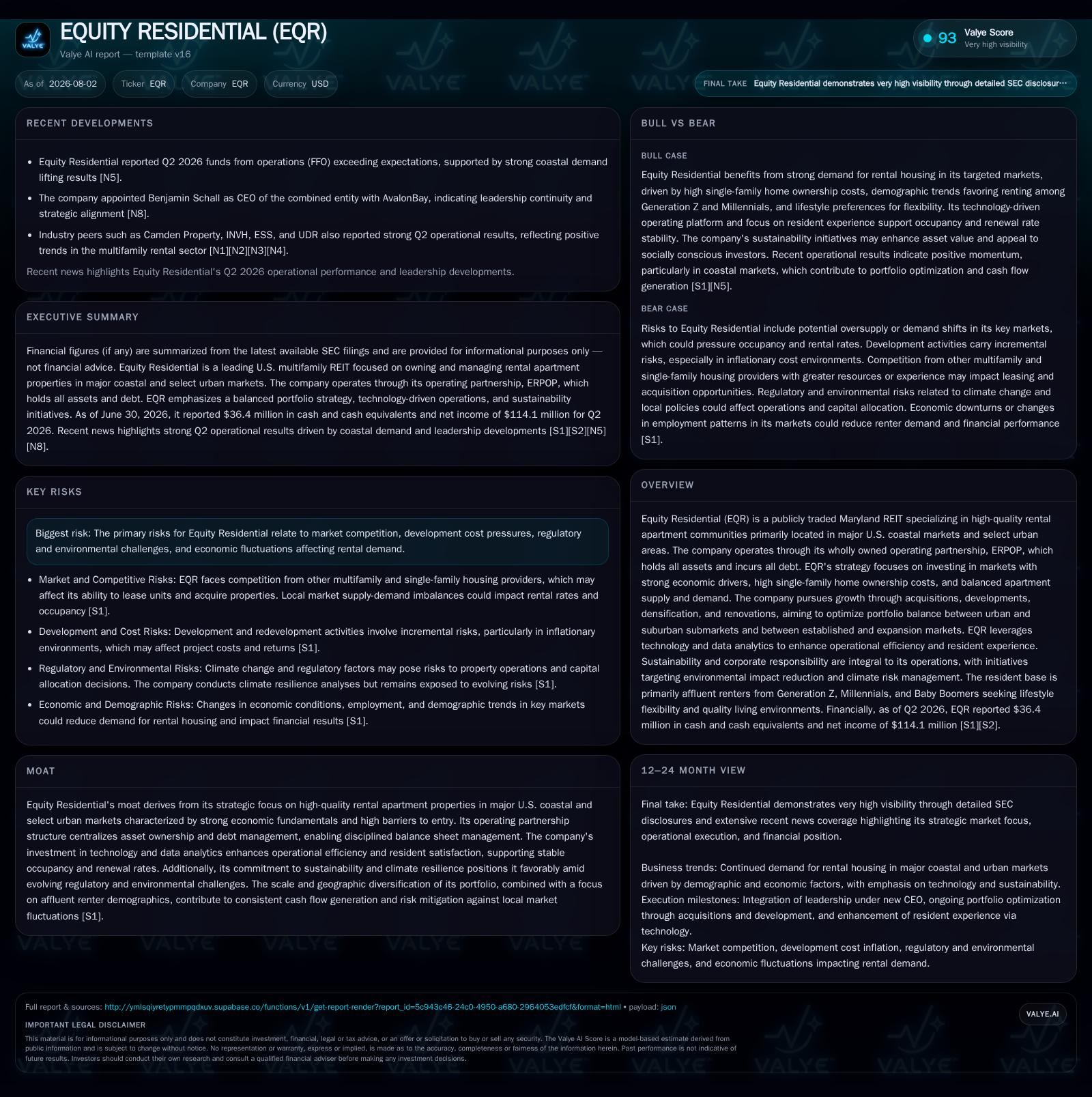
Equity Residential (EQR) remains a leading multifamily residential REIT with a strategic focus on coastal U.S. apartment communities that benefit from high barriers to entry and robust economic fundamentals. Its latest quarterly filing reveals steady operational performance driven by sustained occupancy and rent growth, particularly in major coastal markets. The company is concurrently progressing through a transformative all-stock merger with AvalonBay Communities, which positions the combined entity as a dominant player in the sector with enhanced scale and geographic diversification. Key operating metrics such as net operating income (NOI) growth and funds from operations (FFO) remain stable amid ongoing investments in development and renovations. However, risks from rising interest rates, construction cost inflation, and integration challenges persist.
Recent Operating Update
Equity Residential’s most recent quarterly filing dated July 30, 2026 (Form 10-Q) indicates a continuation of solid operating performance reflecting strong demand in its key coastal markets. The company reported funds from operations (FFO) exceeding Wall Street expectations for Q2 2026, aided by resilient occupancy rates and effective rent pricing strategies in dense urban locales such as New York City, Boston, Seattle, and Southern California [S2][N1]. Leasing velocity remains robust despite a general cooling trend observed across some U.S. real estate segments, underscoring Equity Residential’s strategic focus on high-barrier-to-entry coastal markets where supply is constrained.
Simultaneously, the company disclosed significant progress on its announced all-stock merger with AvalonBay Communities. Filed May 20, 2026, the Merger Agreement envisions creating a combined company commanding one of the largest portfolios in the multifamily residential REIT sector [S3][S16]. This transaction notably designates AvalonBay as the accounting acquirer despite Equity Residential serving as the legal acquirer—a consequence of AvalonBay shareholders receiving majority ownership (~51%) post-close and assuming executive control. The integration will necessitate careful management of portfolio rationalization, tenant retention efforts, and operational synergies.
Business Model Overview
Equity Residential operates through its wholly owned ERP Operating Partnership (ERPOP), which holds virtually all assets and assumes all indebtedness. This structure allows centralized control over property operations, acquisition initiatives, development projects, financial leverage, and risk management [S1]. The business generates recurring revenue primarily through rental income collected from multifamily apartment properties it owns in key metro areas.
The company targets premium rental communities located in major U.S. coastal metro areas characterized by strong economic fundamentals: diversified employment bases, limited new housing supply relative to demand well-aligned with persistent urbanization trends. Equity Residential balances its portfolio between core urban neighborhoods and select suburban submarkets to optimize occupancy dynamics and maximize rental yield potential.
Monetization hinges on robust lease turnover management—maintaining high occupancy rates around or above industry averages—and progressive rent growth backed by sustained regional housing affordability challenges that deter single-family homeownership. Growth is driven via acquisition of stabilized assets fitting strategic criteria; development of new luxury communities; densification initiatives through redevelopment or adding units within existing sites; and renovation programs aimed at enhancing unit quality to justify higher rents or reduce turnover.
Technology plays an increasingly important role: leasing automation platforms reduce vacancy cycles while data analytics inform pricing adjustments that align with competitive market conditions without sacrificing resident retention [S1]. Sustainability efforts serve dual purposes: lowering energy costs/helping meet regulatory mandates and appealing to environmentally conscious renters who place premium value on green building features.
Industry Structure and Competitive Position
As a multifamily residential REIT focused on upscale rental apartments in high-demand coastal markets, Equity Residential competes primarily against other large publicly traded multifamily REITs such as AvalonBay Communities (soon to be combined partner), Camden Property Trust, UDR Inc., and regional players like Mid-America Apartment Communities. Additionally, private real estate investment firms specializing in apartments constitute meaningful competition given their ability often to act nimbly in acquisitions or developments.
Equity Residential’s competitive edge stems from its concentration in major metropolitan areas exhibiting strong barriers to entry such as zoning constraints and land scarcity that limit new supply. Its scale permits more efficient sourcing of capital at attractive cost levels relative to smaller firms or private operators dependent on costlier financing channels. Operationally, its investment in technology-enabled property management supports superior resident experience metrics — increasing renewal rates that buffer against vacancy-induced revenue volatility.
The forthcoming merger with AvalonBay would substantially increase scale—boosting geographic diversification across overlapping but somewhat complementary portfolios—and provide opportunity to exploit cost synergies associated with property management efficiencies and administrative overhead reduction [S3][S16]. Scale also strengthens bargaining power over service providers while enhancing access to capital markets under favorable terms.
Growth Drivers
Several structural trends underpin Equity Residential’s growth trajectory:
- Urban Population Growth & Housing Affordability: Increasing costs of home ownership propel demand for quality apartment rentals concentrated in economic hubs where job creation centers reside.
- Limited New Supply: Strict zoning laws combined with high construction costs restrict new apartment development volume particularly in coastal metros where EQR concentrates capital deployment.
- Development Pipeline & Renovations: The company sustains a disciplined development pipeline complemented by selective densification/renovation projects that enhance asset quality while delivering incremental net operating income (NOI).
- Technological Enhancements: Deployment of leasing automation and comprehensive data analytics elevates leasing velocity measures—key drivers behind consistent same-store NOI expansions.
- Mergers & Acquisitions: The planned combination with AvalonBay represents scale-enhancing consolidation aligning similar market exposures enabling cross-utilization of expertise across property operations.
- Sustainability & Climate Resilience: Forward-looking investment frameworks incorporating ESG considerations aim to reduce operational costs long-term while satisfying growing environmental regulations important for coastal assets vulnerable to climate risks.
Risks & Watchpoints
Despite inherent strengths several risks could temper Equity Residential’s outlook:
- Economic Cyclicality Impacting Rental Demand: A downturn reducing employment or wage growth could pressure occupancy rates or compress achievable rents particularly if supply starts catching up in key markets.
- Rising Interest Rates: Increased borrowing costs elevate financing charges since all debt sits at ERP Operating Partnership level; refinancing near-term maturities must be monitored closely [F1][S11].
- Construction Cost Inflation: Escalating labor/material expenses diminish profit margins on development/densification initiatives potentially slowing pipeline completion timelines.
- Integration Risks Post-Merger: Effectively combining two large multifamily portfolios requires managing cultural alignment among teams plus realizing anticipated synergies without disrupting tenant services.
- Regulatory & Environmental Challenges: Coastal market regulatory regimes evolve frequently; failure to adapt could constrain expansion or escalate compliance costs.
- Competitive Pressure from Private Operators & Single-Family Rentals: Though not direct substitutes fully “owned” by public REITs’ scale advantages can erode if alternatives gain traction among renters seeking different living arrangements.
What To Watch Next
Key milestones will include progress announcements regarding merger closing approvals from relevant shareholder meetings expected over next quarters alongside any updates on regulatory filings concerning the transaction. Tracking same-store NOI growth metrics quarterly post-merger will provide insight into integration effectiveness along with capital expenditure efficiency reports detailing how well developmental projects maintain schedule/budget targets. Lease renewal rates combined with average rent per unit increases will continue to serve as bellwether indicators for underlying property-level health. Debt refinancing activity ahead of maturing notes should also be assessed for impacts on interest expense trends.
Financial Profile Discussion
At June 30, 2026, Equity Residential reported approximately $36 million in cash equivalents juxtaposed against roughly $4.6 billion total debt held at its ERP Operating Partnership subsidiary reflecting a highly leveraged capital structure typical among large multifamily REITs focusing on growth via acquisition/development [F1][S2]. Net debt stands near $4.56 billion after adjusting for available liquidity resources suggesting continued dependence on stable free cash flow generation for coverage ratios maintenance.
The use of an operating partnership structure consolidating asset ownership facilitates disciplined balance sheet management permitting flexibility in capital allocation towards accretive investments or distribution policies while mitigating influence over direct lending terms. Market-sensitive weighted average cost of capital (WACC) estimates range between low single-digit percentages showing historically favorable borrowing conditions which will require vigilant monitoring amid tightening credit markets post-merger [S3].
Overall equity valuation analyses conducted by Morgan Stanley underpin the strategic merit of the merger considering implied enterprise values calculated based on EBITDA multiples reflective of current sector norms ranging mid-to-high teens supporting sustainable returns given forecasted NOI accretion profiles [S3].
This analysis reflects public filings as of July 30–31, 2026 incorporating operational updates alongside announced transaction details. Future developments around the pending merger execution remain critical determinants shaping Equity Residential's medium-term strategic course within the competitive multifamily REIT arena.
Disclaimer: This is research-only, informational analysis and not investment advice. It may include AI-generated interpretation and general industry context. Always verify important details using primary sources.

Comments