
DMC Global Faces Margin Pressure and Market Volatility While Pursuing Geothermal Growth
Q2 2026 update highlights continued raw material challenges, diversification benefits, and solid liquidity in capital-intensive industrial segments.
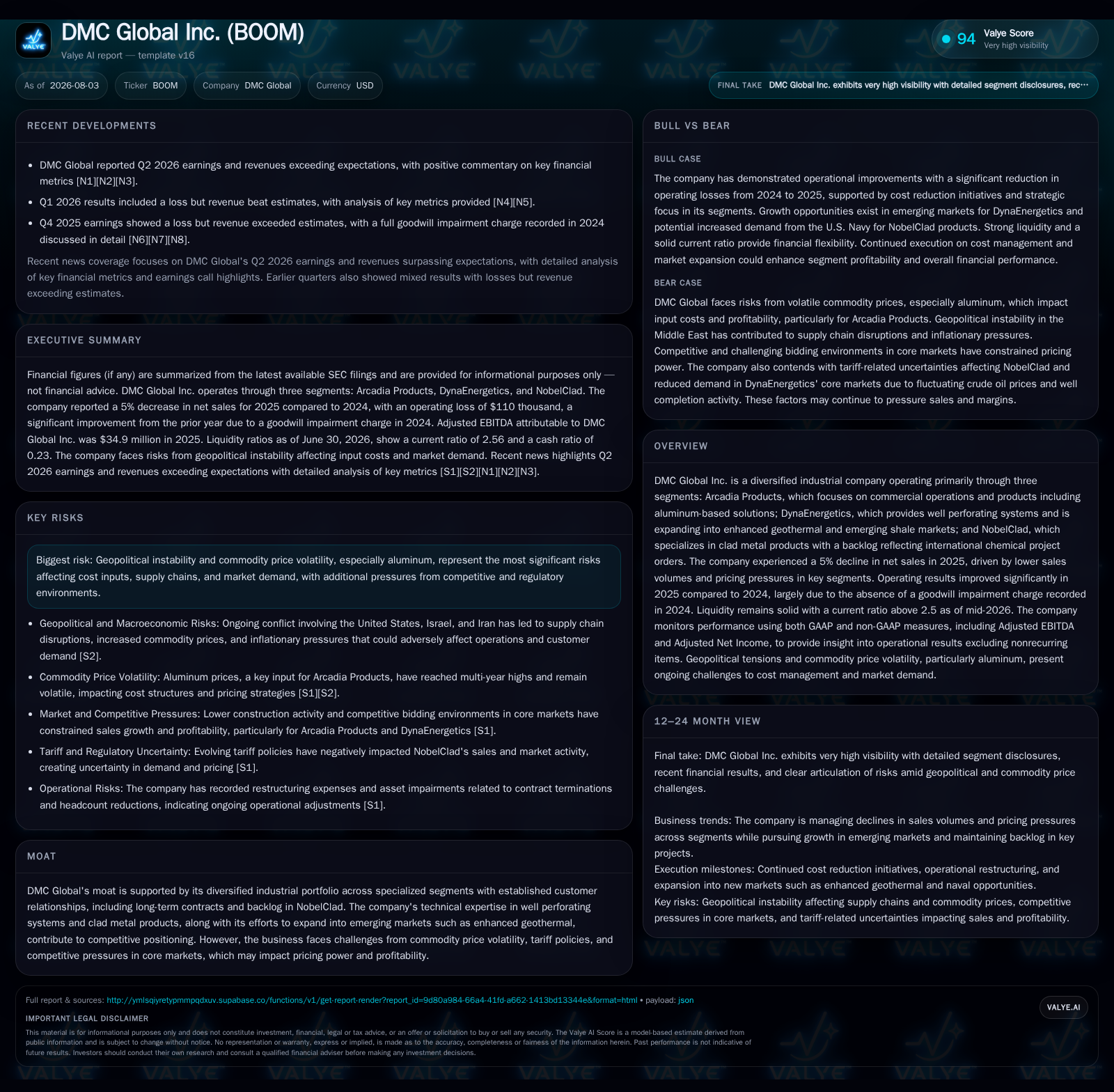
DMC Global Inc.’s latest quarterly filing reflects ongoing headwinds in sales volumes and pricing due mainly to aluminum input cost volatility and softer end markets, particularly within the Arcadia Products and DynaEnergetics segments. The company’s diversified portfolio spanning well perforating systems, clad metals, and aluminum products provides some insulation against cyclical pressures, while its backlog expansion in NobelClad supports near-term demand visibility. Despite lower net sales in 2025, operating performance improved from a nonrecurring goodwill impairment absence. Liquidity remains robust with a strong current ratio as of Q2 2026. Key risks include geopolitical instability impacting commodity prices and trade disruptions, while growth opportunities center on enhanced geothermal markets and international chemical projects.
Recent Operating Update: Persistent Commodity Headwinds Amid Steady Backlog
DMC Global’s Q2 2026 filing reveals persistent challenges stemming from elevated aluminum prices that reached multi-year peaks earlier this year due to geopolitical tensions linked to the U.S., Israel, and Iran conflicts [S2]. Aluminum is a critical raw material for the Arcadia Products segment, which operates primarily in regional commercial construction markets. Elevated input costs have constrained Arcadia’s ability to fully pass through price increases in a competitive bidding environment characterized by slowed construction activity [S1]. These market dynamics tangible impact is seen in continued pressure on net sales volumes and gross margins within Arcadia Products during the quarter.
Despite these headwinds, the company's diversified segment structure provides some cushion. The DynaEnergetics segment has experienced softer demand for well perforating systems amid volatile crude oil prices reducing North American onshore well completion activity. To counteract this cyclical weakness, DynaEnergetics has intensified cost reduction efforts and broadened its focus toward emerging sectors such as enhanced geothermal energy and selected international shale regions—markets with higher growth potential less correlated with traditional oil price cycles [S1].
Meanwhile, NobelClad’s order backlog rose at the end of Q4 2025 to $62.6 million from $57 million in Q3, signaling resilient customer demand primarily driven by an international chemical processing project ordering surge. This growth importantly offsets weakened U.S. market bookings caused by tariff-related uncertainties affecting domestic steel-aluminum product competitiveness [S1]. The backlog metric here offers valuable forward revenue visibility since most firm purchase orders translate into shipments within a twelve-month horizon.
Business Model: Specialized Industrial Manufacturing Serving Diverse Market Needs
DMC Global operates through three strategically distinct segments: Arcadia Products' aluminum-based commercial products; DynaEnergetics' well perforating systems mainly for oilfield services; and NobelClad's explosion-welded clad metal plates utilized in corrosion-resistant equipment for chemical processing and defense contracts [S1], [S11]. Each segment targets different end customers—construction companies for Arcadia, energy service operators for DynaEnergetics, and industrial/OEM clients for NobelClad—with business models combining product sales, engineering support services, and long-term supply contracts.
Revenue drivers differ by segment but generally hinge on capital expenditure cycles within end industries (e.g., construction starts, oil & gas drilling/completions, chemical plant builds), commodity price-driven raw material costs influencing product pricing/margins (notably aluminum and steel), backlog conversion rates reflecting future demand timing, plus operating efficiency impacting adjusted EBITDA margins [S1]. Pricing power fluctuates with competitive intensity; Arcadia faces bidding pressure limiting margin recuperation on rising inputs whereas DynaEnergetics must continually innovate perforating technologies to defend or grow market share amidst fluctuating energy prices.
Backlog in NobelClad underscores its project-based nature with longer sales cycles tied to specialized engineering requirements and regulatory or environmental approvals typical of chemical processing infrastructure—a relatively stable but capital-intensive niche with fewer direct competitors [S1], [S11].
Industry Structure and Competitive Position: Niche Segments Amidst Cyclical Volatility
The industrial equipment/manufacturing landscape enveloping DMC Global is typified by capital-intense production of specialized metal components supporting energy (oil & gas extraction), construction materials supply chains, chemical processing equipment manufacturing, and select defense applications. Peers can be identified among diversified industrial firms like Kennametal or Tenaris who likewise balance product innovation with raw material cost exposure.
Commodity price volatility remains a systemic challenge industry-wide given dependence on aluminum and steel inputs subject to global supply-demand swings intensified by tariffs or geopolitical events [S12]. Regulatory risk adds further complexity particularly where product certifications or environmental compliance create barriers or timelines affecting order flow.
DMC’s moat derives from three factors: established long-term technical relationships with customers exemplified by NobelClad’s international project backlog; proprietary expertise in well perforating system design enabling entry into emerging geothermal markets; and diversified end-market exposure reducing dependence on any single cyclically depressed sector.
However, competitors engaging aggressively on pricing or newer technologies could erode market share while tariff policy unpredictability challenges cost management especially for Arcadia Products targeting competitive construction segments [S12], [S1].
Growth Drivers: Emerging Energy Markets & International Project Demand
Several structural drivers underpin DMC Global’s growth prospects beyond cyclical recovery:
- The enhanced geothermal market expansion is a notable strategic pivot for DynaEnergetics seeking to leverage existing perforating system capabilities into renewable energy infrastructure needing similar technology applications—a slightly less commoditized growth avenue shielding revenues from fossil fuel price swings [S1].
- International chemical processing infrastructure investments buoy NobelClad’s order backlog with substantial project wins supporting a pipeline that partially mitigates domestic uncertainty due to tariffs or slower U.S. capital spending [S1].
- Potential acceleration of U.S. Naval readiness programs aligns well with NobelClad's clad metal transition joints supplying corrosion-resistant materials aimed at government defense contracts—offering opportunity for contract renewals or expansions that tend to be long duration with high incremental margins relative to commercial bookings [S1].
- Cost reduction initiatives across all segments intend to preserve margins amid volatile input costs while targeted tariff mitigation strategies may protect competitiveness in critical geographies during uncertain trade environments.
These growth vectors illustrate management’s intent to broaden market footholds into higher-growth or more stable sectors while controlling operational leverage risks.
Risks / Watchpoints / Growth Constraints: Geopolitical & Commodity Pressures Persist
Key risk exposures for DMC Global include:
- Ongoing geopolitical instability surrounding the Middle East conflict creates potential supply chain disruptions notably inflating aluminum prices beyond recently experienced peaks—escalated costs could further compress Arcadia segment profitability if timely pricing adjustments fail amid competitive eroded bidding power [S2].
- Tariff-related uncertainties influencing both input costs (steel/aluminum) and export competitiveness remain unresolved headwinds especially for domestically focused segments facing trade policy changes or retaliatory duties which dampen U.S.-based OEM order intake [S1], [S12].
- Competitive pressure leading to pricing concessions restricts margin recovery even as operational efficiencies improve; maintaining technology leadership especially in well perforating equipment is required to fend off lower-cost new entrants in DynaEnergetics’ core markets.
- Capital intensity inherent across manufacturing plants requires consistent investment; failure to deploy capex effectively could limit scale benefits or technology refresh needed for market relevance although cash flow generation appears sufficient presently.
- Legal/regulatory developments including stormwater management violations at Arcadia facilities pose contingent liabilities that can impact financial flexibility despite accruals made thus far.[S14]
- Customer concentration risks exist given large projects dominating NobelClad’s backlog which may result in lumpiness or revenue recognition timing uncertainty.
What to Watch Next: Backlog Trends & Margin Recovery Signals
Upcoming milestones likely informative for assessing trajectory include:
- Quarterly backlog updates especially at NobelClad indicating sustainable demand momentum on international chemical projects.
- Pricing recovery or stabilization signs within Arcadia Products against fluctuating aluminum input costs will signal potential margin normalization if competitive bid dynamics permit pass-throughs.
- Expansion success into enhanced geothermal markets reflected by new contracts or announced client wins indicate execution progress diversifying revenue base away from volatile North American oil & gas rig counts.
- Progress reports on tariff mitigation measures effectiveness reflecting whether cost pressures translate fully into margin erosion or are absorbed partially via internal efficiencies.
- Any changes related to the potential exercise of the Put or Call Options tied to redeemable noncontrolling interest affecting leverage profile given acquisition financing implications.[S10]
- Continued monitoring of geopolitical developments impacting commodity flows beyond current visibility horizons remains crucial given rising global inflationary pressures.
Financial Profile Discussion
As of June 30, 2026, DMC Global held approximately $28.5 million in cash equivalents against total debt near $59.1 million resulting in net debt of roughly $30.5 million—a moderate leverage stance considering operational scale within capital-intensive manufacturing sectors [F1]
Operating income has struggled under margin pressures with a reported loss of $110 thousand as of fy-end 2025; however this improves from larger impairments tallying in prior periods underscoring base earnings capacity normalized below peak cyclicality levels [F1], [S1]. Adjusted EBITDA metrics have declined compared with prior years principally due to input cost inflation but exclude significant goodwill impairment charges recognized previously providing a clearer view of operational profitability trends.[S24]
The credit facility accommodates revolving loans up to $200 million plus term loans secured by receivables and inventory offering financial flexibility though covenants enforce leverage caps around 3x EBITDA with temporary elevation allowances tied to minority interest acquisition options ensuring disciplined balance sheet management[S5]–[S7].
Capital expenditure outlays remain steady supporting maintenance of manufacturing capacity and incremental investment aligned with strategic expansion priorities though exact figures are not detailed recently [S21]
In summary, liquidity metrics provide sufficient runway for ongoing operations coupled with measured debt levels typical for specialty industrials navigating cyclicality while pursuing selective growth avenues requiring periodic reinvestment.
This analysis is based solely on publicly available information as of July 29, 2026 published filings without forward-looking statements or investment opinions.
Disclaimer: This is research-only, informational analysis and not investment advice. It may include AI-generated interpretation and general industry context. Always verify important details using primary sources.

Comments