
Design Therapeutics Advances GeneTAC Platform with Improved Clinical Data and Strong Cash Position
Latest Q2 2026 results reveal clinical progress for lead candidate DT-216P2 alongside robust liquidity supporting ongoing R&D efforts.
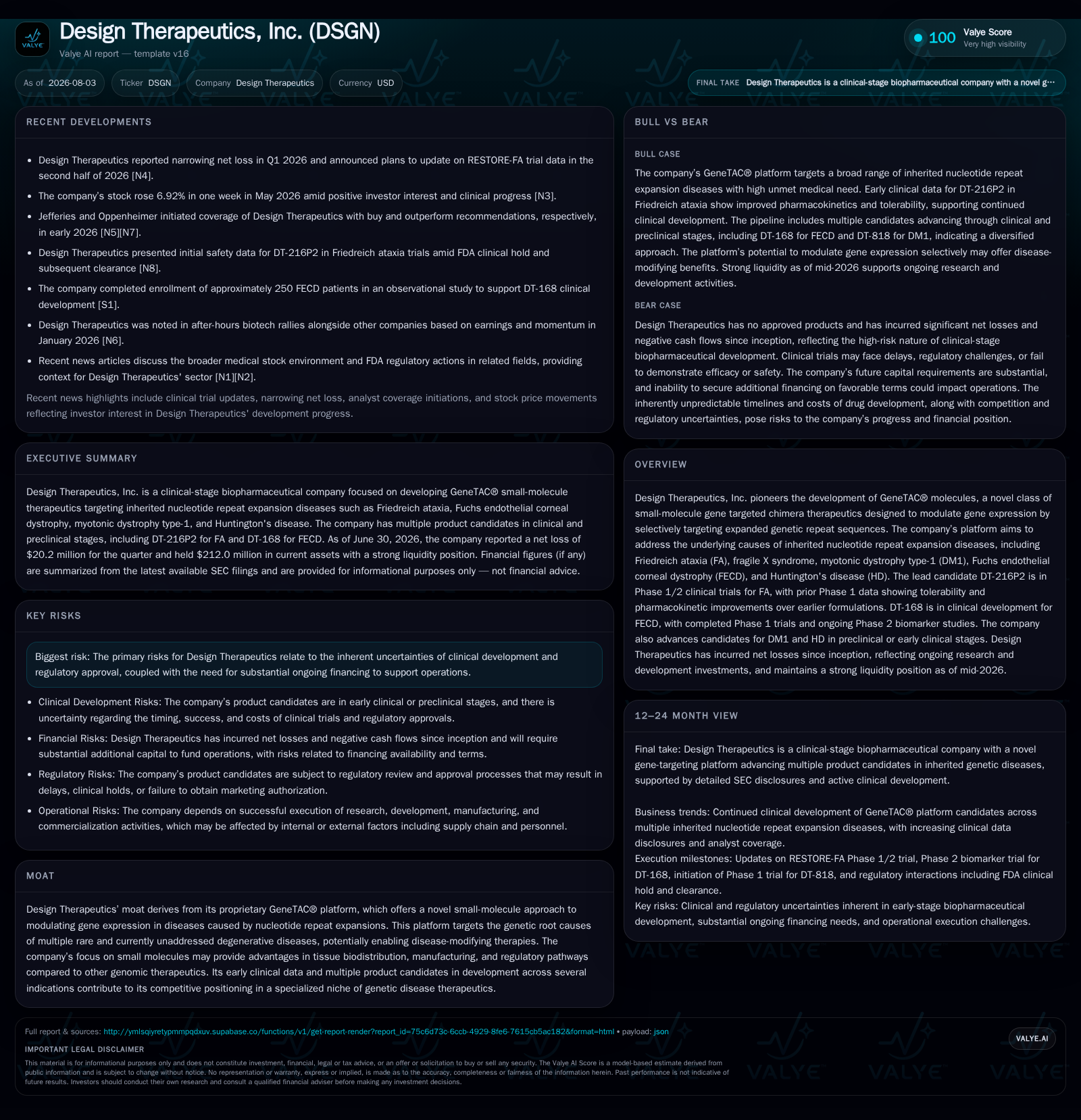
Design Therapeutics’ Q2 2026 10-Q highlights encouraging pharmacokinetic improvements in its lead Friedreich ataxia candidate DT-216P2 from the proprietary GeneTAC® platform. The FDA lifted a prior clinical hold in December 2025, enabling Phase 1/2 multiple ascending dose trials underway with readouts expected late 2026. The company pursues a pipeline addressing multiple nucleotide repeat expansion diseases, benefiting from small-molecule modality advantages. Despite inherent clinical development risks, Design’s strong cash position and current ratio provide runway visibility amid high R&D burn typical of this biotech sub-sector.
Q2 Clinical Progress Validates GeneTAC Pharmacokinetic Enhancements
Design Therapeutics’ latest quarterly filing dated August 3, 2026, underscores progress in its lead gene-targeted therapeutic candidate DT-216P2 aimed at Friedreich ataxia (FA) [S2]. This candidate builds on the initial DT-216 molecule but utilizes an improved formulation (DT-216P2) that demonstrated superior pharmacokinetics (PK) in a Phase 1 single ascending dose (SAD) trial involving healthy volunteers compared to the previous DT-216P1 version [S1]. Specifically, the PK profile of DT-216P2 exhibits higher area under the curve (AUC) values and more sustained plasma exposure, enhancing the potential to maintain therapeutic frataxin induction over time. This improvement is critical as prior multiple ascending dose (MAD) data suggested that prolonged exposure correlates with better durability of FXN gene expression recovery.
The Q2 update also marks a significant regulatory milestone: the FDA lifted an earlier clinical hold on the IND application for DT-216P2 in December 2025, permitting active dosing of FA patients in the RESTORE-FA Phase 1/2 MAD trial [S1]. This trial is designed to evaluate safety, tolerability, PK, and pharmacodynamics (PD), including endogenous frataxin modulation after up to twelve weeks of dosing. A key near-term event investors will monitor is this biomarker readout anticipated during H2 2026. Positive results would validate the platform's mechanistic premise and confirm the improved formulation’s ability to drive desired gene expression changes without compromising safety.
Platform Differentiators Drive Broad Pipeline Targeting Inherited Repeat Expansion Disorders
Design Therapeutics’ proprietary GeneTAC® platform constitutes a novel small-molecule approach tailored to selectively modulate gene expression by targeting expanded nucleotide repeat sequences underlying monogenic diseases such as FA, fragile X syndrome, DM1, FECD, and Huntington’s disease (HD) [S1]. Unlike larger biologics or oligonucleotide-based therapies—which face challenges related to delivery and manufacturing—GeneTAC® molecules benefit from small-molecule properties that can improve tissue penetration, biodistribution (notably to brain and heart tissues crucial for FA), scalability in manufacturing, and streamlined regulatory pathways.
The pipeline breadth spans multiple indications: besides DT-216P2 in FA, the company’s eye-drop candidate DT-168 targets Fuchs endothelial corneal dystrophy (currently undergoing Phase 2 biomarker-driven studies post Phase 1 completion) [S1]. Early-stage programs include candidates for DM1 and HD prepared for preclinical or initial clinical evaluation. This diversification mitigates risk concentration while leveraging platform technology across distinct genetic pathologies driven by nucleotide repeat expansions.
Competitive Context: Small Molecule Modulation Against Nucleotide Repeat Expansions
Within the specialized subset of biotech companies addressing genetic diseases via small molecule or oligonucleotide therapeutics targeting nucleotide repeat expansions, Design Therapeutics compares favorably due to its advancing clinical-stage assets and differentiated platform. While precise peer disclosures are limited here, general industry patterns suggest many competitors remain in early phases or rely on less tissue-accessible modalities. The improved PK properties observed with DT-216P2 potentially confer a competitive edge by enhancing exposure consistency crucial for efficacy.
Capital efficiency is evident given liquid resources relative to clinical progression. As of June 30, 2026, cash and equivalents stood at $12.9 million supported by current assets totaling roughly $212 million against $11.24 million current liabilities—notably translating into an unusually high current ratio near 18.86—reflecting strong short-term liquidity supporting ongoing trials without immediate solvency concerns [F1]. This contrasts positively with many similarly staged rare genetic disease biotechs operating tighter runway constraints.
Regulatory engagement has progressed with the FDA lifting a prior clinical hold late last year on DT-216P2 trials—a hurdle faced commonly by novel molecular therapeutics undergoing complex IND evaluations—and active patient dosing now underway confirms Design's ability to navigate regulatory complexities effectively.
Growth Catalysts: Upcoming Readouts, Regulatory Clears, and Pipeline Expansion
Key near-term catalysts identified from filings pivot around compelling biomarker data from the RESTORE-FA Phase 1/2 MAD study slated for late 2026; this will provide first patient-centric PD validation of sustained frataxin induction grounded on enhanced PK profiles established earlier [S2]. Successful demonstration may open avenues for accelerated development paths or partnerships.
Simultaneously ongoing Phase 2 biomarker evaluations for DT-168 targeting FECD represent another pipeline advancement spotlighting potential market differentiation via topical ocular administration of GeneTAC® molecules [S1]. Further candidate nominations or IND submissions remain plausible as the platform matures across indications.
Investor attention will also focus on regulatory timing—any further interactions clarifying study designs or approvals—and updates around enrollment pace or protocol amendments influencing development timelines.
Key Risks: Clinical Uncertainty, Regulatory Hurdles, and Funding Needs
As typical within early-stage biotech focused on novel modalities addressing rare genetic disorders, substantial risks persist. These include:
- Clinical development uncertainty intrinsic to first-in-class mechanism agents where safety/tolerability profiles can impact dose escalation or induce regimen modifications.
- Regulatory risks highlighted historically by FDA clinical holds—as experienced by Design previously—and possibility of future holds sourced to unexpected toxicity signals or manufacturing concerns.
- Financial dependency accentuated by sizable net losses aligned with intensive R&D spend—the company recorded operating losses exceeding $79 million ending December 31, 2025—and reliance on equity raises or milestone-driven partnerships yet to be secured fully [F1][S2][S1].
- Biomarker-driven endpoints adding complexity given limited precedents around validated surrogate markers correlating tightly with clinical benefit in nucleotide repeat expansion diseases.
Medically challenging patient populations with progressive neurodegenerative conditions further complicate recruitment/enrollment rates impacting trial execution duration.
Near-Term Milestones to Monitor for Confirmation or Revisions to Thesis
Investors should prioritize tracking:
- The RESTORE-FA Phase 1/2 MAD trial biomarker efficacy readout anticipated H2 2026 assessing durable upregulation of frataxin protein as direct evidence supporting disease-modification claims [S3][S2].
- Data emerging from ongoing Phase 2 studies in FECD evaluating ocular delivery effectiveness of DT-168.
- Any announcements regarding expanded pipeline candidates advancing into clinical stages or new IND clearances which could signal platform scalability.
- Corporate developments around licensing deals or capital raises ensuring operational runway continuity beyond existing liquidity thresholds.
Active communication from management regarding trial enrollment metrics or interim safety updates may further influence developmental sentiment.
Financial Profile Discussion: Strong Liquidity Supports Extended R&D Pathway
Financially, Design Therapeutics maintains $12.9 million cash and equivalents as of June 30, 2026 [F1], augmented by highly liquid investment securities reflected within current assets totaling approximately $212 million against relatively low current liabilities (~$11.24 million), yielding a robust current ratio near 18.86—a substantial buffer uncommon in early-stage biotechs balancing capital-intensive pipelines.
Operating expenses are dominated by research and development outlays consistent with rapid advancement through costly clinical evaluations; net income remains negative reflecting absence of revenue-generating products currently [S10][S12]. Capital strategy emphasizes sustaining long-term R&D investment funded through public markets backed by shelf registration statements enabling equity issuance when required
Preserving runway through prudent expenditure while achieving inflection points via pivotal data readouts will be critical factors determining future capital needs and dilution risk.
This analysis synthesizes detailed information from Design Therapeutics' latest SEC filings prioritizing recent quarterly disclosures alongside foundational annual context to assess operational progress within its innovative GeneTAC® platform targeting rare monogenic nucleotide repeat expansion diseases. The company's trajectory hinges on demonstrating durable clinical benefits while managing funding requirements inherent to pioneering biotech enterprises operating without commercial revenues at present.
Disclaimer: This article is an independent analytical commentary based on publicly available filings and does not constitute investment advice nor endorses any financial decision related to Design Therapeutics.
Disclaimer: This is research-only, informational analysis and not investment advice. It may include AI-generated interpretation and general industry context. Always verify important details using primary sources.

Comments