
McKesson's Q1 2027 Growth Supported by Specialty Services and Technology Integration
Latest quarterly results highlight McKesson's focus on specialty drug services, automation, and strategic segment separation.
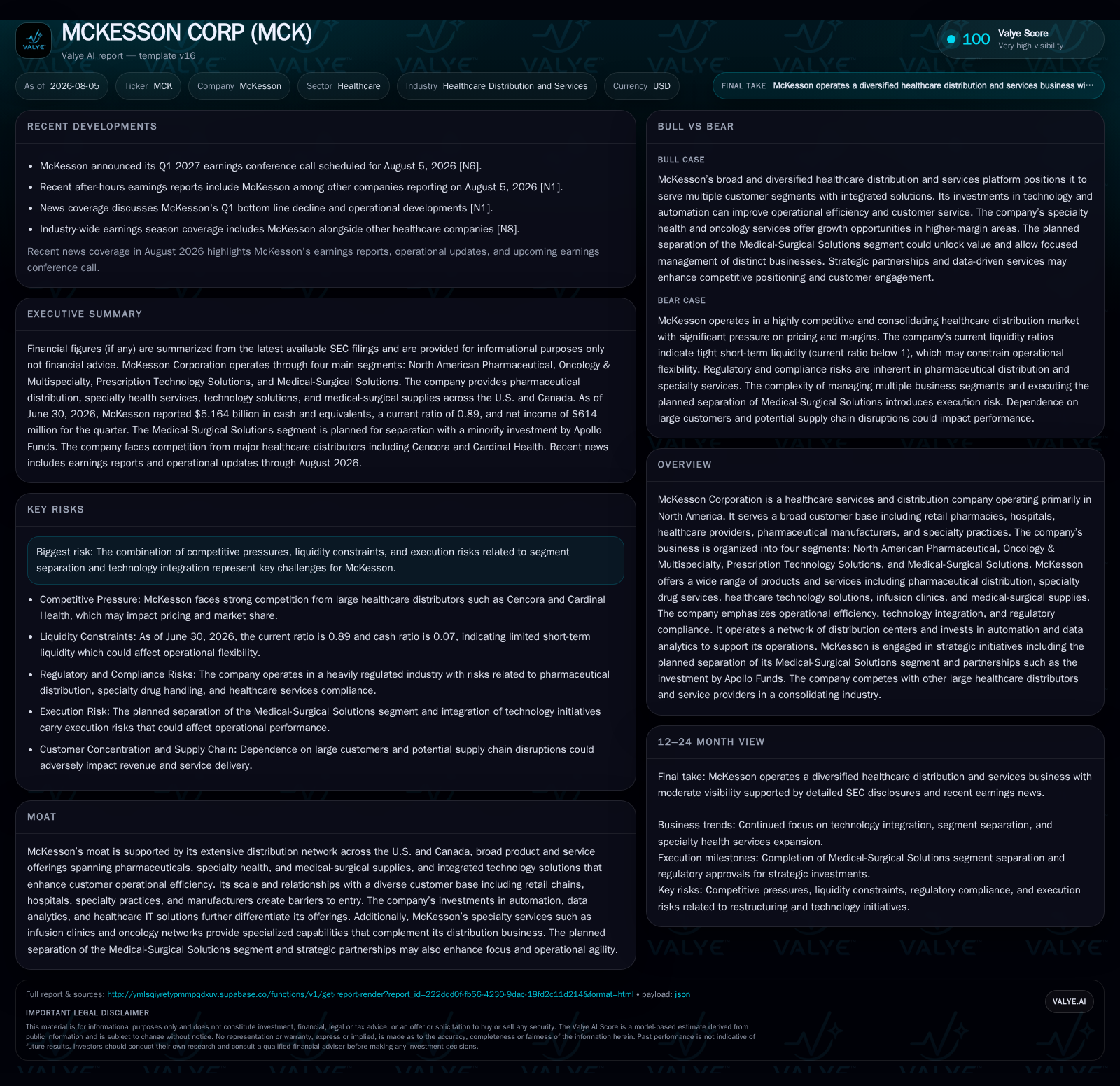
McKesson Corporation reported stronger-than-expected revenues in Q1 2027, driven by growth in specialty pharmacy services and Prescription Technology Solutions. The company continues executing its strategy to separate the Medical-Surgical Solutions segment and expand technology-enabled offerings that integrate across healthcare providers and manufacturers. While operational efficiency gains from AI and automation underpin performance, competitive pressures and liquidity constraints remain risks to monitor.
Recent Operating Update
McKesson Corporation’s Q1 fiscal year 2027 earnings release dated August 5, 2026 revealed revenues exceeding consensus expectations driven primarily by momentum in their specialty pharmacy services segment alongside Prescription Technology Solutions [S2][N2]. This marks a continuation of the company's trend toward higher-value pharmaceutical services beyond traditional wholesaling.
Alongside revenue growth, management highlighted ongoing strategic initiatives including the planned separation of the Medical-Surgical Solutions segment. This was evidenced by April’s definitive agreement with Apollo Global Management affiliates acquiring approximately a 13% minority stake via $1.25 billion convertible preferred equity investment focused on this segment [S1][S21]. The transaction aims to unlock segment-level value while enhancing operational focus.
However, the quarter also reflected continuing pressure on liquidity metrics. McKesson’s current ratio stands at approximately 0.89 as of June 30, 2026, indicating working capital below unity which may constrain near-term operational flexibility given high current liabilities relative to current assets [F1]. This underlines the importance of cash flow management amid incremental investments in technology and segment restructuring.
Business Model
McKesson operates as an essential intermediary in North American healthcare distribution services, stretching across four primary segments: North American Pharmaceutical Distribution, Oncology & Multispecialty Services, Prescription Technology Solutions, and Medical-Surgical Solutions [S1]. Its broad customer base encompasses retail pharmacies (including chains and independents), hospitals, long-term care facilities, specialty practices such as oncology clinics with infusion services, pharmaceutical manufacturers, payors, and patients.
Revenue arises principally from product sales—pharmaceuticals and medical-surgical supplies—but is increasingly supplemented by value-added services like specialty drug management programs, clinical support (notably for complex therapies in oncology), healthcare IT solutions including electronic prior authorization tools and real-time inventory platforms (e.g., McKesson Connect SM), plus patient adherence initiatives spanning payors to biopharma partners [S1][S21]
This diversification shields McKesson somewhat from commoditized price competition typical of full-line distributors. The Prescription Technology Solutions segment exemplifies this strategy by interfacing extensively across stakeholders—connecting over one million providers with PBMs and health plans—and supporting numerous biopharma brands through technology-enabled access solutions that streamline medication affordability and adherence pathways [S1].
Operationally, McKesson leverages a network of numerous distribution centers nationwide employing Six Sigma methodologies emphasizing data-driven process improvements targeted at reducing errors while optimizing safety compliance with entities such as DEA and FDA regulations for controlled substances handling [S1][S7]. Automation investments aim to further improve inventory turnover efficiency—critical given product expiry risk—and speed up order fulfillment while data analytics increasingly inform demand forecasting and supply chain resilience.
Industry Structure and Competitive Position
The healthcare distribution industry is oligopolistic in North America with three principal players occupying much of the market: McKesson Corporation itself alongside Cencora (formerly AmerisourceBergen) and Cardinal Health. This triad dominates pharmaceutical wholesale distribution attributed to their scale advantages oriented towards big-box retailers, hospital systems consolidating purchasing requirements under group purchasing organizations (GPOs), specialty pharmacies targeting complex therapies like oncology drugs, and technology-enabled service offerings enhancing medication delivery efficacy [S1][S20].
Within this competitive context McKesson’s moat derives from its integrated offering that spans traditional wholesaling plus distinct specialty service capabilities such as infusion clinic operations (e.g., INVIVA in Canada), oncology networks combining clinical research insights with provider services (including SCRI), plus an expansive digital platform suite facilitating interoperability across providers’ electronic health records (EHRs), payors’ reimbursement mechanisms, manufacturers’ commercial teams—even including market access advisory consulting through its Canadian PDCI unit [S1][S21].
This multi-pronged positioning fuels customer retention given switching costs associated not just with logistical disruption but also IT integration challenges—a factor less replicable by smaller or regional distributors lacking comparable scale or technological heft.
Growth Drivers
Key secular growth drivers supporting McKesson include rising demand for specialty pharmaceuticals fueled by innovation in biologics and gene therapies necessitating specialized distribution logistics plus clinical support; expansion of outpatient infusion clinics aligning with shifts away from inpatient care; digital transformation mandates among health systems encouraging adoption of prescription technology solutions that promote medication access efficiency; aging demographics driving increased medication utilization overall; regulatory emphasis on medication safety heightening demand for compliant supply chain partners; consolidation among healthcare providers increasing scale needs that favor large distributors; increased use of AI-driven analytics optimizing supply chain forecasting accuracy; alongside strategic partnerships like the Apollo investment enhancing segment agility [S1][N1][N2]
Early-stage AI applications have started improving labor productivity in warehouse operations by directing inventory placement patterns dynamically based on demand signals while enabling predictive maintenance schedules on automation equipment aimed at minimizing downtime—all crucial margin-levers given historically thin distributor operating margins dominated by cost-of-goods-sold components [N1][S20]
Risks and Watchpoints
While McKesson’s strategic orientation addresses many industry challenges there remain persistent risks warranting scrutiny:
- Regulatory compliance remains costly especially regarding controlled substance distribution subject to DEA security standards and state-level permits; potential shifts in governmental priorities may raise compliance burdens or enforcement rigor unpredictably impacting operating costs [S7][S24].
- Pricing pressures emanate from pharmacy benefit managers forcing margin compression while reimbursement rates fluctuate with changing healthcare policies.
- Execution risks inherent to segment separation pose hazards if value realization timelines slip or integration costs escalate.
- Liquidity constraints amplified by working capital management inefficiencies could limit capacity for opportunistic investments or buffer against unforeseen disruptions; the sub-1 current ratio exemplifies these tensions today [F1][S2].
- Supply chain disruptions—whether due to external shocks or internal operational issues—could impair product availability critical to customers’ patient care mandates.
- Data privacy/security risks grow as more clinical/operational data flows through McKesson’s IT platforms requiring robust cybersecurity governance.
- Concentration risk from dependence on major customers or key suppliers could amplify exposure if relationships sour or contract terms shift unfavorably.
- Market dynamics promoting direct manufacturer-to-provider models threaten traditional wholesaler roles requiring adaptation.
What to Watch Next
Investors should monitor several KPIs reflective of McKesson’s execution progress:
- Revenue growth velocity particularly within specialty pharmacy units and Prescription Technology Solutions indicative of successful downstream service expansion.
- Adoption rates of new automation technologies along with order fulfillment accuracy improvements that signal margin sustainability.
- Progress updates on Medical-Surgical Solutions spin-off including regulatory milestones relevant to transaction closure involving Apollo Funds stake.
- Operating margins across segments capturing benefits of efficiency programs versus pricing headwinds.
- Customer retention statistics within retail pharmacy networks plus contract renewals win/loss ratios vis-à-vis major biopharma partners.
- Regulatory developments impacting distribution compliance cost structures especially pertaining to controlled substances dispensing rules.
- Cash flow from operations trends paired with balance sheet metrics such as leverage ratios which provide insight into financial flexibility in pursuing growth capital expenditures.
Financial Profile Discussion
As of June 30, 2026, McKesson held cash & equivalents totaling approximately $5.16 billion against total debt around $8.43 billion yielding net debt near $3.27 billion—a moderate leverage posture for a distributor of its scale given persistent capital intensity in automation deployments [F1]. However, the current ratio stands at roughly 0.89 reflecting higher short-term liabilities relative to current assets which underscores working capital tightness commonly observed in distribution businesses dealing with complex payment cycles involving pharmacies reimbursed by multiple payors simultaneously [F1][S2].
Going forward capital expenditure levels will be important given continued emphasis on technology enhancements while monitoring leverage trends will be critical for preserving investment grade credit profiles supporting favorable borrowing terms amid variable interest rate environments post credit facility renewals reported earlier this year [S9][F1].
Disclaimer
This analysis is for informational purposes only reflecting historical filings and public disclosures without making any investment research views concerning McKesson Corporation securities.
Disclaimer: This is research-only, informational analysis and not investment advice. It may include AI-generated interpretation and general industry context. Always verify important details using primary sources.

Comments