
W&T Offshore’s Q2 Report Reinforces Operational Control and Capital Discipline Challenges
The latest quarterly filing underscores W&T Offshore’s operational strengths in managing a large, predominantly operated offshore Gulf portfolio, while highlighting leverage constraints amid capital-intensive upstream demands.
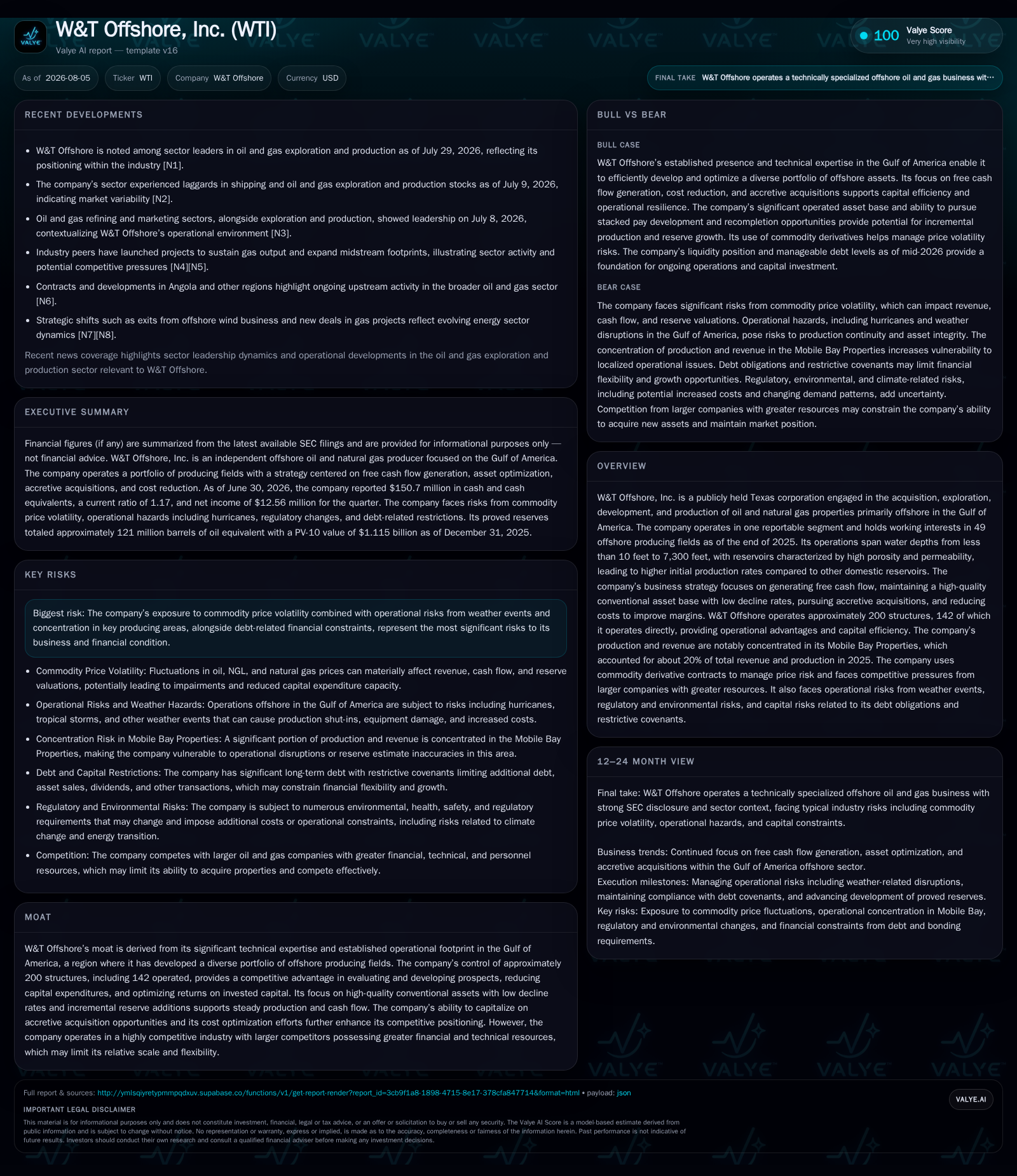
W&T Offshore’s Q2 2026 results demonstrate resilience through stable production from its Gulf of America offshore assets, supported by significant operational control over approximately 142 of 200 structures. The company maintains competitive lifting costs despite the complexities of deepwater shelf operations. However, net debt near $208 million relative to cash reserves of $151 million constrains financial flexibility under existing covenants. Growth depends on accretive acquisitions complementing organic reserve replacement, though integration and regulatory risks persist. Key near-term factors include sustaining production levels, commodity price fluctuations, and regulatory permitting developments.
Q2 Operational Update: Sustained Production and Cost Control in Offshore Portfolio
W&T Offshore’s second quarter filing reaffirms the company’s operational resilience anchored in its Gulf of America offshore asset base [S2]. The firm holds working interests across 49 fields and controls about 200 offshore structures, operating directly approximately 142. This dominant operated footprint provides crucial advantages in scheduling drilling activities, optimizing maintenance programs, and controlling lifting costs—a key margin driver given the capital intensity and technical complexity of deepwater shelf operations [S1].
Financial Position: Leverage Constraints Amid Capital-Intensive Operations
As of June 30, 2026, W&T Offshore reported cash and equivalents totaling approximately $151 million against total long-term debt close to $359 million as of year-end 2025 [F1]. This translates into a net debt position near $208 million with a current ratio around 1.17, indicating sufficient but limited liquidity headroom [F1].
The company’s debt agreements impose covenants restricting additional indebtedness or asset sales without lender consent. Any breach could trigger acceleration clauses or refinancing difficulties amid volatile credit markets affecting mid-tier energy producers [S4], [S6], [S7]. This dynamic places pressure on WTI to prioritize capital allocation toward projects that maximize returns while maintaining compliance with financial covenants. Given the sector’s capital intensity—especially offshore—operating cash flow remains the primary funding source for exploration, development, and reserve replacement activities.
Competitive Positioning: Scale and Technical Expertise Provide Operational Moat
WTI’s competitive strength lies in its substantial operating control over nearly three-quarters of its offshore structures within the Gulf Coast shallow water and deepwater shelf environments [S1]. This operational scale enables tighter oversight compared to peers with more non-operated interests or geographically dispersed assets. It also allows more efficient redeployment of existing platforms for incremental resource extraction rather than costly greenfield developments typical among larger integrated majors such as Chevron or ExxonMobil.
This specialization supports lower finding and development costs by mitigating risks associated with complex reservoir geology at depths reaching up to approximately 7,300 feet underwater. Such technical proficiency is critical for sustaining margins in an industry segment where operational efficiency can differentiate independent upstream players.
Growth Strategy: Acquisitions Complement Organic Reserve Replacement
Given the relatively short reserve lives typical of Gulf properties, WTI pursues accretive acquisitions alongside internal development to maintain steady-state production levels [S1], [S2]. Acquisitions focus on mature fields with established production profiles that may be undervalued by larger competitors concentrating on mega-projects or unconventional basins.
However, acquisition activity entails risks including integration challenges, potential exposure to plugging and abandonment liabilities exceeding provisions (currently recorded at $36.2 million), and uncertainties related to reserve estimation accuracy or commodity price fluctuations impacting project economics [S1], [S16]. Additionally, existing leverage limits flexibility in financing such growth initiatives without compromising liquidity.
Risks and Watchpoints: Commodity Volatility, Operational Hazards, Regulatory Burdens
WTI’s revenue streams are sensitive to fluctuations in oil and natural gas prices which impact proved reserve valuations and capital spending capacity [S1]. Geographic concentration—particularly reliance on Mobile Bay properties—increases vulnerability to Gulf-specific weather events like hurricanes that can temporarily halt production and elevate restart costs.
Regulatory compliance risks include tightening environmental standards potentially raising operating expenses and decommissioning liabilities beyond current estimates. Legal developments related to surety bond collateral demands from ongoing litigation could affect liquidity depending on resolution outcomes [S13], [S17]. Moreover, failure to keep pace with technological advancements poses obsolescence risks in highly competitive offshore settings requiring efficient extraction technologies [S8], [S9], [S28].
What to Watch: Production Trends, Commodity Price Environment, Permitting Progress
Key near-term indicators include quarterly updates confirming whether WTI sustains or grows daily production rates—a proxy for successful reserve management within cyclic commodity markets [S2]. Announcements regarding acquisitions or divestitures will signal strategic adjustments under financial constraints.
Regulatory permitting timelines for exploration or development projects overseen by agencies such as BOEM and BSEE warrant close monitoring due to their potential impact on capital expenditure scheduling and operational continuity [S9], [N2]. Finally, developments in surety litigation affecting collateral requirements could influence near-term liquidity planning.
Financial Profile Discussion
Latest financial data show W&T Offshore holding approximately $151 million in cash against nearly $359 million in long-term debt as of year-end 2025 with no disclosed refinancing activity since then [F1]. The current ratio near 1.17 reflects adequate coverage but limited buffer against shocks such as asset impairments or cash flow interruptions from commodity downturns or operational incidents [F1].
The company’s debt agreements impose covenants restricting additional indebtedness or asset sales without lender consent. Any breach could trigger acceleration clauses or refinancing difficulties amid volatile credit markets affecting mid-tier energy producers [S4], [S6], [S7]. It emphasizes business model specifics contextualized through industry-standard KPIs while acknowledging cyclical risks characteristic of upstream offshore exploration and production companies like W&T Offshore.
Disclaimer: This is research-only, informational analysis and not investment advice. It may include AI-generated interpretation and general industry context. Always verify important details using primary sources.

Comments